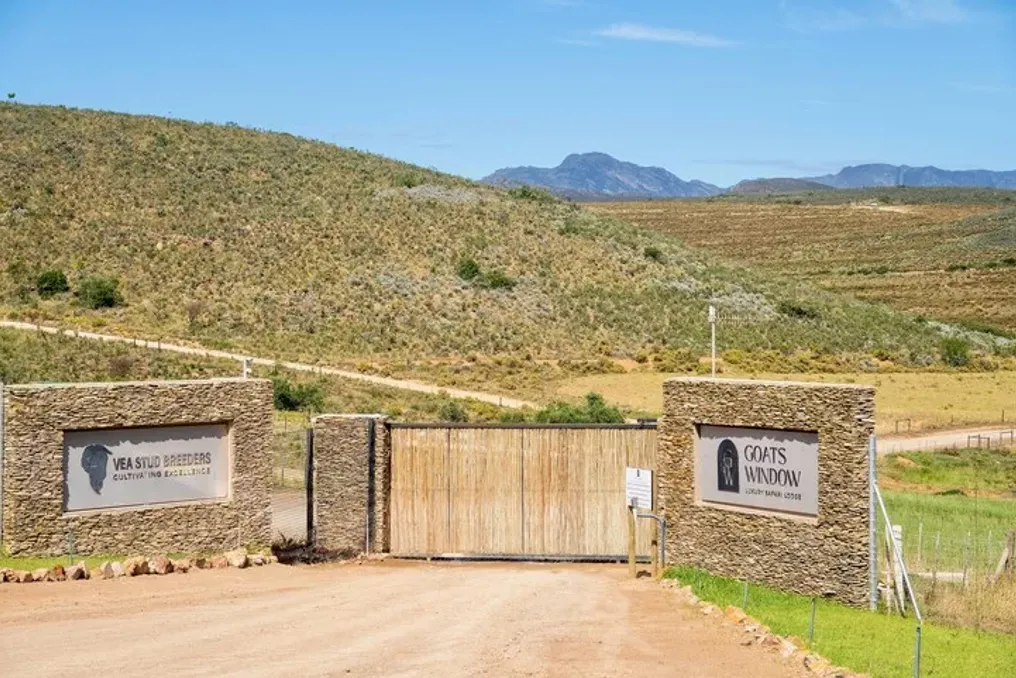
A subsidiary of a global business conglomerate in South Africa has been fined R10 million and ordered to pay a non-profit environmental group R5 million for illegal construction in the Cape Winelands without the necessary environmental permits.
As part of a guilty plea and penalty agreement with the National Prosecuting Authority, the fine is suspended for five years provided that R5 million is paid in five installments of R1 million to the non-profit group Stop Rhino Poaching, which funds anti-poaching patrols and reserve protection across the country.
The agreement was reached between the National Prosecuting Authority (NPA) and the developer VEA Group Holdings (Pty) Ltd, who was represented in court by one of its directors, Regard Shepherd.
The development site, advertised as the luxury safari lodge Goats Window, includes 23 completed modules located on the Brakkefontein farm, situated 11 kilometers south of Bonnievale, in the foothills of the Riversonderend mountains. These modules comprise three executive residences, two lodges, ten 'glamping' tents, four lap modules, access roads, parking, and associated infrastructure.
Furthermore, the developer paid an additional administrative fine of R1.75 million to initiate a formal application to the national Department of Forestry, Fisheries and the Environment (DFFE) to obtain retrospective approval for the illegal construction.
Construction of the lodge began in early June 2024 and immediately triggered several 'listed activities' under the National Environmental Management Act (NEMA) and the National Heritage Resources Act. Listed activities are those that may cause damage or degradation to the environment and must be properly assessed before the necessary environmental permit is issued for the project.
The guilty plea and penalty agreement was finalized at the Bonnievale Regional Court on October 16, where the developer pleaded guilty to two charges that were combined for sentencing purposes.
According to the deal documentation, the developer failed to halt work on the project immediately after receiving notification from the DFFE in accordance with NEMA, nor did it heed the 'stop work' order from the Langeberg Municipality.
In its guilty plea, the developer admitted that its employees started work on the site on June 6, 2024, and completed construction by April 3, 2025.
VEA Group was aware of the illegality of the construction as of December 2, 2024, when farm manager William Smith signed a Specialist Statement form for the retrospective application assessment. He reported that Enviroworks, an independent environmental assessment specialist, was appointed to manage the process.
In compliance with statutory public participation, Enviroworks prepared a document with background information in January 2025, explaining the application for 'legalisation of illegal activity already conducted at Brakkefontein.'
The guilty plea and penalty agreement document lists factors deemed relevant to determining the amount of fines imposed. Among the general aggravating factors noted is that the offences were not isolated or momentary but occurred over a prolonged period. It states: 'During this time, the accused continued to carry out the listed activity without the necessary environmental permit, demonstrating a persistent disregard for the environmental regulatory framework established by NEMA.'
Another factor was that the Riversonderend mountain catchment area is a zone of recognized ecological sensitivity and strategic importance for water security. 'Illegal construction within this catchment area created a real risk of irreversible environmental damage and undermined the purpose of environmental authorisation processes, which are specifically designed to prevent such consequences.'
The third factor, the illegal felling of local vegetation, 'was not insignificant or trivial in scale' and led to permanent disruption of natural habitat. 'Local vegetation plays a vital ecological role... Its removal constitutes a substantial and tangible degradation of the natural environment. Thus, the accused's conduct caused harm in an area where environmental protection is of the highest priority.'
Additionally, the illegal activity was conducted for commercial purposes, and VEA Group did not immediately cease operating the tourist facilities after receiving the NEMA directive from the DFFE. 'The accused could have gained financial benefit from the illegal construction, shifting environmental costs onto the public and future generations. This commercial motive distinguishes this case from unintentional or survival-related environmental violations.'
Mitigating circumstances in determining the fine included the accused having no prior convictions, pleading guilty, and showing remorse. 'His guilty plea led to the conclusion of investigations and prosecution, which had been ongoing since January 2025. This saved the court and the state from the costs and inconvenience of a protracted legal process.'
'The accused took responsibility for his actions and is now making every effort to bring the construction into compliance with the NEMA regulatory system.'
'The development of tourist facilities on the farm created employment opportunities, thereby improving the lives of local communities in the area. It also contributes to skills development through staff training in hospitality and customer service.'
The fact that VEA Group's portfolio in South Africa annually paid approximately R200 million in taxes was another mitigating factor. 'Currently available expert reports have not revealed irreversible environmental degradation... The accused cooperated with investigators and the prosecution and pleaded guilty from the outset.'
Four appellants—two local landowners, an independent environmental consultant representing an anonymous objector, and the Langeberg Municipality—appealed the R1.75 million administrative fine. One of their arguments was that it was too lenient given the circumstances.
In its application for leniency, VEA Group stated that the expected capital value of the lodge upon completion would be R50 million, and the facility would generate an expected annual income or economic contribution of R12 million.
The appeals were dismissed by the DFFE. DFFE representative Evile Ntshangase informed GroundUp that this was the first time the department had been involved in a case where the indictment and NEMA sentence included a court order to pay Stop Rhino Poaching.
'We are aware of other instances where similar payments were mandated. However, those cases related to biodiversity legislation violations, whereas the VEA Group case pertains to violations of Environmental Impact Assessment Regulations issued under NEMA.'
The department welcomed the conviction and sentence, stating: 'This outcome reinforces the legal obligation for developers to obtain the necessary environmental authorization before commencing any construction requiring such authorization, and underscores the consequences of non-compliance with environmental legislation.'
On its website, VEA Group calls the luxury safari lodge Goats Window its 'flagship property' and describes it as 'a secret haven in the Bonnievale hills, blending sophisticated architecture, breathtaking wildlife encounters, and regenerative living... Luxury. Heritage. Divine harmony. At Goats Window you are not just staying, you are stepping into a living story. Where champion goats graze on golden hills, wildlife roams freely, and eco-luxury lodges offer front-row seats to nature's masterpiece. Here, the untamed soul of South Africa meets soft linens, quiet fire, and captivating serenity.'
A notice is currently posted on the website: 'The luxury safari lodge Goat’s Window is temporarily closed until further notice... Thank you for your understanding.'
VEA responded: 'VEA Group acknowledges its failure to comply with environmental standards and takes responsibility for this matter. We have taken steps to resolve the situation, including the appropriate application process and independent environmental assessments.'
'As a diversified South African business group, we remain committed to investing in our country, building sustainable businesses, creating jobs, and developing people. Through our operations, we contribute to local economies and support suppliers, contractors, and communities.'
'Goats Window is part of this commitment, as it created jobs, fostered skills development, and provided opportunities for the Bonnievale community. We hope to resume operations of the lodge once the necessary regulatory approvals are obtained. We recognize that economic development and environmental responsibility must go hand in hand. We have learned lessons from this experience and continue to strive to strengthen our compliance processes while continuing to contribute positively to the economy and people of South Africa.'