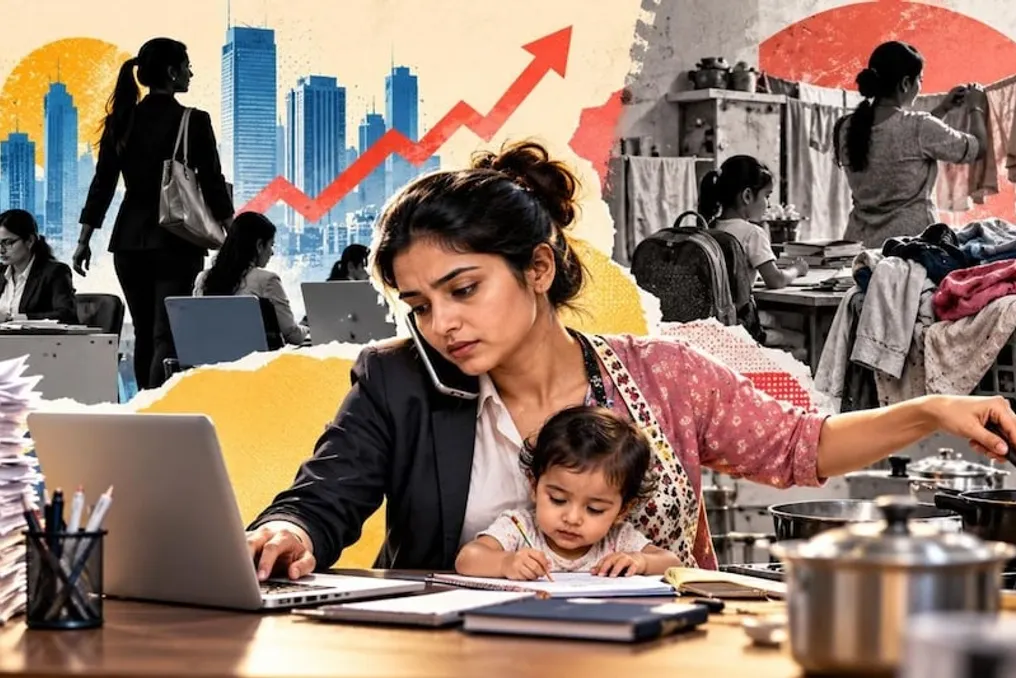
In India, there is an increase in the number of women entering the labor market, yet the volume of unpaid domestic work remains virtually unchanged. According to the ICRIER report titled 'Participation Paradox,' the share of women in the workforce has significantly grown over the past eight years, but the distribution of household chores has not changed.
The number of working women in India has increased from 104 million in 2017–2018 to 201 million by 2025. Consequently, their share in the labor force has risen from 22% to 38%.
This growth is particularly noticeable in rural areas. In rural areas, the share of women in the labor force increased from 23.7% in 2017–2018 to 44.9% in 2025. In urban areas, this figure rose from 18.2% to 25.9%. Nevertheless, despite more active participation in paid work, an equal division of household chores has not occurred.
The largest increase in female labor force participation was recorded in rural areas: from 23.7% in 2017–2018 to 44.9% in 2025. In cities, this figure rose from 18.2% to 25.9%.
Despite the increase in women's participation in paid work, men's contribution to housework remains low. According to statistics, women spend an average of 464 minutes daily on household chores, while men spend 178 minutes. This means that women perform 4 hours and 46 minutes more domestic work daily than men.
The burden of domestic care also affects women's free time. The gap between men and women regarding time allocated for rest and entertainment has widened: in 2019, this gap was 57 minutes, and by 2024, it reached 70 minutes.
Responsibility for the home and children continues to create difficulties for women when seeking employment. About 60% of surveyed women reported that they cannot work outside the home due to household duties and childcare, whereas only 1% of men cited domestic responsibilities as a reason for being unable to work.
Alongside labor force participation, a gender pay gap persists. In rural areas, women's wages are about 45% of men's, and in urban areas, this figure reaches 61%. Thus, even with an increase in the number of working women, their income does not match that of men.
These data indicate that despite entering the labor market, the division of household chores between women and men is not equal. Many women are forced to perform tasks such as cooking, cleaning, and childcare in parallel with office work, which negatively affects their personal time and rest.