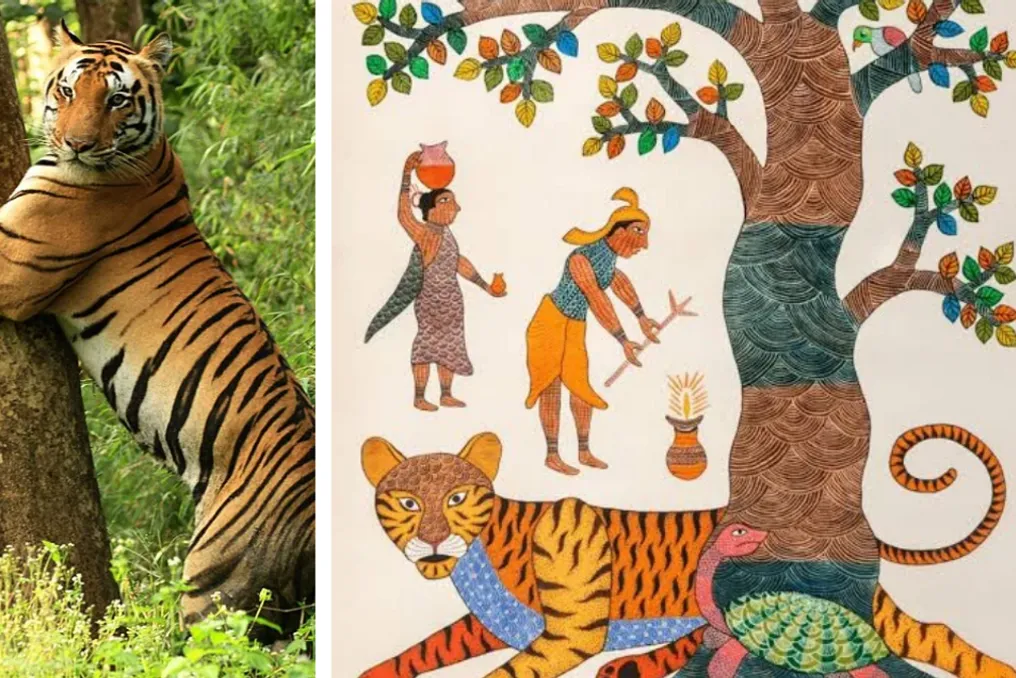
For many generations, in the homes of the Gond community in the Kanha landscape, Madhya Pradesh, there is a story of two tigers named Ram and Lakshman. According to oral tradition, recalled by Dayal Singh Kusre, a member of the Gond community who worked as a cook in various parts of Kanha, these tigers once lived with people. People fed them, treated them with respect, and considered them protectors.
This story is preserved in the collective memory of the community, as well as in the practice of offering tributes to the tigers. This is not a scientific description of tiger behavior. In Kusre's opinion, this story is inextricably linked to a broader understanding of nature. He notes that 'forests and wildlife are not something to be protected from afar. Both are part of a common landscape where people must learn to live alongside other species.'
When Tigers Were Part of the Household
Kusre recalls the folklore of the Gond tribe, according to which Ram and Lakshman held a place in the household's collective memory. According to Gond traditions, family members were forbidden from meeting tigers when they first entered the house. Young brides, in particular, were told not to open a certain locked room or door.
This prohibition was linked to the belief that tigers do not recognize new family members, similar to how traditional homes sometimes established rules for interaction between young women and older men. In one story, the daughter-in-law eventually opened the door, unaware of the instruction. She saw the tiger's face, and the animal left the house. Kusre relays the tiger's message to the eldest man of the family: he will now live in the forest and find food there.
The room and its closed door symbolize the boundary that household members had to respect. The tiger was part of the story, but so important was the responsibility of people to acknowledge that relationships with wildlife have limits. This tradition also carries the idea of reciprocity. Kusre says: 'The family believed that if people had food, they should also take care of the wildlife around them.'
He also describes the annual practice of sacrificing a goat or chicken to the tiger in the forest with the belief that the animal will continue to protect the family. For Kusre, the reverence for Ram and Lakshman is part of a broader connection to nature. He states: 'For us, nature is everything; we bow at its feet. Even if we have to cross 10 kilometers of forests, we pray to nature, and the Adivasis feel confident. They trust nature for protection.'
He also recalls old Gond beliefs regarding encounters with tigers. 'Our ancestors usually encountered tigers, but actually seeing a tiger is difficult,' he says. Tigers are secretive, and their presence in the landscape does not mean that people see them regularly. These details relate to Kusre's account of the Gond oral tradition, but they do not imply that people should approach, feed, or try to keep wild tigers today.
The relevance of these stories lies in the fact that they reveal the values through which tribal communities understand the natural world.
What Communities Living Near Wildlife Learn
Conservation biologist Shivangi Bendre, whose work focuses mainly on the Central Indian landscape and mitigating human-wildlife conflict, argues that it is important to understand the daily practices through which communities adapt to the presence of wild animals. She tells The Better India: 'I think it is important to look not only at the lifestyle of communities but also at their livelihoods and the various, sometimes ingenious, ways they have learned to live alongside wild animals. These practices arise from generations of experience sharing landscapes with wild animals.'
Bendre cites communities living near sloth bears in Hampi. Based on a report by the Wildlife Conservation Society India titled 'A relational perspective of Sloth Bear - Human Relations in Hampi region of Karnataka' by Mohammed Hisham K, she notes that 'when sloth bears enter the area, people may light fires, clap, or make sounds to warn the animals of their presence.'
'The idea is to communicate in such a way that the animals can recognize that people are here. Instead of reacting after an encounter, community members use these practices to signal their presence and reduce the likelihood of an unexpected meeting,' she explains. However, these practices or stories should not be automatically considered universally effective or safe. Their usefulness depends on the species, local conditions, and circumstances of the encounter. Nevertheless, Bendre believes that the knowledge gained by people living near wildlife deserves attention in conservation planning. Their experience can help researchers understand how encounters happen, what people fear, and what local responses can help reduce risks.'
When a Fearful Animal Becomes Part of Culture
Bendre also points to Pilivesha, a traditional tiger dance practiced in Karnataka, as an example of how cultural expression can shape people's attitudes towards wildlife. In Pilivesha, performers portray tigers through dance and elaborate body painting. The animal becomes part of public cultural expression, presented through movement, performance, and artistic skill.
'It is interesting how such cultural practices can shape people's attitude towards an animal that might otherwise cause fear,' says Bendre. In the context she described, this tradition helped make the tiger more familiar as a cultural symbol, leading to some reduction in the fear associated with its presence.
Research by Rohan Sharma from WCS India titled 'Celebrating Nature-Culture Relationships: Documenting Cultures and Traditions of Tiger Folklore in Coastal Karnataka through the Annual Pilivesha Celebrations' also provides context to these relationships. The study examines that this tradition does not necessarily reduce conflict with wild tigers or that cultural familiarity can replace practical safety measures. It shows how the animal's place in the community's life can extend beyond the risks associated with encounters.
Dikesh Chaudhary, a project officer at The Corbett Foundation, emphasizes the importance of preserving such traditions as part of community history. He states: 'The idea is to preserve the tradition. It is a challenge, a cultural part. It is part of the history of the Gond and Baiga communities, and therefore it is important.'
For Chaudhary, these traditions also answer a question that may arise in conservation discussions: why should we save tigers? 'There are people who may still have questions: 'Baagh kyon bachana hai?' (Why should we save the tiger?). Here is the answer to that question. We must know why we need to save the tiger.'
Cultural traditions themselves cannot explain all ecological reasons for species conservation. Tigers play a role in forest ecosystems, and their protection is linked to broader habitat and biodiversity conservation. However, the values that communities attach to the animal can also influence whether its continued presence is viewed as valuable.
Are All Traditional Beliefs Beneficial for Nature Conservation?
Respecting cultural memory does not mean accepting every traditional belief without question. Some beliefs may prevent animal killing or encourage people to view wildlife as worthy of protection. Others may have little direct bearing on conservation. And some may create risks for people, especially when the belief affects decisions during emergency medical care.
Bendre discusses this distinction using an example she encountered during research in Kanha, where the belief about a snakebite can affect people's reaction after a bite. 'There is a belief that there is a specific jhari-buti (medicinal plant) that, if consumed by a person bitten by a snake, no matter where it is, the snake will die and split into two halves,' she says.
According to Bendre, people who believe in this remedy may consult traditional healers instead of taking the injured person to a hospital. The problem, she explains, is not that the belief exists, but that following it can delay treatment and endanger the person's life. She adds: 'They are not actually attacking the snake directly, but at the same time, this superstition can put a person's life in danger.'
A belief that does not directly encourage killing a snake may have a different conservation significance than one that delays potentially life-saving medical care. Thus, the question is not whether to accept or reject traditional beliefs entirely. The question is how to acknowledge their significance while eliminating practices that pose risks.
Awareness is Only Part of the Answer
Bendre asserts: 'Education, awareness, and primary healthcare are also things that need to be addressed in parallel with any conservation awareness we conduct.'
Communities need reliable information on animal behavior, practical guidance on reducing contact, and access to proper support in case of incidents. Where wildlife risks affect livelihoods or safety, conservation efforts must also consider these daily realities. The story of Ram and Lakshman cannot tell us how tigers behave, whether they recognize people as family, or if feeding an animal makes it a protector. These questions require evidence, and the story should not be taken as a guide for interacting with wild tigers. In Kusre's narrative, the tigers leaving the house does not end the relationship. The story continues through memory, reverence, and the belief that the forest remains their place. Its central idea is not that wild animals should live with people, but that people must recognize their place in the landscape they share with other species. Coexistence does not mean eliminating all boundaries between humans and wildlife. It means finding ways to live alongside animals, respecting their ecological needs and protecting human lives.