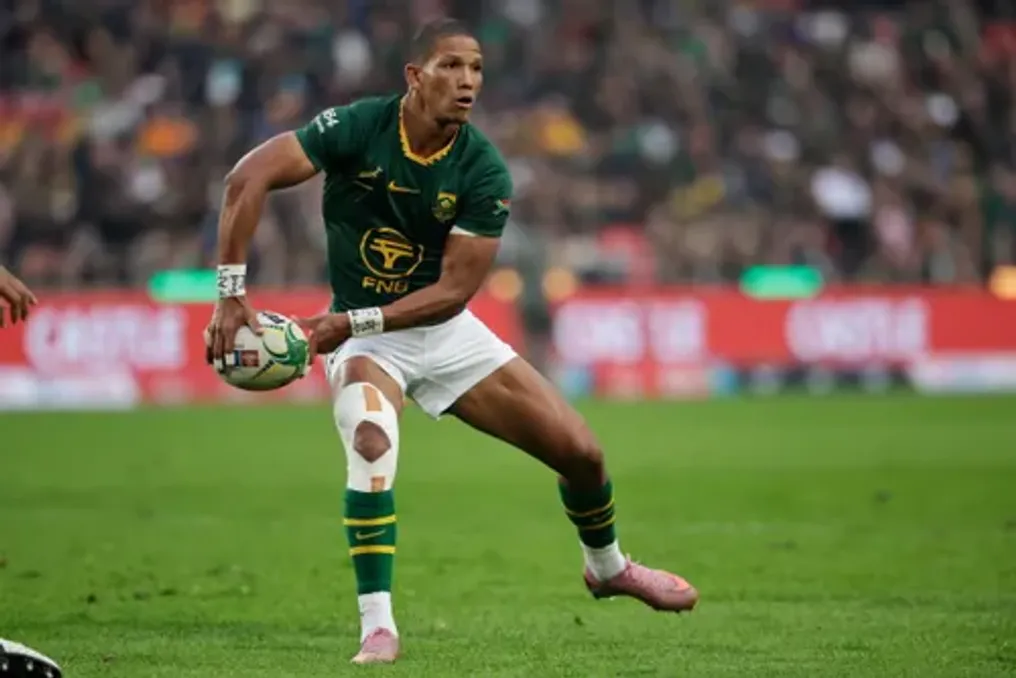
The Springboks squad is missing two of its most reliable penalty kick takers, Handré Pollard and Cheslin Kolbe, ahead of the upcoming Rugby World Cup matches in Europe. Consequently, the responsibility for goal-kicking will fall entirely on Mani Libbok and Sacha Feinberg-Mngomezulu.
Both players possess outstanding playmaking abilities that they have demonstrated vividly in the Springboks' attack in recent years. Sacha Feinberg-Mngomezulu, in particular, has made number 10 his signature role through impressive performances.
Former World Cup-winning midfielder Butch James recently commented on the hierarchy at the flyhalf position, naming Feinberg-Mngomezulu as his primary choice for the Springboks' playing style, while acknowledging the immense pressure associated with number 10.
However, like many other experts, he often views Pollard merely as a temporary solution, especially when it comes to penalty execution. James stated in a recent interview with IOL: 'My first choice would be Sacha Feinberg-Mngomezulu. Sacha would be my first choice at number 10.' He added: 'If Sacha were injured, I would start with Handré from the bench, relying on all his experience.'
Much of the pressure associated with the Springboks' number 10 is not about managing the team on the field or creating moments of genius to free up the backline, but rather about the precise execution of kicks at goal.
During the recent series of matches against the All Blacks, Feinberg-Mngomezulu was not the primary penalty kicker; Cheslin Kolbe performed excellently in the first two test matches before sustaining a jaw fracture in the third match in Soweto. Pollard did not participate in the game against the All Blacks due to injury, but he was planned to play in the second test match in Cape Town.
Acknowledging his merits, Feinberg-Mngomezulu kicked well in the third and fourth test matches, but Pollard represents the gold standard for Springboks penalty kicking, maintaining an accuracy of around 85% under the immense pressure of test matches. Pollard missed only one kick in the 2019 Rugby World Cup semi-final and final, and in the 2023 World Cup in France, he did not miss any kicks at goal in the quarter-finals, semi-finals, and final.
In these high-stakes matches, where the margin for error is minimal, as confirmed by the Boks' three knockout victories in France by one point, there is a need for a player who can be trusted in critical moments. The question ahead of the World Cup matches is whether Feinberg-Mngomezulu and Libbok can act as decisive goal-kickers without Pollard and Kolbe's 'safety net.'
Feinberg-Mngomezulu and Libbok have shown some inconsistency in place kicks, which explains why Kolbe took on the task of taking kicks in several matches over the past few years when Feinberg-Mngomezulu and Libbok played at number 10. Against the All Blacks, the Springboks more often sought to convert penalties because they enjoy putting pressure on the scoreboard by converting penalties earned through their excellent work in set pieces.
Will the Springboks follow the same tactics over the next month with Feinberg-Mngomezulu and Libbok at flyhalf, or will they kick more for attacking lineouts, risking the maul to create scoreboard pressure? Alternatively, South Africa could rely on its forward dominance, choosing rucks inside the 22-meter zone to secure free kicks for penalty advantage, aiming to score or earn a try close to the line.
Erasmus will hope that Feinberg-Mngomezulu and Libbok improve their accuracy in penalty kicking to prove that there is something more to their game than just exciting roles as playmakers and ball carriers. One thing is clear: this will be the ultimate test of their character, especially in major test matches against France and Ireland.