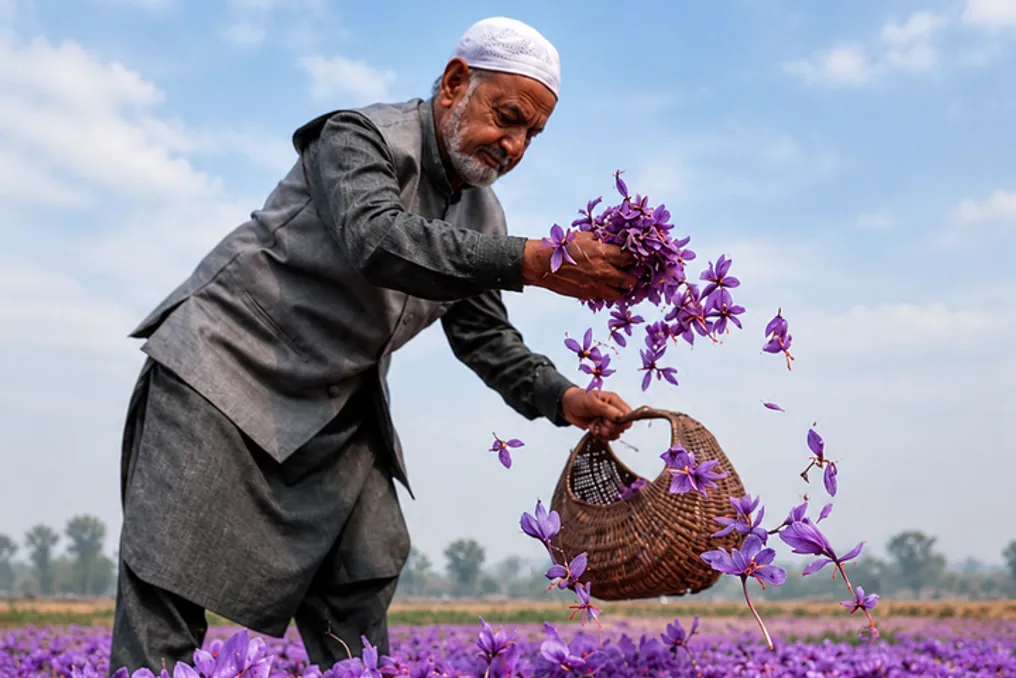
In Kashmir, 150 thousand flowers are required to obtain one kilogram of saffron
Read more
The Better India
thebetterindia.com

In Kashmir, 150 thousand flowers are required to obtain one kilogram of saffron

Every autumn season, the fields around Pampore, a town in the Pulwama district of Kashmir located approximately 16 kilometers from Srinagar, turn purple almost overnight. The crocuses bloom at the end of October and disappear by mid-November each year.

This short period is significant because Pampore produces about 80 percent of Kashmir's saffron, which is obtained from the stigmas of Crocus sativus flowers. The plant blooms only once a year, and this occurs only when autumn becomes cool.

The blooming time is determined long in advance. Farmers plow the fields in March and April, treat the soil during the summer to retain moisture, and then plant the bulbs at the end of July into soil that remains moist but never waterlogged.

After planting, the bulbs await changes in weather. Cool days closer to the end of October trigger flowering, and timely rains in September and October support it, causing the flowers to bloom within the same few weeks every year.

As soon as the flowers open, families must act very quickly. They go out at dawn, hand-picking every flower into woven baskets, and walk through each field three times to collect the flowers in full bloom.

All these efforts yield a small harvest because only a part of each flower is used. Each flower has three crimson stigmas, and approximately 150,000 flowers are needed to obtain one kilogram of dried saffron, which explains its high price.

The harvest ends quickly, but the work continues indoors. In November and early December, families gather in living rooms to separate the stigmas from the petals, sharing old stories and songs with visiting relatives.

Saffron is closely linked to local culture. On the first day of the harvest, farmers bring some saffron to the shrine of Hazrat Sheikh Sharif-ud-Din in Namblabal, Pampore, and an annual state festival welcomes visitors to the fields.

After separating the stigmas, they are dried, which preserves quality and extends shelf life for several years. Thus, fresh Kashmiri saffron only reaches the markets from late November, after sorting and grading each year.

The short saffron bloom depends on cool days, soil moisture, and autumn rains; recent dry periods have reduced harvests. For the families of Pampore, these few weeks of the year provide both a livelihood and a shared heritage.

Similar stories

Bengaluru resident grew over 120 plants in a two-room apartment and shared tips for beginner gardeners
Read more
thebetterindia.com

Bengaluru resident grew over 120 plants in a two-room apartment and shared tips for beginner gardeners

Komal Singh decorated her two-room apartment in Bengaluru with various types of plants. Her gardening began as a simple decision to return to a hobby she had put off while working in the corporate world.

After moving to Bengaluru, she wanted to take up gardening and started growing vegetables from seeds on the balcony, utilizing limited space. Komal notes: 'I took this as a challenge and started growing vegetables from seeds in my small balcony garden.'

As she learned more about growing plants, her small balcony gradually turned into a garden. Among the crops she grows are tomatoes, bell peppers, ginger, and beets. Komal's balcony demonstrates that a backyard or large terrace is not always necessary for home food cultivation.

Furthermore, Komal shares her knowledge through her platform 'Urban Home Vibes'. There, she offers practical ideas for those who want to start gardening at home, including information on plant cultivation, composting, and homemade fertilizers.

Substrate is important for creating a home garden. The gardener recommends using a mixture consisting of 50 percent soil, 30 percent compost, and 20 percent coconut fiber. The correct choice of mixture provides plants with a suitable base for growth in pots.

Even a small balcony can be suitable for growing several plants. It is necessary to choose pots that fit the available space and start with vegetables or other plants suitable for the growing conditions. More can be added as one learns.

Komal's garden includes not only vegetables; flowers and leafy plants add variety to her collection, showing that a balcony can accommodate various types of greenery without needing a separate garden.

Each plant has its unique needs, and gardening requires some patience. It is recommended to start with a small number of pots, carefully monitor the plants' reaction, and make changes as necessary. One should not try to do everything at once.

Komal's story serves as a reminder that one can start gardening without waiting for more spacious housing or more space. A few pots, seeds, and a willingness to learn are enough.

Seedling center established in Kashkadarya for neighborhood greening with plans to increase production
Read more
podrobno.uz

Seedling center established in Kashkadarya for neighborhood greening with plans to increase production

A center designed for propagating seedlings to improve local mahallas was opened in the Guzar district of Kashkadarya region. Initially, the production is planned for 1.6 million trees and plants, but in the future, the output volume is set to increase to five million seedlings annually.

President Shavkat Mirziyoyev inspected the work of this center as part of the nationwide 'Yashil Maqon' initiative during his visit to the region. The complex covers an area of 65 hectares, and the total project cost is estimated at 9.5 billion soms. The creation of the center has resulted in about 100 new jobs.

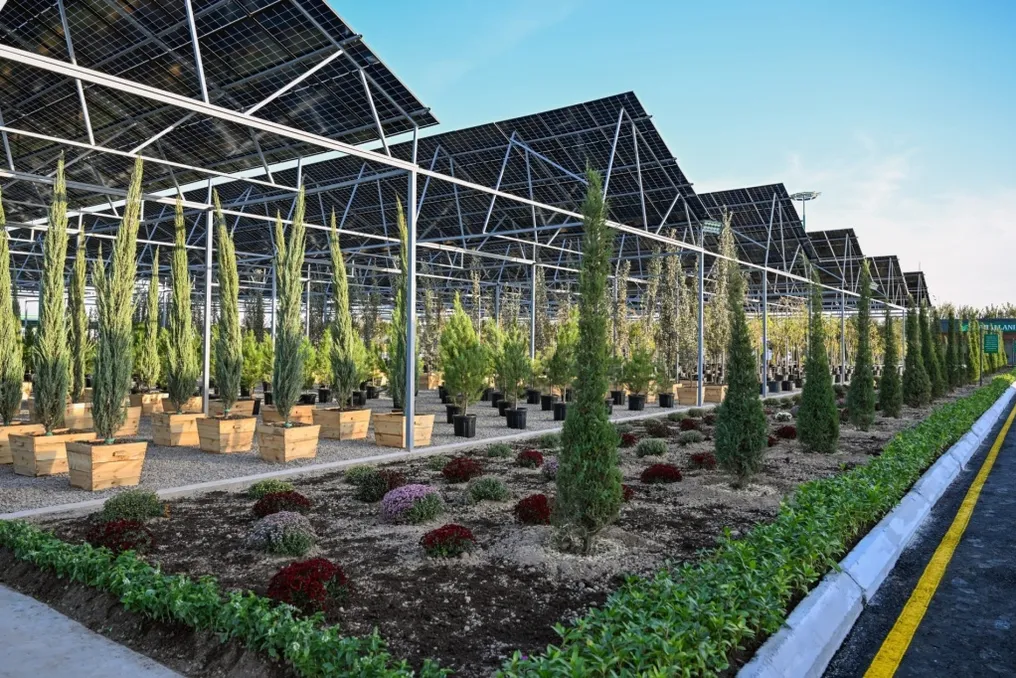
The center's territory is divided into zones: 50 hectares are allocated for growing ornamental trees, five hectares for fruit crops, and another three hectares are used for cultivating shrubs and flowers. The center features 41 varieties of ornamental and coniferous trees.

The center's infrastructure is equipped with a greenhouse, special cultivation plots, seed germination facilities, and protective structures. Three reservoirs with a total capacity of 4.2 thousand cubic meters have been installed for irrigation, and a drip irrigation system has been implemented on 20 hectares. Additionally, composting and mulching units are used, and some energy needs are covered by solar panels.

Thanks to the application of modern technologies, seedling cultivation is possible throughout the year, including periods outside the main planting season. Preliminary estimates suggest this allows for an 8–10 times increase in production volume compared to traditional methods and reduces water consumption threefold. It is projected that the cost of seedlings will decrease by 30–40%.

The center will also support mahallas in greening efforts: it will supply necessary trees and shrubs, manage the treatment of damaged plantings, soil mulching, and installation of drip irrigation systems. A mentor-forester will be assigned to each mahalla, and training is conducted for members of the 'mahalla seven' before the start of each planting season.

Residents can also participate in the project: they will be issued young plants based on cooperative agreements. After caring for these seedlings on their private plots for one or two seasons, the ready plants are guaranteed to be purchased, allowing families to earn additional income.

During his visit, the head of state noted that planting trees and creating gardens is a valuable tradition of the Uzbek people. He was also presented with information on the complex's potential to expand green areas in mahallas and increase the income level of the local population.

Popular