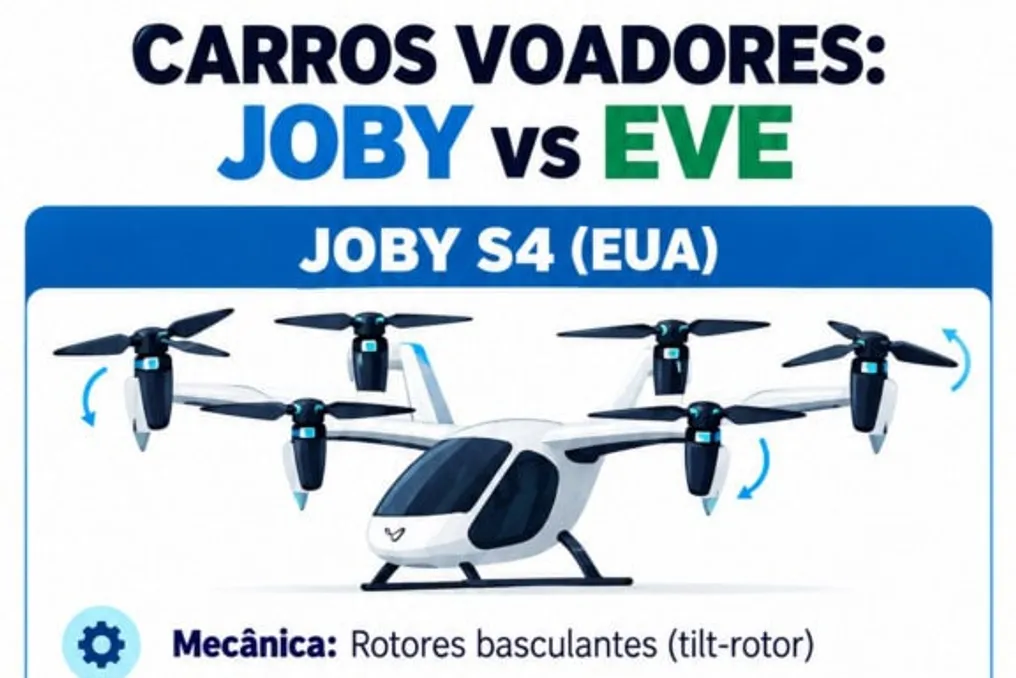
Experts discuss the prospects of eVTOL flying cars by 2026 and obstacles to their mass adoption
Read more
Olhar Digital
olhardigital.com.br

Experts discuss the prospects of eVTOL flying cars by 2026 and obstacles to their mass adoption

Despite expectations that flying cars will appear by 2026, the most advanced projects are currently only prototypes undergoing testing. However, the fact that eVTOL (Electric Vertical Take-Off and Landing — electric vertical take-off and landing vehicle) is moving out of the concept stage is not in doubt.

Fernando Martini Catalano, Professor at the Department of Aerospace Engineering and Director of the School of Engineering San Carlos (EESC-USP), confirmed that this will happen. He explained how these aircraft work and what barriers prevent them from beginning full operation.

Fernando Castro Pinto, a lecturer at the Department of Mechanical Engineering of the Polytechnic School UFRJ, also participated in the discussion. Two companies dominate the sector: Joby Aviation from the USA and Eve Air Mobility, a division of the Brazilian company Embraer.

Currently, there is a race between companies to meet the requirements of aviation authorities such as Anac (National Civil Aviation Authority) and the FAA (the equivalent of Anac in the USA). Joby is focusing on conquering the American and Middle Eastern markets using the Joby S4 model, capable of carrying one pilot and four passengers with a tilt-rotor propulsion system. Eve, meanwhile, is betting on the simplicity of its mechanical design and the experience of global certification gained from Embraer.

Joby has partnered with Toyota to ensure large-scale automotive production. Demonstrative and experimental flights of the Joby S4 with passengers are expected to begin in the USA in late 2026 – early 2027. Simultaneously, commercial transport by this American company is expected to start in Dubai, United Arab Emirates.

Eve's eVTOL, codenamed Eve 100, is also designed for one pilot and four passengers. Its technical advantage lies in the 'lift + cruise' design, which uses separate rotors for vertical takeoff and a rear propeller for horizontal flight, providing simpler mechanics and lower maintenance costs compared to the Joby project.

Like Joby, the Eve project is in the testing and certification phase. Although mass production has not yet begun, the factory in Taubaté (São Paulo state), designed by Embraer, is capable of assembling up to 480 aircraft annually. Embraer and Eve management predicts final certification and the start of commercial operation by the end of 2027 or during 2028.

Morgan Stanley estimates the global eVTOL and Urban Air Mobility (UAM) market at $1 trillion (5 trillion Brazilian reais) by 2040, including passenger transport, cargo delivery, and necessary digital and physical infrastructure (vertiports). However, the bank recently lowered its 2030 forecasts by 75%, bringing them down to $12 billion (60 billion reais), because regulatory barriers proved higher than anticipated.

Technical and safety issues are the main obstacle. Fernando Castro Pinto notes that the main technological challenge is similar to the battery problem in electric vehicles: the more energy required, the larger the battery, the heavier the aircraft, and the more energy is needed. Fernando Martini Catalano adds that the weight of batteries remains too high relative to the energy they provide.

Furthermore, Fernando Pinto pointed out other obstacles to implementation in Brazil: the need to obtain a driver's license and comply with traffic rules. He emphasized that an accident at 30 meters altitude would have much more serious consequences than on the ground.

Consolidating eVTOL fleets will require not only a high level of qualification exceeding standard driving licenses but also harmonious coexistence with civil aviation and helicopters, adhering to routes and airport restrictions. The pilot must possess commercial class pilot skills, understanding all limitations related to routes, radio communication, and attentiveness.

When will flying cars become a reality? Catalano believes it will take seven to ten years, noting that the aircraft itself is only part of the problem; the entire ecosystem, including vertiports, charging logistics, noise reduction, and urban legislation, is necessary. Fernando Pinto, on the other hand, predicts decades for mass transport, as infrastructural bottlenecks such as the capacity of the urban power grid, as well as the evolution of battery technologies and the creation of a legal framework, must be resolved.

Catalano suggests considering medical emergency transport, organ transport, and cargo transport as the initial entry of eVTOL into cities, as these can become faster and more accessible solutions compared to helicopters, especially since not all hospitals are equipped with helipads, and a vertiport can be a cheaper and more urgent alternative.

The main challenge, according to experts, is to make the use of flying cars relatively inexpensive so that they do not remain a luxury item but serve a real benefit to the population.
Similar stories

How the Tesla Roadster takes flight: an explanation of the car's flight science
Read more
www.aajtak.in

How the Tesla Roadster takes flight: an explanation of the car's flight science

In films, from Hollywood to Bollywood, viewers often see cars flying in the air and performing acrobatic stunts. Many filmmakers achieve such scenes either with professional acrobats or by using visual effects (VFX). However, Tesla, owned by Elon Musk, has demonstrated something resembling a scene from a science fiction movie.

Last Thursday evening, during a live demonstration in Texas, the new Tesla Roadster performed an impressive maneuver: it drove backward down a curved ramp, lifted into the air, and then landed safely on all four wheels, like an airplane. This presentation of the new Tesla Roadster model caused great astonishment among the public regarding the possibility of cars leaving the roads and moving through the air in the future.

Nevertheless, it is important to understand that the ability of a car to fly in the air and create a safe flying vehicle for use on regular roads are two completely different tasks. Although the new Roadster demonstrates the potential of this technology, its practicality and permission for operation on public roads still need to be proven.

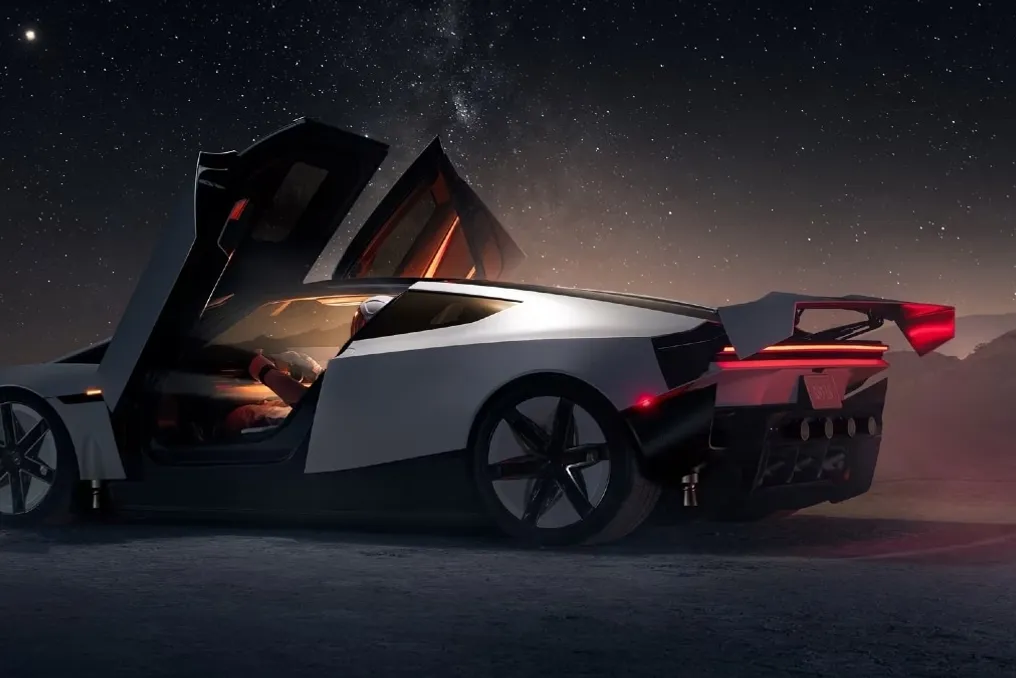
Tesla presented three modifications of the Roadster: Roadster, Roadster Thrust, and Roadster Rocket. Among them, the Rocket model is the most advanced and technically complex. Its creation utilized the rocket technology of SpaceX, founded by Elon Musk. This variant is equipped with a special thruster system that helps not only accelerate the car but also lift it into the air and control its direction.

The goal of this technology is not just to increase the car's speed, but also to ensure its ability to be airborne and maneuver in various directions. Tesla has developed three types of systems: the first provides forward motion, the second assists in ascent and course change, and the third creates downward thrust to keep the car close to the road surface.

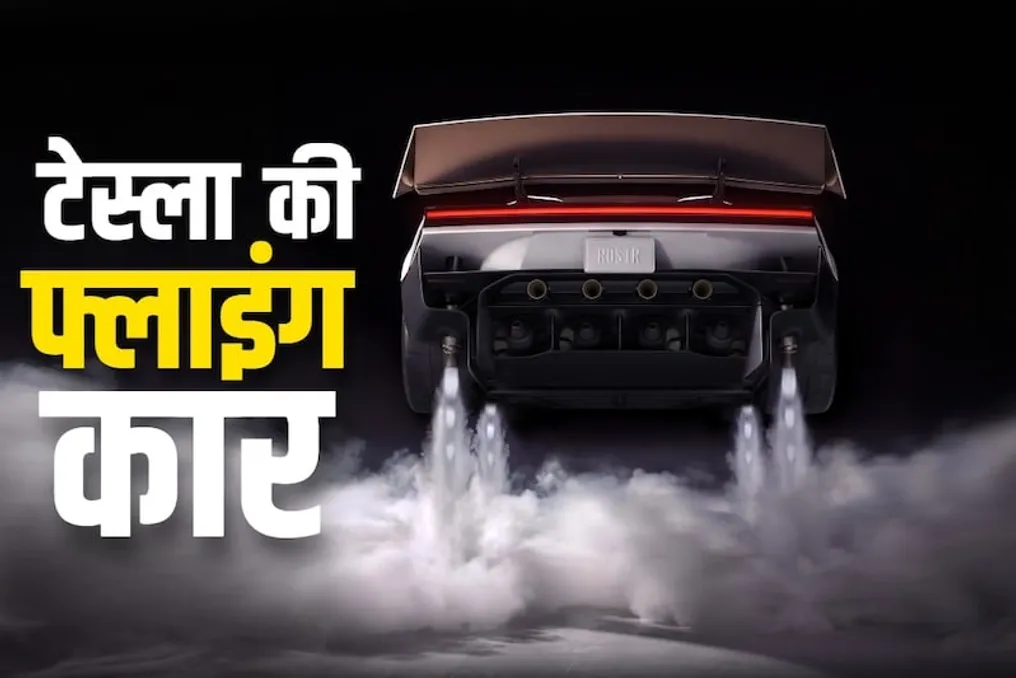
Usually, when talking about rockets or jet engines, the picture presented is one of fuel combustion and hot gas expulsion. However, Tesla's technology uses compressed cold air, known as Cold Gas Thruster. Lars Moravi, Tesla's chief vehicle engineer, stated during the car presentation that the four nozzles at the rear release air at speeds exceeding the speed of sound. The force generated by this process pushes the car forward.

To understand the principle of operation, one can draw an analogy with a balloon. When air is released from a filled balloon, the air quickly exits, and the balloon begins to move in the opposite direction. Tesla's technology works on a similar principle, but here the air is stored under very high pressure and released through special nozzles. Furthermore, this process does not require burning gas.

The Roadster Rocket is equipped with additional engines in different parts of the car, including those located underneath. These are used to lift the car, as well as to turn left or right in the air and maintain balance. Thus, this system is designed not only for forward movement but also for controlling the car's position in the air.

Additionally, wing-like systems located under the car suck in air from below. This creates downward pressure, allowing the car to grip the road surface firmly. This can be compared to a vacuum cleaner that sucks in air and fixes itself to the surface. Tesla claims that this system generates a force twice the weight of the car, which helps stabilize it at high speed.

Elon Musk, presenting the Roadster for 2026, announced that no special fuel or propellant would be required to operate this car. According to him, the car itself will be able to replenish its air tank autonomously. Musk had spoken about using SpaceX's Cold-Gas Thruster technology in the Roadster since 2019.

In this system, high-pressure air is stored in a special vessel reinforced with a layer of composite material for strength. When necessary, this air is released through the engines. Nevertheless, Tesla has not specified how simple the process of refilling the tank will be in real conditions or how long it will take to prepare the car for normal driving after using this system.

According to available data from Tesla, the Roadster Rocket features two air tanks with a total capacity of about 600 liters. It is stated that these tanks can hold about 250 kilograms of pressurized air. If this volume of air were filled at normal pressure, it would occupy the space of a small two-room apartment. Media reports indicate that the air pressure inside the tanks is about 5500 PSI, which is approximately twice the pressure used in standard CNG cylinders.

Tesla unveils new Roadster with flight capabilities; reservation terms and production timelines clarified
Read more
www.aajtak.in

Tesla unveils new Roadster with flight capabilities; reservation terms and production timelines clarified

Tesla has introduced its new Roadster model, which is equipped with several thrusters allowing the car to perform various aerial acrobatics. These capabilities were demonstrated by the company during an online event. However, it remains an open question whether this technology will become a reality or remain merely a demonstration in video materials.

This question is particularly relevant given that the previous version of the Roadster, presented by Elon Musk in 2017, was never mass-produced. Now, the new model has attracted significant attention due to its flying abilities.

Before considering purchasing this vehicle, several important points must be understood. Firstly, there is the issue of legality of operation: until such a vehicle is actually built, it does not have permission to drive on public roads, meaning it cannot be used on regular streets even after purchase.

The company has started accepting pre-orders for this model. The car will be available in three variants, each with corresponding terms and conditions. The company itself stated that the top model, named 'Rocket Variant,' is currently not certified for road use.

To reserve the vehicle, an initial deposit of $5,000 USD is required. Subsequently, an additional $245,000 must be paid within 10 days. Thus, the total reservation amount is $250,000 (equivalent to approximately 2.37 crore rupees). Since the company has not announced a final price, it is also unclear. Tesla specified in the terms that it cannot state the exact cost of the vehicle, and this sum of $250,000 is only the reservation amount.

The third important point concerns delivery timelines. Although Tesla announced that production will begin in 2028, the terms also state that the company cannot guarantee exactly when consumers will receive the vehicle. It is worth noting that in 2017, when the first Roadster was presented, people paid up to $50,000 for a reservation, and the company promised production would start in 2020, but that car was never produced.

Popular