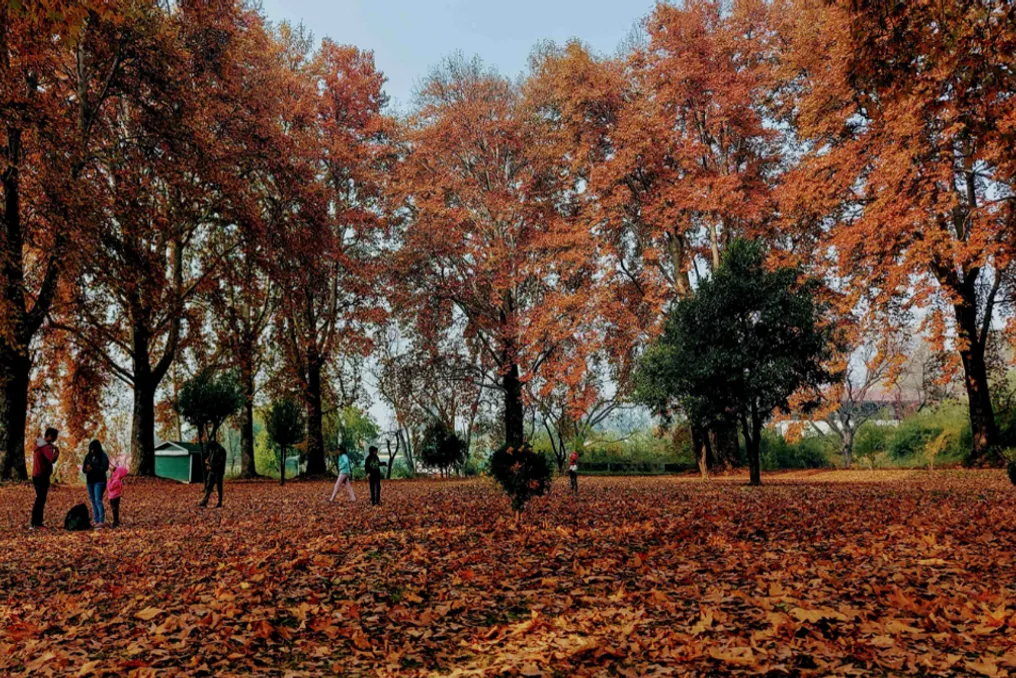
As October and November arrive, the weather in Delhi changes, with a slight chill felt in the morning and evening. During this period, a distinct aroma appears in many areas of the city, parks, and residential zones. Some residents perceive this smell positively, while others find it strange. Sometimes it feels as if someone has sprayed perfume or that the air is filled with the scent of flowers.
However, this sudden scent in the atmosphere of Delhi is caused not by perfumes or flowers, but by a specific tree—the Saptaparni, also known as the Devil Tree. Although this tree looks ordinary for most of the year, before the onset of the cold weather, it changes the surrounding environment with its fragrance. The following discusses how the Saptaparni tree looks when its flowers appear and how far its scent spreads.
The scientific name of Saptaparni is Alstonia scholaris. It is an evergreen tree whose leaves remain green year-round. Its characteristic feature is that its flowering time differs from that of ordinary trees. Usually, flowers begin to appear on this tree in late September in Delhi, blooming from October to December. The flowers are quite small, having a light white, cream, or green hue, and they bloom not singly, but in clusters.
When thousands of tiny flowers bloom on one tree, their fragrance begins to spread over vast areas around it. In the evening, this scent can be even stronger. This is why people walking past the streets of Delhi often detect this tree's aroma.
It is difficult to describe the fragrance of Saptaparni flowers in a single word. Some people perceive a sweet, perfume-like scent in it, while others describe it as sharp, reminiscent of cardamom and spices. Some compare it to the scent of Ratrani flowers. Nevertheless, not everyone likes this smell; some find it too strong and heavy. People sensitive to this odor may experience headaches, nausea, or allergic reactions when near the tree. Thus, while for some the aroma of Saptaparni signals the approach of winter and holidays, others do not anticipate the flowering season of this plant.
The name of this tree is related to its distinctive feature. In Sanskrit, 'sapta' means seven, and 'parni' means leaf. Its leaves often appear in groups of seven. Although it is not necessary for every branch to have exactly seven leaves, the number can vary from four to eight. The leaves are long, smooth, and glossy, radiating outwards from a single point. From a distance, one can notice a round cluster of leaves on the branches.
Saptaparni is a plant native to India. It grows in various regions of the country, including many Himalayan areas. However, it was not originally part of the local flora of Delhi. The mass introduction of this tree into Delhi began in the 1940s, especially in areas like golf courses. Gradually, it started appearing on the streets, in parks, and residential areas of the capital. The reason for its popularity in cities also lies in its resilience: the tree is capable of growing in different climatic conditions and thrives well in an urban environment. Its evergreen leaves keep it in a green state year-round. Today, old and large Saptaparni trees can be seen in many parts of Delhi, such as near Lodhi Garden and golf courses.
The history of Saptaparni is not limited to its scent and leaves. In English, it is called the Devil Tree. This name is associated with various ancient folk tales and beliefs. In some regions of South India, there was a belief that Yakshinis inhabited this tree. In folklore, Yakshinis are depicted as mysterious and beautiful women, and in some stories, they are presented as spirits connected to forests and trees. It was said that a strange, strong aroma emanated from the Saptaparni trees at night. Due to this smell and the mysterious stories associated with the tree, fear arose among people. However, these stories lack scientific basis; they are old folk beliefs passed down through generations.
Saptaparni is also called the Blackboard Tree. An interesting reason for this is that in the past, its light wood was used to make writing slates and blackboards for children. The word 'scholaris' in its scientific name is also related to education. Furthermore, graduation ceremonies were held at Vishwavarti University in Santiniketan, West Bengal.