Ecuador to Host Biodiversity Conference of the Parties (COP18) in 2028
Read more
Noticias ao Minuto
noticiasaominuto.com

Ecuador to Host Biodiversity Conference of the Parties (COP18) in 2028

Ecuador has been elected as the chair of the 18th Conference of the Parties on Biodiversity (COP18), which will take place in 2028. This decision was made following a vote during the plenary session of COP17, held in Armenia, where Ecuador defeated Panama.

Chairing COP involves hosting several thousand participants, as well as leading and coordinating negotiations among approximately 200 member states of the Convention on Biological Diversity of the United Nations (CBD).

Previously, Armenia was chosen to host COP17 in 2024 through a secret ballot, defeating Azerbaijan. This process marked the first instance of voting in CBD history, as selection had previously been done unanimously.

Similar stories

COP31 in Antalya will provide Uzbekistan with opportunities to solve climate problems
Read more
uzdaily.uz

COP31 in Antalya will provide Uzbekistan with opportunities to solve climate problems

The thirty-first Conference of the Parties to the United Nations Framework Convention on Climate Change (COP31) is scheduled to take place in Antalya, Turkey, from November 9 to 20, 2026. The event will gather international participants to discuss global climate challenges and possible ways to overcome them.

The conference is expected to attract representatives from governments, international organizations, the scientific community, business, and civil society. The main focus will be on measures to combat climate change and strengthen international cooperation.

Key areas of the conference work

Key priorities will include the implementation of the Paris Agreement, reduction of greenhouse gas emissions, adaptation to climate change, climate finance, and international partnership. One of the main events will be the Summit of World Leaders on Climate Action, which will take place on November 11–12.

Heads of state and government plan to discuss national climate challenges, progress in fulfilling international obligations, and opportunities to accelerate climate transformations. The COP31 program will cover a wide range of topics, including energy, sustainable agriculture, food security, biodiversity conservation, urban development, and the implementation of eco-friendly technologies.

Thematic days will be organized on climate finance and 'green' investments, transport, circular economy, youth and education, scientific research, industrial innovation, water ecosystems, and sustainable tourism.

Opportunities for Central Asia

For Uzbekistan and other Central Asian countries, this conference presents a chance to address pressing environmental issues, particularly water scarcity, desertification, land degradation, and the need to adapt to climate change. Discussions at COP31 may open up additional prospects for expanding international cooperation and attracting investment in environmental protection projects.

Potential areas of interaction include the implementation of water-saving technologies, ecosystem restoration, development of renewable energy, and measures to increase agricultural sustainability. The scientific community, youth, and business should also play a significant role in developing and applying practical climate solutions.

A central issue at the conference will be translating international climate commitments into measurable results. Achieving climate goals will require access to financing, technological development, and stronger partnerships between states. For Uzbekistan, COP31 will be a platform to demonstrate national environmental initiatives, strengthen international relations, and study additional mechanisms for supporting projects aimed at solving climate problems. The success of the conference will depend not only on the agreements reached but also on the effectiveness of their implementation into practical actions.

Six South African reserves offer an alternative wildlife viewing experience
Read more
getaway.co.za

Six South African reserves offer an alternative wildlife viewing experience

The best wildlife interaction experience is not always achieved from inside a vehicle window. Within South Africa, nature reserves provide opportunities to explore the environment through organized hikes, following interpretive trails, studying local ecosystems, and gaining a more detailed understanding of wild areas.

The local forests of Garden Route are rich in exceptional flora and fauna diversity, much of which can be easily missed when traveling between destinations by car. Garden Route National Park offers several ways to experience these ecosystems on foot. In Garden of Eden, near Knysna, there is a short, wheelchair-accessible boardwalk featuring information boards detailing local fauna, Afromontane forests, forestry management, plants, and people. Visitors can explore the surroundings while birdwatching and observing other forest inhabitants. Further along the route, the Tsitsikamma section features interpretive displays and natural trails, including the popular Bloukrans Trail, which leads to a suspension bridge over the Storms River.

This UNESCO World Heritage site protects a landscape composed of sandstone formations, riverine forests, and savannas, while also preserving remnants of an important early African kingdom. The Mapungubwe Interpretation Centre provides information on the archaeology, cultural history, and biodiversity of the site. Visitors can also tour designated viewpoints and the park's canopy walkway, offering a different perspective on the surrounding landscape. The park's informational exhibits help connect the natural environment with the people who lived here centuries ago. This makes Mapungubwe particularly valuable for travelers interested in the intersection of nature conservation, archaeology, and human history. While wildlife viewing is possible, the main attractions are the educational facilities and the landscape itself.

Langebaan Lagoon is one of the main attractions in West Coast National Park, drawing birdwatchers and nature lovers year-round. Instead of relying solely on observations from a vehicle, visitors can spend time at bird hides and viewpoints, watching waterfowl without disturbing them. The park's interpretive signage adds another layer to the visit. Exhibits in the Geelberg and Syberg areas cover topics such as local birds, marine mammals, native plants, geology, archaeology, and coastal history. Postberg is particularly popular in spring due to its wildflowers, although access is seasonal. Walking through designated areas and stopping to read information boards helps visitors understand why the region's habitats are important for resident and migratory species.

Rietvlei Nature Reserve, located near Pretoria, offers opportunities to study nature through guided activities and birdwatching. The reserve has a dedicated walking trail designed for environmental understanding rather than just covering distance. This four-hour daytime hike requires advance booking and is conducted in groups led by a guide. It is intended for participants aged 12 and older. For those who prefer to observe wildlife from a stationary spot, the reserve is also equipped with six bird hides accessible along self-drive roads. These hides allow for birdwatching in their natural habitat and enable observations at a more relaxed pace. Before planning a trip, visitors should check current conditions and hiking requirements.

Approximately 10 km south of Gaborone, Mokoro Lodge offers diverse organized activities that bring visitors closer to Botswana's wildlife and landscapes. Depending on availability and the reserve's current program, activities include guided walks, rhino and giraffe tracking, horseback safaris, and game drives. The reserve also features an education center, museum, and library, making it a useful stop for travelers wishing to learn about nature conservation alongside wildlife viewing experiences. The Mokoro Lodge ecological education program welcomes school groups, helping young guests develop an understanding of biodiversity and the importance of protecting natural habitats. For travelers, the combination of organized activities and educational facilities provides several ways to engage with the reserve beyond traditional safaris. It is necessary to check which activities are running and if advance bookings are required before visiting.

Van Staden's Reserve offers a different approach to traditional wildlife excursions. Its seven walking trails allow visitors to experience the intersection of fynbos vegetation and forest, with plant diversity being a significant part of the interest. Visitors can arrange guided walks led by local guides who share information about the reserve's flora and fauna. Birdwatching and plant identification are also popular activities, and a wooden bird hide along Nymph Trail provides a spot for bird observation. The reserve is especially appealing to travelers who want to appreciate the fine details of the ecosystem, from local plants to the birds that depend on them. Organized walks last approximately one to two hours, and visitors should contact the reserve administration to confirm arrangements and payment.

Before visiting, check whether the walking routes are self-guided or require a registered guide. Some reserves only allow visitors to walk in designated areas, while others offer activities that must be booked in advance. Bring appropriate footwear, water, sun protection, and binoculars if you plan to birdwatch. Most importantly, remember that walking wildlife viewing requires respect for animals and their habitats. Follow the guide's instructions, stay on marked trails, and avoid approaching or feeding wild animals.

COP31 will be held in Antalya, Turkey, using an adapted area of the former Expo, according to SP Architects
Read more
archdaily.com.br

COP31 will be held in Antalya, Turkey, using an adapted area of the former Expo, according to SP Architects

The 31st Conference of the Parties to the United Nations Framework Convention on Climate Change (COP31) will take place in Antalya, Turkey, from November 9th to 20th. The event will operate under a mixed governance model, where Turkey will host the summit and the presidency, while Australia will lead the formal negotiations.

This meeting will bring together various stakeholders, such as national delegates, government representatives, scientists, businesses, and civil society, with the aim of debating global climate action. Topics include emission reduction, adaptation to climate effects, and climate finance, at a time when countries are dealing with extreme weather events, resource consumption, and the shift towards low-emission economies.

This year's agenda dedicates specific discussions to topics such as zero waste, energy, and transport, while also focusing on more resilient cities. In preparation for the conference, the SP Architects office is renovating the former EXPO 2016 park in Antalya to host the event, with the intention of keeping the site in use after COP31 concludes.

The thematic subjects of COP31 encompass energy and transport, food and agriculture, climate finance, circular economy, and the preservation of oceans and terrestrial ecosystems. November 11th and 12th will be reserved for the World Leaders Climate Action Summit, a moment when heads of state and government will meet to discuss international cooperation and environmental commitments.

On November 12th, there will be a special focus on resilient cities and the built environment. Topics such as low-climate impact buildings, urban resilience, disaster risk management, local governments, smart cities, natural solutions, mobility, infrastructure, and sustainable waste systems will be addressed. These debates will occur within the context of the environmental impact of the construction sector, covering emissions related to building operation and the manufacturing of construction materials.

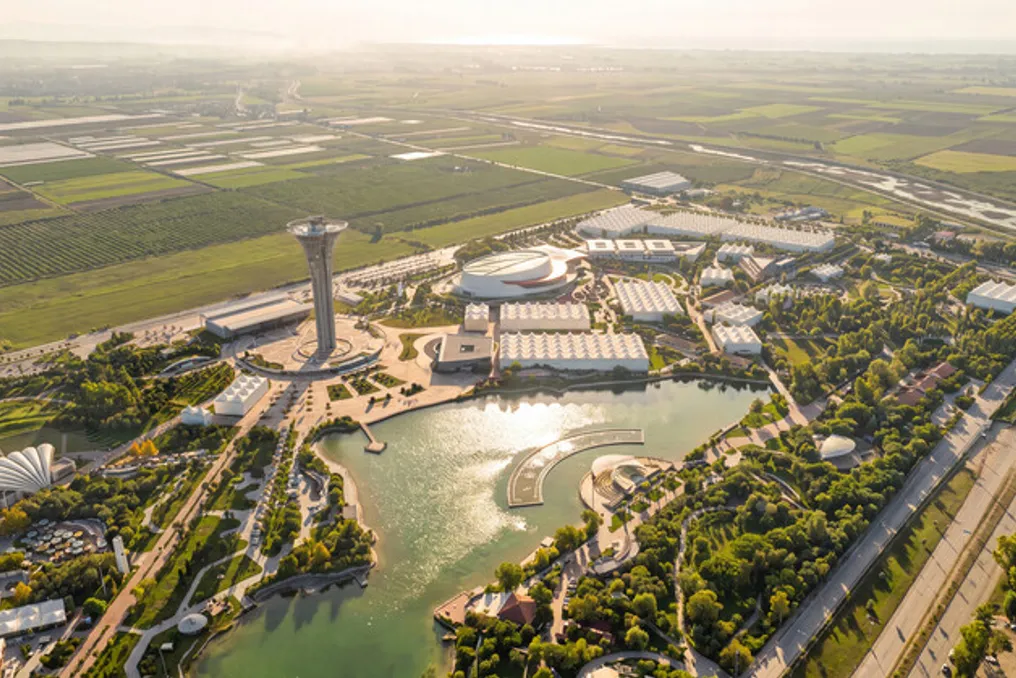
The chosen venue for COP31 utilizes the structure originally developed for EXPO 2016 Antalya, an international horticultural fair. This site, located in the Aksu district of Antalya, featured landscaped areas, exhibition facilities, and buildings focused on agriculture and biodiversity. SP Architects is making adaptations to this existing site through a mix of renovations and new structures, both permanent and temporary.

The conference space will be divided into two zones with distinct purposes. The Blue Zone, managed by the United Nations Framework Convention on Climate Change (UNFCCC), will be the venue for formal negotiations and meetings with accredited participants. The Green Zone will be dedicated to public events, exhibitions, and debates. Uniting these two areas in the same location requires careful planning of circulation flows, security perimeters, and shared facilities.

According to SP Architects, the design team has led the development from the conceptual phase to construction over the past year. This work was carried out from an office located on the site itself and in collaboration with the Turkish Ministry of Environment, Urbanization and Climate Change, the UNFCCC, and other stakeholders.

The project integrates modular and recyclable construction elements, along with measures focused on environmental control and operational efficiency. There are plans for the space to continue hosting fairs, shows, and other events after COP31, in coordination with the metropolitan and district administrations of Antalya. This planned continuity expands the utility of the site beyond the international conference, relying on the infrastructure created for a previous large-scale event.

Past COP editions have highlighted both the progress in international climate negotiations and the obstacles in turning promises into practical actions. Following the climate finance goal set at COP29 in Baku and the advances of COP30 regarding adaptation finance and just transition in Belém, COP31 will take place in a scenario of continuous discussions on emission reduction and climate finance. Under the motto 'From Dialogue to Consensus, From Consensus to Action,' the Antalya conference seeks to reinforce the implementation of current climate agreements, including those related to sustainable development and urban resilience.
Popular