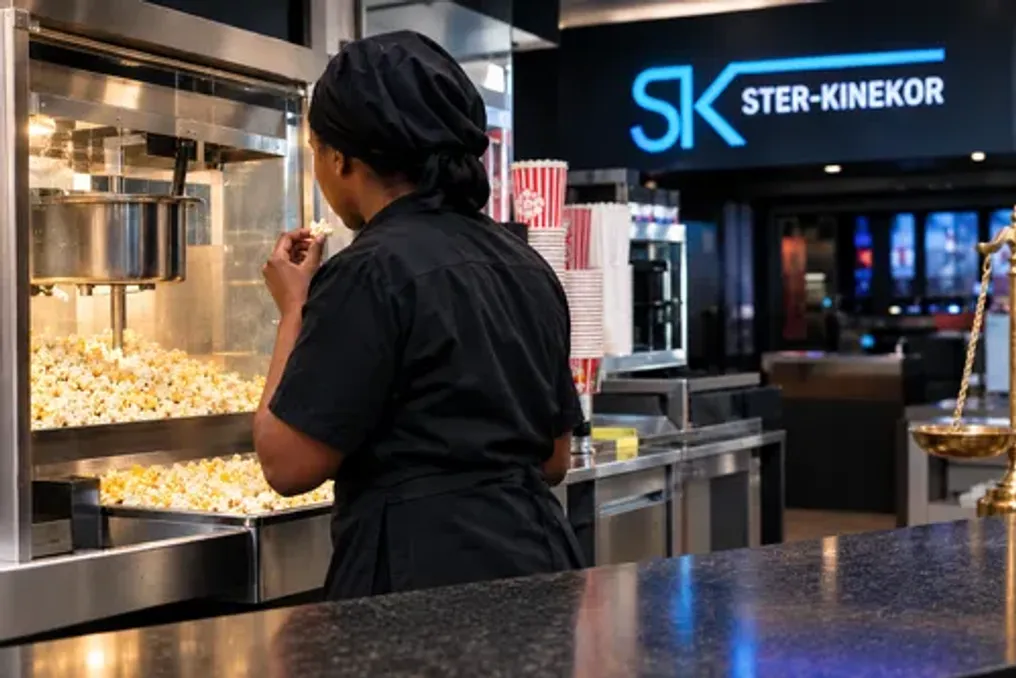
Ster-Kinekor Theatres failed in its attempt to overturn the court's decision, which found the dismissal of an employee accused of consuming popcorn at the workplace to be substantially unfair. The labor court determined that the cinema company could not prove that the employee violated workplace rules.
Presiding Judge M. J. Motchega dismissed Ster-Kinekor's appeal, upholding the arbitration award from the Commission for Conciliation, Mediation and Arbitration (CCMA), which ordered the reinstatement of employee Ivonne Mogano with retroactive effect.
The conflict arose following an incident on June 30, 2023. Mogano, who worked as a multi-functional employee at the Ster-Kinekor theatre in The Zone in Rosebank, Johannesburg, was accused of eating popcorn in the kitchen while it was being prepared.
She had been employed by the company since May 23, 2014. After a disciplinary hearing on July 12, 2023, she was dismissed two days later, having been found guilty of misappropriation of company assets, dishonesty, and non-compliance with company policy and standard practice.
Mogano challenged the substantial fairness of her dismissal at the CCMA. During the arbitration, Ster-Kinekor's General Manager, Tairan Naiker, testified that he found Mogano eating popcorn that she had prepared. According to him, when he asked her questions, she remained silent and continued eating.
He reported returning approximately 20 minutes later and seeing that she was still eating popcorn. The company argued that the standard operating procedure for preparing popcorn did not allow employees to taste the product, as quality control was the responsibility of management.
However, Mogano countered the claim that she was eating popcorn, stating that she merely put a few kernels in her mouth to check the salt level. She showed that in 2022, after a customer complaint about overly salty popcorn, both she and Naiker tasted it. She added that Naiker subsequently instructed her to taste the popcorn to check the salt level, but not to eat it.
The Commissioner accepted Mogano's explanation, finding that Ster-Kinekor failed to prove that she knew the workplace rule prohibiting employees from tasting popcorn. The Commissioner also concluded that the company failed to prove that she committed an act of dishonesty or violated its policies.
Subsequently, Ster-Kinekor appealed to the Labor Court, arguing that the commissioner had misinterpreted the evidence and erroneously concluded that Mogano was tasting, not eating, the popcorn.
Court finds no evidence of a rule prohibiting tasting
Reviewing the appeal, the court examined the company's standard operating procedure and the evidence presented during the arbitration. Ster-Kinekor insisted that although its procedure did not explicitly forbid employees from tasting popcorn, this prohibition could be inferred from the fact that it specified a fixed recipe and placed quality control responsibility on management.
Nevertheless, the court found that Naiker could not point to any provision in the procedure that specifically prohibited employees from tasting popcorn. He also admitted during cross-examination that he himself had previously tasted popcorn and given some to Mogano for tasting after a customer complaint about excessive salt.
The judge ruled that knowledge of how to prepare popcorn does not automatically mean that Mogano knew that tasting it for salt was forbidden. The court also noted that the company procedure required the general manager and multi-functional supervisors to conduct daily checks of popcorn preparation and output tests, but it lacked a provision directly forbidding employees from tasting popcorn.
The judge emphasized that an employer relying on a workplace rule must prove both the existence of that rule and the employee's awareness of it. The court's ruling stated: 'When an employer relies on its procedure as a source of the rule, behavior within that procedure that is not expressly prohibited cannot be elevated to a disciplinary offense by inference.'
The court also rejected Ster-Kinekor's argument that the commissioner incorrectly favored Mogano's version over Naiker's. Judge Motchega stated that disagreeing with the decision-maker's preference for one version of events over another is a matter for appeal, not review.
The court concluded that the commissioner's finding that Mogano had the right to taste the popcorn was supported by the evidence.
Allegations of commissioner bias dismissed
Ster-Kinekor also accused the commissioner of conducting the arbitration unfairly, claiming he ignored evidence presented during re-examination and refused to take further notes. However, the court found no evidence supporting these allegations. The judge noted that the commissioner initially questioned whether the Ster-Kinekor representative was introducing new evidence during re-examination but allowed questioning to continue after receiving explanations.
The court found that nothing in the arbitration record demonstrated that the commissioner acted biasedly or ignored the company's evidence. Ultimately, the judge concluded that the arbitration award was supported by evidence and represented a decision that a reasonable commissioner could have made.
The labor court granted an extension for the late filing of Ster-Kinekor's appeal, which was filed one day past the established six-week deadline. Nevertheless, the appeal was dismissed. The court did not issue a ruling on legal costs.
_