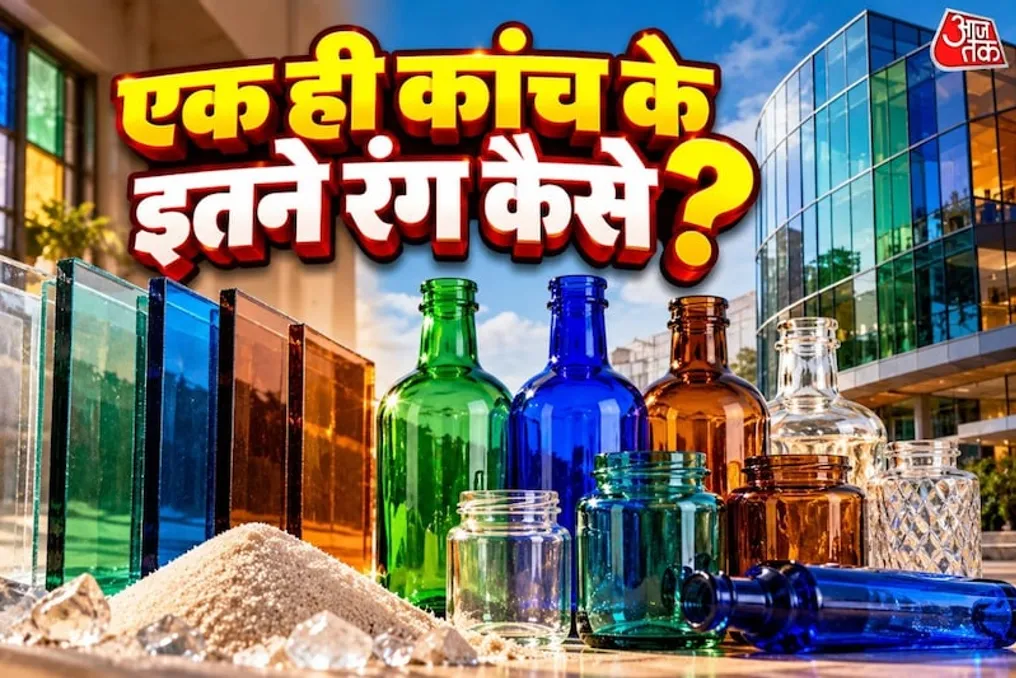
Manufacturing Glass of Various Colors from the Same Sand: The Scientific Process
Read more
Aaj Tak
www.aajtak.in

Manufacturing Glass of Various Colors from the Same Sand: The Scientific Process

Glass is used in many areas of our daily lives, such as house windows, cars, bottles, spectacles, and shop doors. Some of these glasses are completely transparent, while others appear in various colors like green, blue, or brown. It is interesting to know why the color of glass varies; it primarily depends on the specific elements present within the glass and its interaction with light.

The main material used in the process of making glass is silica, or sand. However, ordinary sand cannot be turned into glass by simply heating it. For this, materials like soda ash and limestone are mixed with the sand. All these components are heated at extremely high temperatures, causing the mixture to melt into a thick liquid. Subsequently, it is given the desired shape and slowly cooled, resulting in the formation of glass. A characteristic of glass is that its internal structure lacks a regular crystalline arrangement, which is why it is called an amorphous solid.

When we look out of clear glass, we can see objects on the other side clearly. This happens because normal clear glass allows most parts of visible light to pass through it. When light strikes the glass, some portion is reflected back, some is absorbed, and the remainder passes through to the other side. Very little of the light visible in clear glass is absorbed, which is why looking through it is possible. However, it is not accurate to say that glass allows light to pass through completely; due to thick glass or impurities present in it, a slight green or another color may still be visible.

A slight green tint often appears on the edges of thick glass, which is caused by a small amount of iron present in the glass. Trace particles of iron may be present in the sand and other raw materials used in glass making, which remain in the glass during its formation. These iron particles absorb certain colors of light more than others, allowing green light to pass through more readily compared to some parts of red and blue light. Consequently, the glass appears slightly green. The thicker the glass, the longer the path of light transmission, making the green effect more apparent. This is why the edges of many common windows and thick glass sheets appear green.

To make blue glass, oxides of special metals are added, with cobalt oxide being a prime example. Even a small amount of it can impart a blue color to the glass. In fact, different metal oxides absorb different colors of light. When cobalt oxide is added to the glass, it absorbs light of certain colors and allows blue light to pass through, making the glass appear blue. Similarly, using other elements in the glass allows for the creation of light blue, dark blue, and many other shades.

Glass can be molded into many colors besides just green and blue. For this, various metals and their oxides are used during the glassmaking process. Examples include: iron oxide and chromium oxide for green glass, cobalt oxide for blue glass, compounds related to iron and sulfur for brown glass, manganese compounds for purple glass, and selenium or copper for red glass. However, the final color of the glass also depends on the quantity of these substances added and the method by which the glass is prepared.

Colored glass is not limited only to decoration; its purpose is not always to enhance beauty. Often, it is used keeping specific requirements in mind. For instance, green and brown bottles are used in the packaging of many medicines and beverages. These colors help block certain parts of light, protecting the products inside from damage caused by light. Additionally, colored glass in buildings is used to control sunlight and heat, as this specialized glass helps maintain room temperature by blocking some parts of sunlight and heat.


Similar stories

Reasons for the Change in Color of Chinar Leaves in Kashmir: From Green in Summer to Red in Autumn
Read more
www.aajtak.in

Reasons for the Change in Color of Chinar Leaves in Kashmir: From Green in Summer to Red in Autumn

The beauty of Kashmir is often associated with chinar trees, especially in October and November when they look particularly impressive. These trees, which are lush green in summer, take on shades of yellow, orange, and deep red in autumn, creating the impression that the trees are covered in a red carpet. The question arises about the scientific explanation for this sharp change in leaf color—is it related to cooling down or is there another scientific reason. In fact, a specific natural reaction within the trees is behind this process.

The main reason for the change in leaf color lies in the pigments contained within them. In summer, the leaves are rich in a green pigment called chlorophyll. This component is necessary for plants to perform photosynthesis, the process by which they produce food using sunlight. Thanks to the sunlight and favorable weather in summer, chlorophyll remains active, causing the chinar leaves to appear dark green.

However, as autumn arrives, the days get shorter and the temperature begins to drop, and the tree gradually prepares for winter. During this period, the amount of chlorophyll in the leaves begins to decrease. As the influence of the green color weakens, yellow and orange pigments that were already present in the leaves become visible. This is why the color of chinar leaves changes from green to yellow and orange.

Pigments can also contribute to the red color of the leaves. Usually, the yellow and orange colors in the leaves are caused by elements such as carotenoids and xanthophylls, which are present in the leaves initially but are masked by the green color in summer. Meanwhile, red and purple colors in the leaves of many trees are formed by a pigment called anthocyanin. The amount of this pigment can depend on factors such as temperature, sunlight intensity, and sugar levels in the leaves. Nevertheless, the exact understanding of which elements are responsible for all the shades of red observed on the chinar leaves in Kashmir has not yet been fully established.

The chinar tree grows well in regions with a temperate climate and sufficient water. The climate of Kashmir, with its temperature fluctuations between summer and winter and changing weather in autumn, creates ideal conditions for the change in its foliage color. In other parts of India, trees may not change color in this way during the change of seasons; some remain green year-round, while others shed their leaves during dry periods. Therefore, the transition of chinar leaves from green to gold and red gives Kashmir's nature a unique appearance.

Chinar is not just a tree; it is an important part of the culture and history of Kashmir. It is recognized as the state tree of Jammu and Kashmir. Its impressive branches and dense shade make it special. Muslim rulers also encouraged the planting of chinar in Kashmir. Old chinar trees can still be seen in historical gardens, such as Nishat Bagh in Srinagar. The shape of the chinar leaves is used in the design of Kashmiri embroidery, carpets, shawls, and traditional handicrafts. Thus, the significance of this tree extends beyond ecology and is connected to the cultural heritage of Kashmir.

Over time, many old chinar trees in Kashmir have suffered. Urbanization, road construction, deforestation, and diseases pose a threat to them. In this regard, the administration of Jammu and Kashmir has launched the 'Tree Aadhaar' initiative. Under this program, chinar trees are accounted for, and information about their location, age, size, and health status is collected.

Scientists discover green white dwarf WD J1330+6435 that has swallowed planets
Read more
www.aajtak.in

Scientists discover green white dwarf WD J1330+6435 that has swallowed planets

Scientists have recorded a green star in space for the first time. This star, named WD J1330+6435, is located in the constellation Draco, in the Milky Way galaxy, at a distance of about 280 light-years from Earth. It is a white dwarf that has absorbed fragments of planets that were previously orbiting it.

According to scientists' data, the green hue of the star is due to the interaction process between sodium, which came from these fragments, and helium present in the star itself. Usually, a star's color is determined by its temperature: cool stars appear orange, Sun-like stars are white, and hotter ones are pale blue. However, WD J1330+6435 deviates from this rule.

The study showed that elements such as calcium, lithium, and sodium, originating from destroyed planets, were found in the outer layer of WD J1330+6435. The green color of this star largely depends on sodium. Although sodium usually absorbs orange light (as seen in the orange color of streetlights), something different is happening in this case.

Scientists explain that this star has a very high density. Sodium atoms constantly collide with helium atoms, which changes how sodium functions. After this, it begins to absorb parts of the yellow, orange, and red light. This affects the light emitted by the star; when the balance of different colors in the light is disrupted, the star acquires a green tint, called charrage, which has a slight yellowish hue. Such a color is not observed in ordinary stars like the Sun.

White dwarfs form during the final stage of a star's life. Their size can be comparable to the size of the Earth, but they contain a huge amount of matter. Typically, a white dwarf can have a mass approximately equal to half the mass of the Sun. Due to extremely high density, even a small amount of sodium can have a significant impact on the light they emit. In the case of WD J1330+6435, most of the orange light is absorbed by sodium, leading to the visible green color of the star.

As part of this study, scientists examined the colors of 151 white dwarfs within 65 light-years of Earth. Most of them turned out to be white, but one appeared light pink. This dwarf, named WD J1011+2845, is located about 48 light-years away in the constellation Cygnus. Unlike the case with WD J1330+6435, the color change of this dwarf is related not to sodium but to carbon. Scientists believe that the release of carbon from inside the star influenced its coloration. The study also showed that some white dwarfs with high carbon content can appear pink or purple, while others containing elements from destroyed planets can be yellow.

To study the starlight, researchers used data obtained from a telescope in New Mexico, as well as computer models. During the work, information was gathered on the colors and composition of 151 white dwarfs. This analysis proved that a star's color is determined not only by its temperature but also by the elements contained within it and the structure of its outer shell. WD J1330+6435 is the first registered example of a green star in space.

How to use old glass bottles for Diwali home decoration instead of buying expensive items
Read more
www.aajtak.in

How to use old glass bottles for Diwali home decoration instead of buying expensive items

During the holidays, people clean and decorate their homes, and Diwali is one of the most special times. During Diwali, people decorate their homes with lights and lamps, and they also meticulously adorn them. In such conditions, the prices of decorative items available on the market increase. However, it is not necessary to buy expensive figurines, lamps, or other decorative items from the store every time to decorate the house. This time, you can make the decoration special by using old glass bottles.

Often, empty glass bottles are thrown away or sold to the dump, but with a little creativity, they can be turned into beautiful lanterns, flower vases, and decorative figurines. These items can give a new look to the corners of your home and further enhance the festive Diwali decor. The main advantage is that this does not require spending a lot of money. With a few simple things, you can refresh old bottles and decorate the house with light and flowers. If you want to make your home beautiful and original with less expense this Diwali, use old glass bottles in the following four ways instead of throwing them away.

If there is a free corner in your room or you want to place something new on your bedside table, an old glass bottle can help you. Take a clean glass bottle and place a small battery-operated LED string light inside. The light shining inside the bottle will look very beautiful, and you will get a beautiful lamp for a small price. You can place this bottle in the bedroom, living room, on a bookshelf, or in any free corner of the house. The soft light from it in the evening will give the room a special look. If the color of the bottle is good, the light coming from it can look even more attractive.

Even if you love decorating your home with flowers, glass bottles can be useful. You don't need to buy a new vase every time to decorate your home with flowers. A glass bottle can be used as a flower vase after thorough cleaning. After washing, make sure to remove any labels or stickers from the bottle. Now fill the bottle with water and put fresh flowers or decorate it with artificial flowers. You can place it on the dining table, coffee table, near the window, or in the living room. Placing flowers in vases of different sizes can give the home a new look.

If you like to do something new in home decor, you can turn old glass bottles into beautiful figurines by painting them. For this, the bottle must be thoroughly washed and dried. Then cover it with acrylic paint of your chosen colors. You can choose white, gold, blue, or any other color according to your home decor. If you wish, you can apply small patterns to the bottle or simply paint it one color for a minimalist look. After the paint is completely dry, place it on the coffee table, dining table, or shelf. Thus, even a simple bottle can become a beautiful decorative item.

If you enjoy gardening, old glass bottles can be used for small plants. To do this, the bottle should be thoroughly cleaned and a small plant or cutting that grows easily in it should be planted. However, one thing needs to be considered here. Usually, glass bottles do not have drainage holes, so when planting a plant in soil, excess water may accumulate. This creates a risk of damaging the plant roots. In this case, it is best to attach cuttings that grow easily in water, or arrange a small plant in its own pot inside the bottle. You can place these bottles near the window, on the balcony, or in any corner of the house where the plant will receive enough light according to its needs.

Popular