Lenovo releases Tianxi AI 4.5 for AI PCs, allowing phones and tablets to offload tasks to desktop computers
Read more
Pandaily
pandaily.com

Lenovo releases Tianxi AI 4.5 for AI PCs, allowing phones and tablets to offload tasks to desktop computers

Lenovo introduced its personal AI agent, Tianxi AI 4.5, on Artificial Intelligence PCs (AI PCs) on October 30. This release followed versions for phones, launched on October 20, and for tablets, released on October 27, meaning the update now covers all three device types.

Lenovo positions this version for office workers, offering enhancements for completing work tasks, participating in meetings, and business travel. A central feature is the new Super Mode, which transforms the assistant from a question-answering tool into a task executor.

Tianxi AI 4.5 integrates connectors for Feishu, the Lenovo browser, and WeCom, linking them to a personal knowledge base. This allows for the shared use of local files and cloud documents. A user can issue a single command that prompts the assistant to break down and execute multi-step work across different applications, such as checking meeting schedules, assigning tasks, or finding material and sending a group notification.

A skills marketplace is also available, consolidating connectors, collaborative multitasking, and various skills, including enhanced slide generation. Furthermore, a system management package allows users to customize graphics, power, and system parameters upon request.

The AI note-taking function for meetings has been completely revamped. It now provides real-time transcription with subtitles and can participate in brainstorming as a participant, offering opinions and ideas. Attendees can ask the AI questions during a meeting based on the live transcript, and the system automatically highlights key moments. Upon session completion, summary cards are generated, saved to the knowledge base, and synchronized across devices.

The knowledge base now supports uploading up to 20 files, and images can be uploaded directly into the chat. All three device types support full-duplex voice input, allowing the conversation to be interrupted to add instructions mid-dialogue without repeating the activation word. When the user is away from their workstation, they can use their phone or tablet to initiate a complex task on an office or home AI PC running in Super Mode.

Task progress is visible on the phone or tablet, status notifications are received, and completed results can be previewed and managed remotely. The update also extends to Lenovo's AI Host machines. The AI Host P7 model can access cloud models or function as a local edge computing device. The new Auto mode selects between cloud and local models based on task complexity to minimize unnecessary token usage. These hosts support autonomous, round-the-clock task execution.

Similar stories

Contrast between the rejection of AI in games and its acceptance in hardware development
Read more
olhardigital.com.br

Contrast between the rejection of AI in games and its acceptance in hardware development

In December 2025, the game Clair Obscur: Expedition 33 received two negative awards at the Indie Game Awards due to the use of Artificial Intelligence (AI)-generated textures in the final version. In contrast, corporations like Nvidia employ AI to design their own GPUs, which are used in various games, without facing calls for boycotts.

This scenario raises the question of the gaming community's prejudice against AI. The distinction lies between what is considered acceptable and what is not, requiring analysis not only of data but also of examples where the technology was well-received and of internal practices within the hardware industry.

A survey conducted by GDC 2026, based on responses from over 2,300 industry professionals, assessed opinions on the use of generative AI. The results indicated a worse scenario compared to the previous year, especially regarding the use of generative AI.

Among the interviewed professionals, 52% believe that generative AI harms the industry, a significant increase from the 30% recorded the previous year and 18% two years prior.

The numbers are even more critical when looking at the gaming public. A survey conducted by Quantic Foundry, which collected data from 1,799 players, revealed that about 85% of them expressed an unfavorable opinion towards the use of generative AI, with approximately 63% holding a very negative view.

The Quantic Foundry study points out that the gaming public's motivation is a relevant factor. They demonstrated greater negativity when AI is applied to the creation of art, music, sound effects, narrative, and dialogues.

For comparison, the use of AI to adjust difficulty was viewed negatively by 27% of the public, while its use in visual arts reached 83% aversion. This public resistance was also high in other creative areas, with 77% against music and sound effects, and 70% against narrative and dialogues. This suggests that public objection tends to decrease as the use of AI moves away from strictly creative processes.

An example of AI application that found some public acceptance is DLSS and related technologies. These systems use AI to increase frame rate (FPS), reduce latency, and enhance visual quality. Users welcomed these features due to the remarkable quality and performance achieved.

However, problems began to arise during the evolution of DLSS. Features initially focused on performance turned into dependencies for game development, causing new titles to require these tools, often presenting performance flaws even on powerful computers.

The situation worsened with the presentation of DLSS 5. This tool, which incorporates real-time neural rendering to reconstruct pixels with photorealistic lighting and materials, showed difficulties in maintaining visual coherence between scenes, resulting in the distortion of the original work and artificial and generic characteristics. Such problems were received extremely negatively by the gaming community.

Companies like Nvidia apply AI in their chip designs, covering everything from component layout to final project validation. A notable result was the development of a 64-bit adder—a circuit responsible for summing binary values—that occupies about 25% less chip area when created using PrefixRL, as reported by Jeff Dean of Google and Bill Dally of Nvidia.

At the 2026 DAC (Automation and Design Conference), companies such as Synopsys, Cadence, and Siemens displayed AI-assisted automation projects. Synopsys' long-duration design verification agent demonstrated a process 50 times faster, according to the company itself. Simultaneously, Siemens' project, in collaboration with Nvidia, presented agents capable of characterizing libraries more than ten times faster.

Although these are only two examples, they share one common point: the partial replacement of human work by AI did not generate revolt, protests, or boycotts from the public.

Chinese startup Souvi develops AI-based device to preserve personal travel memories
Read more
technode.com

Chinese startup Souvi develops AI-based device to preserve personal travel memories

As more AI hardware focuses on voice assistants, information processing, and workplace productivity enhancement, one Chinese startup is taking a different approach: it uses artificial intelligence to help people preserve life experiences.

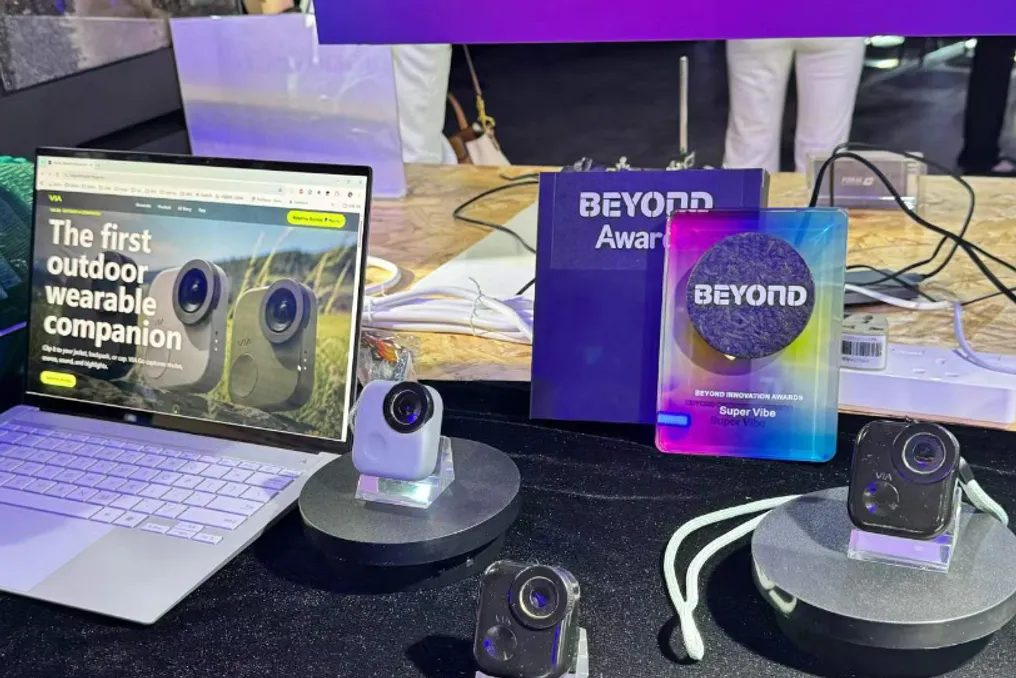
Vibe Technology, a Shanghai-based company, introduced Souvi—an AI-powered memory recording device designed for activities such as hiking, camping, traveling, and city exploration. By combining seamless recording with AI-driven content processing, the product aims to transform disparate photos and videos into more cohesive personal memories.

Unlike traditional action cameras that primarily focus on capturing video footage, Souvi answers a different question: what can people extract from an experience after the trip is over?

Deng Jiawei, the company's CEO, stated in an interview with TechNode: 'We are focusing on AI and personal memory because AI can help people work more efficiently while also offering them new ways to preserve life experiences.'

For many people, travel provides countless memorable moments, but capturing and organizing them requires effort. Taking photos can distract people from the experience itself, and subsequent sorting of material, timeline organization, and video editing can take a long time. A significant portion of this content ultimately remains untouched in phone galleries.

Souvi seeks to eliminate these hurdles. According to the company's product vision, the device captures materials during trips, and AI helps interpret, select, and organize them into curated photos, illustrated travel diaries, videos, or interactive memory pages. The goal is to simplify the user's process of saving and revisiting their experiences.

The slogan 'You live it. Souvi remembers' reflects the idea behind the device, which is designed to record and organize travel memories using AI.

Souvi has been showcased at various tech events, including BEYOND 2026, VivaTech in France, the World Artificial Intelligence Conference (WAIC), and the Hong Kong Electronics Fair HKTDC (Autumn Session). Unlike action cameras that prioritize sports shots, or AI wearables focused on voice interaction and meeting transcription, Souvi targets light outdoor activities and travel.

Deng noted that the initial concept for the product arose from the team's own experiences in hiking and traveling. People want to enjoy the moment while preserving valuable experiences. Souvi focuses on how naturally the device captures everyday events and whether the resulting content can be transformed into meaningful personal memories, rather than just maximizing the volume of recorded material.

The company adheres to a software-first development strategy with parallel hardware development. Its software development team focuses on selecting, understanding, and generating content from raw materials, while the hardware team continues to refine the device and gather data in real-world conditions using prototypes. Both teams work together to improve the overall user experience.

The company also states that its technical work involves adapting and fine-tuning open-source models, utilizing visual understanding capabilities to select travel shots, and developing an internal structure for content generation and task orchestration to organize images, videos, and text into coherent stories.

However, the real challenge is not simply creating an attractive video. It is determining what is worth remembering. An ordinary group photo might capture an important reunion, while a visually stunning clip might hold little personal significance. The AI must understand the connections between different parts of the content while avoiding the fabrication of events that never happened.

In Souvi's vision, it is not just a recording device; it is also an entry point into an operating system of personal memories. In the short term, the team plans to improve the recording and organization experience for individual trips. Over time, the company hopes to integrate content from a larger number of devices and sources, linking moments from different times and places.

Beyond hardware, the company is exploring AI-based content services, including more advanced organization, richer creative capabilities, and more personalized ways to revisit past experiences.

International expansion is also part of the plans. The CEO mentioned that the team is considering Japan, South Korea, and North America, with an initial approach planned through online crowdfunding. However, the company has not yet disclosed purchase data, leaving actual usage frequency, user retention, and willingness to pay as open questions.

This is a practical challenge that Souvi must overcome. A differentiated product concept does not automatically lead to sustainable demand. Whether users are willing to wear the device regularly, whether the AI-organized content provides genuine value, and whether users trust the product with their personal memories will all affect its prospects.

A collection of travel photos and videos may seem mundane today, but years later it could become a significant way to relive an important chapter of life. However, for this vision to become a reality, Souvi must demonstrate that AI can do more than just capture and organize content. It must show that it can help people preserve the memories they truly want to look back on.

Peng Cheng Cloud Brain III begins trial operation with 10,000 petaflops of domestic AI computing
Read more
pandaily.com

Peng Cheng Cloud Brain III begins trial operation with 10,000 petaflops of domestic AI computing

The Peng Cheng Laboratory has commenced the test operation of 10,000 petaflops of domestic artificial intelligence computing power at its large-scale scientific site, Peng Cheng Cloud Brain III, located in Shenzhen. This was announced at the opening ceremony of the World Computing Network Conference 2026 (WCNC 2026), held in the Nanshan district of Shenzhen on October 15 and 16, according to the laboratory's official website.

The laboratory stated that this step transitions Cloud Brain III into the 'construction while operating' phase. Currently, 10,000 petaflops of capacity are online, which are already being used to train large domestic models and function as a specialized AI research network for science, while the remaining capacity is still being installed.

According to the Chinese tech publication IT Home, the fully completed system is planned to reach a capacity of 16,000 petaflops, or 16 EFLOPS, and is described as the largest planned AI computing complex in China. Regarding the architecture, the laboratory's announcement only mentioned that the system utilizes an innovative domestic intelligent supernode architecture designed to eliminate data transmission bottlenecks.

IT Home, citing public reports, noted that Cloud Brain III is built on Huawei's Ascend 384 SuperPoD architecture; however, the laboratory itself did not name the chip supplier in its official release. In late December 2025, the laboratory activated the first phase of computational boards with a total capacity of 4,500 petaflops and associated equipment for testing.

Infrastructure Significance and Development Plans

Lu Yutong, Director of the National Supercomputing Center in Shenzhen, told local media that Cloud Brain III provides the city with a solid foundation for inter-district computational connectivity and broad access to computing services. He also added that high-speed connections will extend to Hong Kong and Macau. This facility is designed as a key node of the China Computing Network (C2NET), a national pilot program that, according to the laboratory director Gao Wen, has been underway for four years.

In his main presentation, Gao outlined the following goal, named ZPG: zettaflop-scale computing, petabit-scale communication speed, and gigawatt-scale green energy. He described a three-stage path for the computing network: integrating computing resources, distributing tasks across regions, and ultimately providing computing on demand, similar to electricity.

Two informational documents were also presented at the conference. One, concerning the development of the global computing network, was prepared by the Peng Cheng Laboratory in collaboration with the WCNC alliance. The second, regarding the coordination of computing and energy systems, was created jointly with the Huairou Laboratory and contains a roadmap until 2035, with the period from 2026 to 2030 focusing on planning and foundational establishment, and from 2031 to 2035 focusing on coordinated operation and system optimization.

Popular