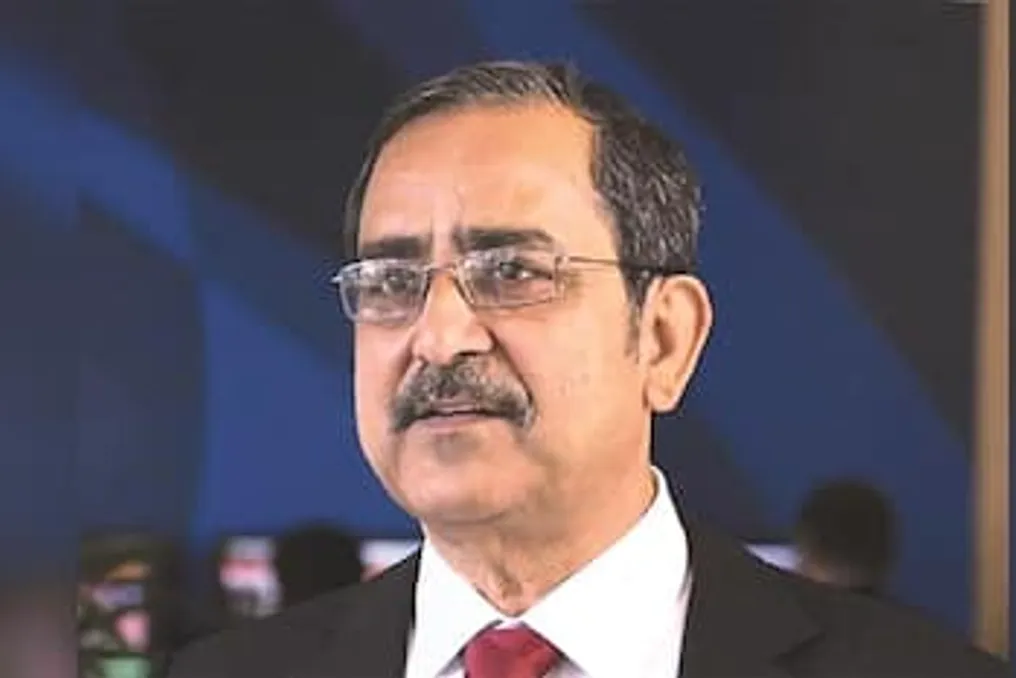
Vice Chairman of NITI Aayog Ashok Lahiri warned against the premature adoption of expansionary measures amidst rising global inflation, El Niño risks, and uncertainty related to the Strait of Hormuz.
Lahiri stated that given the signs of strengthening global inflation, particularly in food and oil segments, as well as the threat posed by El Niño, a sharp intensification of expansionary policy could be inappropriate. He made these remarks in response to media representatives' questions during the CII Banking Colloquium.
During his interaction with journalists, Lahiri noted the general global uncertainty, citing the situation in the Strait of Hormuz and the unknown timing of its opening. He emphasized that if there was a perceived need for government expansionary policy in such a situation, the Monetary Policy Committee (MPC) had already raised the rate. 'I believe it is better to be overly cautious than to regret it,' he said.
He added that global inflation shows signs of 'slight tightening,' especially in food and petroleum prices, and that El Niño also raises concerns, making 'premature expansionary action not very helpful,' in his view.
Earlier the same day, speaking at the CII event titled 'Banks Beyond Lending: Stimulating Industrial Growth in Eastern India,' Lahiri suggested that banks could act as intermediaries, benefiting both the government and themselves by utilizing investment opportunities.
He explained that banks possess extensive knowledge of business opportunities within the state and the state government's activities, beyond just contacts with entrepreneurs and potential investors nationwide. Thus, they can promote state and investor development while simultaneously benefiting from financing some investments through loans.
Lahiri also drew attention to regional disparities in the loan-to-deposit (LD) ratio, which stood at 93.6 percent in the southern region in 2023, compared to the lowest figure of 47.5 percent in the eastern region. Five states in the eastern region—Bihar, Jharkhand, Odisha, Sikkim, and West Bengal—along with the Andaman and Nicobar Islands Union Territory, had an LD ratio ranging from 32.6 to 51.1 percent.
He noted that West Bengal lags behind the technological advancements brought about by successive industrial revolutions. Lahiri stated that this situation needs correction, urging them to 'leapfrog stages and catch up with the world's most efficient producers.' This, in turn, would automatically create demand for investment, income, and wages, and increase credit flows from banks.
He called for the launch of several landmark projects to 'announce the beginning of a new era of growth in West Bengal.' Examples of such projects he cited included establishing a modern deep-sea port and launching a modern industrial park in Singur. According to him, in a state where hopes have waned due to decades of relative decline, such projects would serve as a wake-up call for investors, businessmen, bankers, and the general public.
Furthermore, he urged attracting and facilitating the creation of several new large-scale industrial enterprises. The Vice Chairman of NITI Aayog pointed out that it is cheaper and administratively easier for banks to provide loans to one large enterprise rather than to hundreds of micro, small, and medium enterprises (MSMEs).
Nevertheless, Lahiri stressed that banks play an important role in this process, noting that much still needs to be done in the field of microfinance, where West Bengal is a leader. He reminded that today's industrialists, such as Birla and Ambani, started as small businesses, and banks must play a role in supporting modern MSMEs that will become future major players.