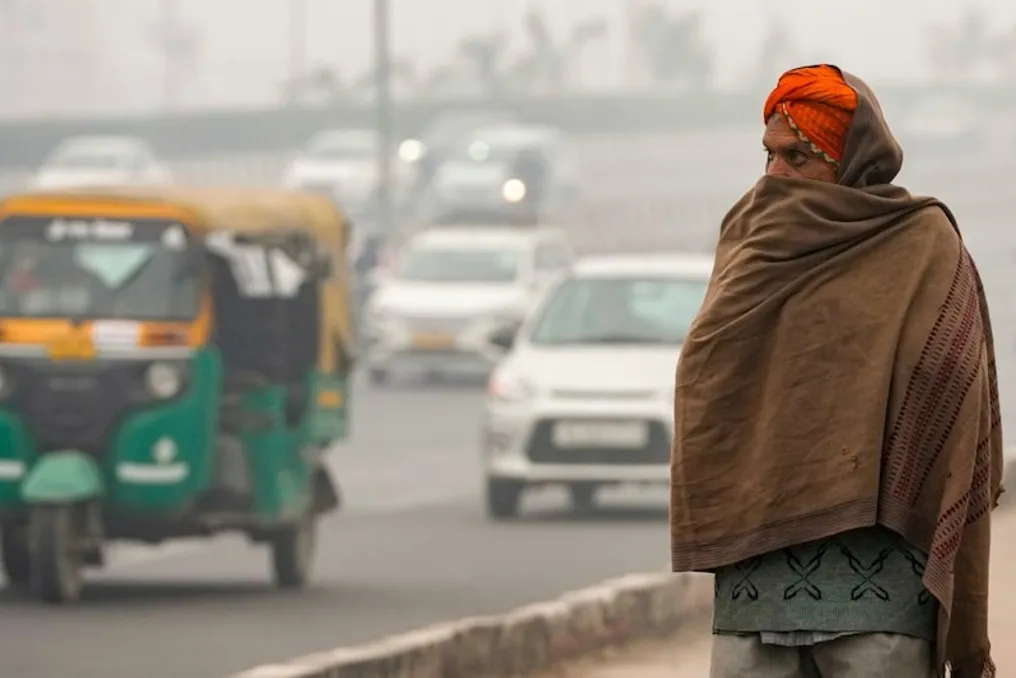
Temperature dropped and air cleared in Delhi-NCR; AQI below 100 in many areas
Read more
Aaj Tak
www.aajtak.in

Temperature dropped and air cleared in Delhi-NCR; AQI below 100 in many areas

According to the Indian Meteorological Department (IMD), Delhi-NCR is expected to have partly cloudy skies this Saturday. The maximum temperature in Delhi is forecasted to be between 26°C and 28°C, and the minimum between 15°C and 17°C. In many parts of Delhi, the minimum temperature will be close to normal, while the maximum is likely to be significantly below normal.

Furthermore, in several areas of Delhi, the Air Quality Index (AQI) is below 150, and in some places, it has even dropped below 100. The Central Pollution Control Board (CPCB) reported that on Saturday morning, the AQI in Alipur and DTU was 135. IIT Delhi recorded a reading of 73, Burari recorded 80, Ashok Vihar recorded 104, Dwarka Sector-8 recorded 86, IGI Airport (T3) recorded 83, Jawaharlal Nehru Stadium recorded 113, and Anand Vihar recorded 116.

For reference, an AQI from 0 to 50 is classified as 'good', from 51 to 100 as 'satisfactory', from 101 to 200 as 'moderate', from 201 to 300 as 'poor', from 301 to 400 as 'very poor', and values from 401 to 500 are considered 'hazardous'.

Regarding the forecast for Sunday, Delhi-NCR is also expected to have partly cloudy skies. The maximum temperature in Delhi is predicted to be between 28°C and 30°C, and the minimum between 16°C and 18°C. Most areas of Delhi will have a minimum temperature near normal on Sunday, while the maximum temperature is likely to be below normal.

The weather department warns of possible rain in various regions of the country. It was noted that on October 30, a low-pressure area formed over the southern part of the Andaman Sea and the adjacent Andaman-Nicobar archipelago. There is a high probability that by October 31, this area will transform into a depression in the southeastern Bay of Bengal and around Andaman-Nicobar and the Andaman Sea. This could lead to heavy rains on the coast of Andhra Pradesh on November 2 and 3, 2026.

It is also forecasted that from October 31 to November 5, precipitation is possible in some areas of Bihar, West Bengal, and Jharkhand, located in the Gangetic plains, as well as in some areas of Odisha. Additionally, localized light rains are expected until November 2 in Himachal Pradesh, Jammu and Kashmir, and Uttarakhand.
Similar stories

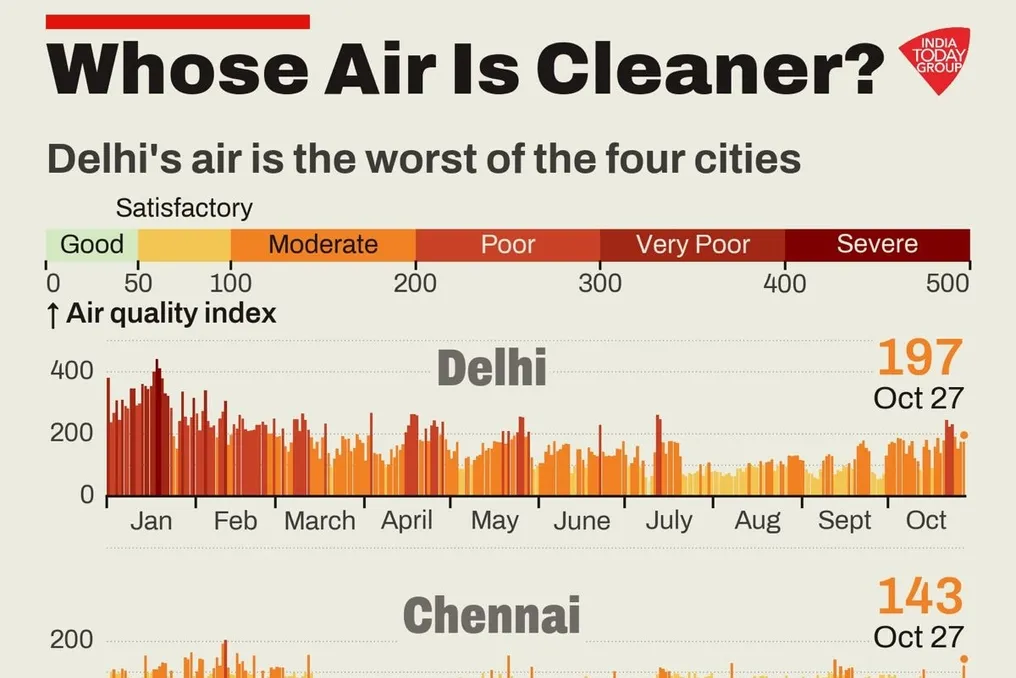
Delhi leads in air pollution among major Indian cities with an AQI of 197
Read more
www.aajtak.in

Delhi leads in air pollution among major Indian cities with an AQI of 197

When comparing the air quality in four major cities in the country, the air in Delhi was the most polluted on Tuesday. According to data from the Central Pollution Control Board (CPCB), the Air Quality Index (AQI) in Delhi was 197. In Chennai, this figure reached 143, in Mumbai it was 99, and in Kolkata it was 81. Thus, Delhi ranked first among all four cities, while Kolkata ranked last.

The AQI is a scale that determines the degree of air purity or pollution in a city; the higher the value, the more polluted the air is considered. This is why on October 27, the air in Delhi appeared the most polluted among all four cities.

The specific figures for the four cities were as follows: Delhi — 197, Chennai — 143, Mumbai — 99, and Kolkata — 81. The AQI in Kolkata was the lowest.

Comparing the data for Delhi and Chennai, it is evident that the AQI in Delhi (197) exceeds the figure in Chennai (143) by 54 points. This gap widens even further compared to the figures for Mumbai (99) and Kolkata (81), indicating that the air in Delhi is more polluted than in the other three cities.

In the CPCB graph, AQI levels are divided into different categories. According to this scale, AQI values from 101 to 200 fall into the 'moderate' category. Based on this, the readings for Delhi (197) and Chennai (143) fell into the moderate category. Meanwhile, the figures for Mumbai (99) and Kolkata (81) were below 100, meaning they did not reach the lower boundary of the moderate category.

It is important to note that the CPCB data is based on the 24-hour average value calculated as of around 4:00 PM on Tuesday.

Delhi air becomes toxic before Diwali: Air Quality Index worsens for the fourth day
Read more
www.aajtak.in

Delhi air becomes toxic before Diwali: Air Quality Index worsens for the fourth day

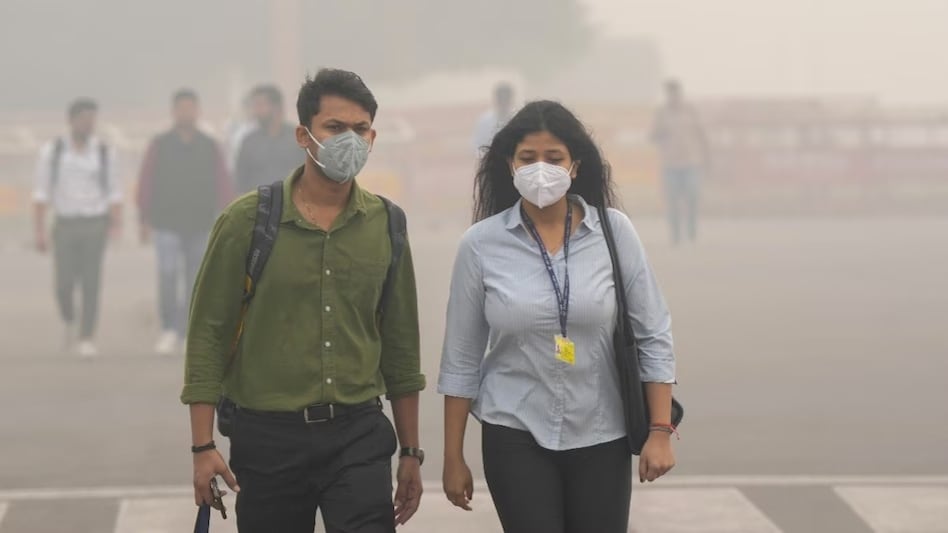
The air in Delhi has once again become toxic shortly before the celebration of Diwali. In the capital, the Air Quality Index (AQI) has been in the poor to very poor range for the fourth consecutive day. In the morning, dense smog and haze were observed in many areas. The deterioration of the situation is linked to weather changes, low wind speed, emissions from transport, and instances of stubble burning in Punjab.

The level of pollution in Delhi began to rise before winter; in areas such as Akshardham, a thick veil of smog was visible in the morning. The AQI in Delhi reached about 230–250, and at some monitoring stations, the air quality reached the 'very poor' category. According to the Central Pollution Control Board (CPCB) standards, an AQI from 201 to 300 is classified as 'poor,' and from 301 to 400 as 'very poor.' This means that even in the 'poor' category, the air can be harmful to health, especially for children, the elderly, and individuals with heart or respiratory diseases.

According to meteorological department forecasts, current weather conditions and wind speed may hinder the dispersion of pollutants, so the possibility of a quick improvement depends on the weather conditions.

A significant factor contributing to the rise in pollution in Delhi is vehicle exhaust fumes. A large number of private cars, diesel buses, and other commercial vehicles operate in the capital. Furthermore, the air quality is worsened by dust from construction work, road dust, and the practice of burning waste.

To control pollution, it is necessary not only to reduce the number of vehicles but also to effectively implement measures such as checking Pollution Under Control Certificates (PUCC), preventing dust on construction sites, and banning open waste burning.

Winds blowing from the northwest also affect the air quality in Delhi. The increase in stubble burning after rice harvesting in Punjab and Haryana can aggravate the pollution problem. To stop stubble burning, state governments must provide farmers with access to machinery and alternative methods to eliminate the need to burn crop residues in the fields.

However, the entire responsibility for Delhi's pollution cannot be placed solely on stubble; numerous factors influence the air quality, including transport, construction activities, road dust, and weather conditions.

To combat pollution in Delhi-NCR, the Commission for Air Quality Management (CAQM) has established phased measures under the Graded Response Action Plan (GRAP). On October 21, 2026, an order was issued to implement the first phase of GRAP measures due to the worsening air quality in Delhi-NCR. The first phase of GRAP is activated when the AQI reaches the 'poor' level (from 201 to 300). Measures taken under this phase include mechanical cleaning of roads, water sprinkling, dust control at construction sites, and a ban on open waste burning. Municipal bodies and relevant agencies are obligated to monitor the implementation of these measures to curb dust and local pollution sources.

In September 2026, CAQM approved a revised GRAP program that includes certain measures related to controlling polluting vehicles in the first phase. These include entry restrictions into NCR and neighboring states for buses meeting BS-IV standards and older.

Particles generated from road dust and construction work play an important role in increasing pollution. According to GRAP, mechanical road cleaning, water sprinkling, and dust prevention measures at construction sites must be carried out. Part of these measures also includes a ban on open waste burning and regular waste collection.

The effect of these rules will only be noticeable with regular inspection of construction sites and action against violators. Coordination between Delhi, Punjab, Haryana, and other NCR states is required to reduce transport emissions, control construction dust, regularly clean streets, and decrease stubble burning incidents.

If wind speed remains low and effective control over pollution sources is not implemented, the situation may worsen in the coming days. Therefore, it is crucial to monitor how strictly governments enforce the directives issued under GRAP and how long the residents of Delhi can breathe clean air.

Air Quality Worsens in Delhi-NCR After Dasara, AQI Exceeds 300
Read more
www.aajtak.in

Air Quality Worsens in Delhi-NCR After Dasara, AQI Exceeds 300

Following the Dasara festival, pollution levels in the Delhi-NCR region significantly increased, reaching hazardous levels. The Air Quality Index (AQI) surpassed the mark of 300 due to smoke from fireworks and stubble burning.

To stabilize the situation, GRAP 1 restrictions were implemented, which prohibit construction work and open waste burning. According to meteorological service forecasts, the situation may worsen in the coming days.

Popular