Tata Motors completes Iveco acquisition, securing 89.42% stake; buyback of remaining shares continues
Read more
Business Standard
business-standard.com

Tata Motors completes Iveco acquisition, securing 89.42% stake; buyback of remaining shares continues

Tata Motors announced the completion of the initial phase of its tender offer for the Italian commercial vehicle manufacturer Iveco Group, acquiring an 89.42 percent stake and thereby bringing the European company under its control. The process of buying out the remaining minority shareholders is ongoing.

The acquisition was executed through a wholly-owned indirect subsidiary of Tata Motors, TML CV Holdings B.V., and involved 238.16 million shares at a price of 14.40 euros per share. According to regulatory filings, following this transaction, Iveco became an indirect subsidiary of Tata Motors.

This development occurred amid objections from some minority shareholders regarding the valuation of Iveco. Investment activist Petrus Advisers questioned the proposed price, arguing that it undervalued the company. In response, Tata Motors increased its offer price from 14.10 euros to 14.40 euros per share earlier this month.

Since approximately 10.58 percent of Iveco's common equity, excluding treasury shares, remains outside Tata Motors' ownership, the company will resume the tender offer for five trading days—from November 2 to November 6. Calculations for shares offered during this additional period are scheduled for November 13.

Tata Motors stated that more detailed information about the post-offer process, including potential voluntary buyback procedures, Dutch legal buyouts, or subsequent spin-off and liquidation, will be announced in due course.

The completion of the initial settlement also brought changes to Iveco's board structure and corporate governance. N Chandrasekaran, Chairman of Tata Sons, has been appointed as the non-executive Chairman of Iveco, while P B Balaji, CFO of Tata Motors Group, and Girish Wagh, CEO of Tata Motors, joined the board as non-executive directors.

Olof Persson will continue to serve as Iveco's Chief Executive Officer. The six-member board also includes independent directors Gunther Butschek and Charles Nichols.

Iveco stated that all outstanding preferred voting shares were bought out without compensation, eliminating their presence after the acquisition. The company also postponed the announcement of third-quarter financial results to November 3 instead of November 5.

This acquisition marks a significant step in Tata Motors' international expansion into the commercial vehicle segment, merging its presence in India and emerging markets with Iveco's established operations in Europe and other international markets.

Iveco, which reported revenues of 13.43 billion euros for calendar year 2025, employs approximately 33,000 people and operates 16 industrial sites and 22 research and development centers. Its business covers trucks, buses, powertrains, and vehicle financing.

Tata Motors noted that this merger will create a more diversified global commercial vehicle business with complementary product portfolios and limited overlap in geographical and industrial operations.
Similar stories

Jio Platforms' stock surge at IPO allows Reliance Group to overtake Tata Group as India's largest conglomerate
Read more
business-standard.com

Jio Platforms' stock surge at IPO allows Reliance Group to overtake Tata Group as India's largest conglomerate

The initial public offering of Jio Platforms led to a significant increase in the value of the company and its parent structure, Reliance Industries Ltd. Jio shares rose by 23% on the first day of trading on Wednesday, providing the company with a valuation exceeding 12.5 trillion rupees ($131.4 billion).

This growth raised the total market capitalization of Reliance Group above 30 trillion rupees, allowing it to surpass Tata Group, whose valuation stood at 25 trillion rupees, according to Bloomberg News. Previously, Tata Group had held the position of market capitalization leader for most of the last decade.

After its listing, which became the largest Initial Public Offering (IPO) in India, Jio also overtook its closest competitor in the telecommunications sector, Bharti Airtel Ltd, becoming the sixth-largest telecom company globally. Currently, Jio is the second-largest company in India by market capitalization, trailing only its parent company, Reliance Industries.

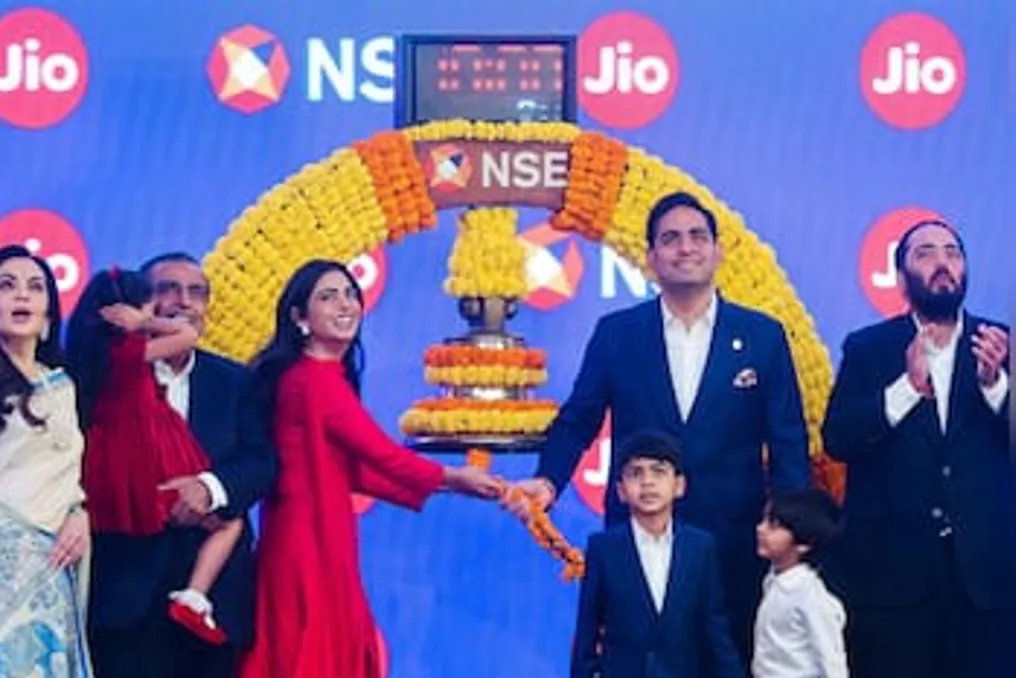
For Ambani, the debut of the offering was a significant moment, as he, along with four generations of his family, from mother to grandchildren, rang the opening bell. The $3.1 billion IPO was fully subscribed in less than 100 minutes and received applications for 22 times the offered shares. This strong market start signaled the potential to overcome the poor momentum of mega-IPOs in India.

Shankar Sharma, founder of GQuant Investech, noted: 'Sometimes a large offering can change the mood of the investing nation, and we all hope that Jio will do this for the Indian market.'

Despite the success, Reliance Industries shares have declined by 25.4% this year, while the benchmark index NSE Nifty 50 has fallen by almost 13.3%. However, the newly listed telecommunications giant must wait several months before it can be included in major Indian stock indices such as the Nifty 50. Stock exchanges must first introduce derivative instruments for the shares for them to become candidates for inclusion in these indices.

Tata Capital's net profit grew by 51% to 1,660 crore rupees in the second quarter of the fiscal year 2027
Read more
business-standard.com

Tata Capital's net profit grew by 51% to 1,660 crore rupees in the second quarter of the fiscal year 2027

Tata Capital announced on Tuesday a 51 percent increase in consolidated net profit, reaching 1,660 crore rupees for the September quarter of the fiscal year 2027. Previously, the company reported a net profit of 1,097 crore rupees for the period from July to September of the fiscal year 2026.

According to the report submitted to the regulatory authority, total income increased by 24 percent, amounting to 4,676 crore rupees in the September quarter of 2027, compared to 3,774 crore rupees for the same period a year earlier.

Rajiv Sabharwal, Managing Director and CEO of Tata Capital, noted that the company's loan portfolio exceeded 3 trillion rupees, highlighting the scale, diversification, and resilience of the company's franchise.

The Assets Under Management (AUM) of this non-banking lender reached 308,030 crore rupees, demonstrating a 26 percent year-on-year growth. Sabharwal also stated that asset quality remained stable, reflecting the company's continuous focus on portfolio quality, prudent underwriting, and effective collections.

Furthermore, in a separate filing with the stock exchange, Tata Capital announced that its board of directors approved a proposal to increase the existing medium-term bond program from USD 2 billion to USD 3 billion. Subject to market conditions, the issuance of foreign currency bonds/debt instruments will be carried out under the MTN Program through external commercial borrowings.

The company operates an all-India network of 1,515 branches, covering 26 states and union territories. Tata Capital shares closed on BSE 0.45 percent higher, at a price of 300.80 rupees per share.

RBI Governor Sanjay Malhotra states that top-tier NBFCs must be listed on stock exchanges
Read more
business-standard.com

RBI Governor Sanjay Malhotra states that top-tier NBFCs must be listed on stock exchanges

Reserve Bank of India (RBI) Governor Sanjay Malhotra announced on Friday that companies classified as Central Investment Companies (CIC) which access public funds, directly or indirectly, are required to register with the central bank. Furthermore, top-tier Non-Banking Financial Companies (NBFCs) must be included in the stock exchange listings.

These statements came amid discussions regarding whether a public offering is required for Tata Sons, the holding company of India's largest conglomerate, the Tata Group.

Malhotra noted at the NDTV World summit in New Delhi: 'We do not answer questions concerning any specific regulated entity.' However, he added that NBFCs and CICs, such as Tata Sons, are required to register with the RBI due to systemic risks. This is because they are at the top of group companies where they can raise funds by using the balance sheets of these companies for repayment.

When separately asked about the rules governing top-tier NBFCs, Malhotra clarified: 'As long as it is an NBFC within our definition, it is a CIC, it has access to funds, directly or indirectly, it is obligated to be registered, and if it is at the top tier, then it is obligated to be listed.' He also emphasized that registration is only not required if the CIC does not have direct or indirect access to public funds.

The central bank classified Tata Sons as a top-tier NBFC in 2022, granting the company three years until 2025 to go public. Instead, the company repaid its outstanding debts and requested the cancellation of its CIC registration. Nevertheless, last month, the RBI rejected this request and demanded that Tata Sons comply with the requirements applicable to top-tier NBFCs.

For its part, Tata Trusts, which controls Tata Sons, proposed merging Tata Electronics Systems Solutions (TESS) and Tata Consulting Engineers (TCE) into a holding company. The goal of this proposal is to avoid an Initial Public Offering by restructuring Tata Sons in a way that, according to the Trusts, would cause it to cease meeting the criteria for an NBFC or CIC. This plan requires approval from the Tata Sons board of directors and consent from the RBI.

Turning to monetary policy, Malhotra stated that the RBI generally does not use interest rates to solve financial stability issues, relying instead on macroprudential measures. However, he did not rule out the possibility of applying monetary policy in certain situations, noting that the decision remains with the Monetary Policy Committee (MPC). He added that the effectiveness of such intervention would depend on the circumstances and would be reviewed by the MPC.

In its latest meeting this month, the MPC raised the key repo rate by 25 basis points to 5.50 percent and changed its stance from neutral to 'calibrated tightening.' The Governor also acknowledged growing cybersecurity risks to the financial system, as banks report data breaches in the dark web. Separately, he expressed concern over the impact of Artificial Intelligence (AI) on financial stability, stating: 'These risks are real. They cannot be ignored, so I will not downplay these risks.'

Malhotra highlighted two main areas of concern: data security and cyberattacks capable of disrupting or disabling systems. He noted that the RBI has a robust regulatory and supervisory system to address both issues, but the rapid pace of software development means vulnerabilities may continue to emerge.

Popular