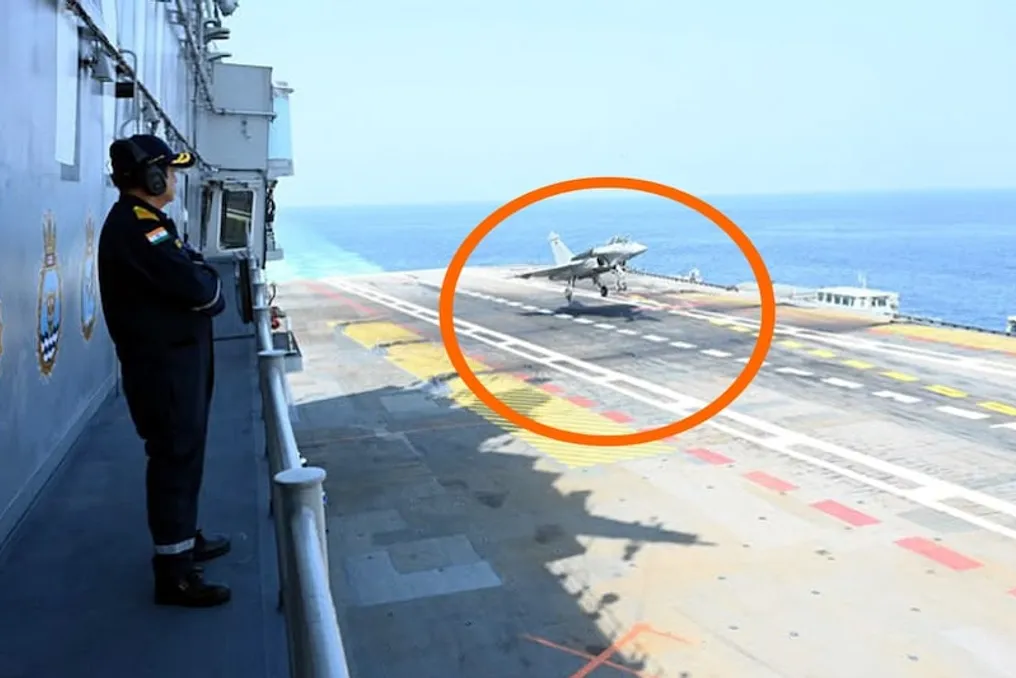
The history of the Indian Air Force marked an important milestone when the French-made Rafale Marin successfully completed its first landing on the domestic aircraft carrier INS Vikrant on October 29, 2026. During tests conducted in the Arabian Sea, the aircraft executed a landing with a 45,000-ton aircraft carrier.
This landing was flawless and met all theoretical requirements. It is the first time that the naval version of the Rafale (Rafale-M) has been operated from an Indian aircraft carrier. The successful landing demonstrated the complete compatibility of this aircraft with the Short Take-Off But Arrested Recovery (STOBAR) system of the Vikrant carrier.
These tests represent the first significant step towards incorporating the Rafale Marin into the Indian Navy. INS Vikrant is the first domestically built aircraft carrier in the country. The commencement of operations of modern combat aircraft on it will multiply the fleet's potential. It is planned to make the Rafale Marin the main element of the Vikrant's air wing. These aircraft will gradually replace the outdated MiG-29K fleet, leading to a significant improvement in the navy's maritime combat capabilities.
The Indian Navy has ordered approximately 26 Rafale Marin aircraft from France under a government contract worth approximately 63 thousand crore rupees. This order includes 22 single-seat and 4 two-seat training variants. The aircraft are equipped with an advanced AESA radar, as well as modern weapon systems such as Beyond Visual Range missiles, Exocet anti-ship missiles, and Scalp cruise missiles.
Thanks to these systems, the fleet will gain the ability to conduct high-precision long-range strikes in the Indian Ocean against enemy targets or vessels. The Rafale Marin is already successfully operated on the French Navy's nuclear aircraft carrier Charles de Gaulle, confirming its effectiveness in carrier operations. Currently, the Indian Navy is working on integrating these aircraft into its systems.
During the current tests, aspects such as landing, takeoff, deck maneuvering, and integration with Vikrant's domestic systems are being verified. Night landings, weapons integration, and the process of obtaining full operational clearance will follow. These tests are necessary because each aircraft carrier has its own characteristics. The Vikrant's STOBAR system is based on catapult take-off and arresting wire landing. The successful integration of the Rafale Marin proves that both the technology and the training are on the right track.
This successful landing is a major step towards fully preparing INS Vikrant for combat operations. The Navy aims to become a blue-water force capable of conducting operations in the open sea. Amid growing challenges in the Indo-Pacific region, an aircraft carrier equipped with modern combat aircraft will provide a strategic advantage to the fleet. The long range and powerful weapon systems of the Rafale Marin will increase the presence and influence of the navy in the Indian Ocean. This victory also demonstrates the successful operation of an advanced foreign aircraft on a domestic platform. After the start of Rafale operations on Vikrant, there will be a qualitative change in the naval aviation power. Replacing the MiG-29K with modern aircraft will reduce maintenance issues and increase operational readiness. Thus, the landing on October 29th became the pride of the Indian Air Force and a solid foundation for future preparation.