
Government notifies National Social Security Council on gig and platform workers
Read more
YourStory [india, en]
yourstory.com

Government notifies National Social Security Council on gig and platform workers

The Ministry of Labour and Employment announced the creation of a National Social Security Council for unorganized, gig, and platform workers. This step aims to ensure comprehensive social security for India's vast informal workforce.

The Council will be responsible for developing, monitoring, and making recommendations on targeted social security schemes designed to bridge gaps in social protection.

Gig workers are those who earn income from activities or participation in work agreements outside traditional employer-employee relationships. Platform workers are those who work through or in conjunction with online platforms.

The establishment of this Council is part of the legislative framework of the Code on Social Security and marks a historic shift by integrating digital specialists of the gig and platform economy into India's official welfare system.

The Minister of Labour and Employment will chair the Council, and its composition will include representatives from central and state bodies, major aggregator companies, employers, civil society organizations, workers' unions, as well as associations of gig and platform workers.

The main task of the Council is to develop, oversee, and propose targeted support programs for millions of gig and platform workers, as well as traditionally unorganized workers, to compensate for the deficit in social protection.

The National Social Security Council must hold meetings at least three times a year and adhere to the rules of conduct at meetings established by the Central Government.

The Council is obliged to recommend to the Central Government the development of suitable schemes for various groups of unorganized, gig, and platform workers. Furthermore, it will advise the Central Government on issues arising during the administration of this Code and supervise social programs managed by the Central Government.

The Council will also analyze record-keeping functions at the state level and audit expenditures from funds and accounts. In addition, it will perform other functions assigned to it from time to time by the Central Government.

Similar stories

India launches plan worth 99,446 crore rupees to transform the formal labor market
Read more
timesofindia.indiatimes.com

India launches plan worth 99,446 crore rupees to transform the formal labor market

The Indian government has set a target to create over 35 million jobs within two years, including 19.2 million first-time entrants into the workforce. The central government program, named Pradhan Mantri Viksit Bharat Rozgar Yojana (PMVBRY), is designed to stimulate formal employment by providing financial incentives to both employers and employees.

This scheme provides payments to initial employees hired for positions under the jurisdiction of the Employees’ Provident Fund Organisation (EPFO). Furthermore, the program rewards companies that increase their staff and retain new workers.

It should be noted that these targets are governmental plans, not independent assessments of expected job creation.

In India's employment structure, agriculture remains the largest employer, providing work for 43 percent of the workforce. Industry accounts for 12.1 percent, construction for 12 percent, trade, hospitality, and restaurants for 12.9 percent, transport, storage, and communications for 5.8 percent, and other services for 13.1 percent. Mining and quarrying make up 0.3 percent, while electricity, water supply, and related services account for 0.7 percent.

A study titled 'Looking Through Employment Elasticities' showed that in most of the 55 organized manufacturing sectors studied since the mid-2000s, employment elasticity was above 0.5. Employment elasticity measures the relationship between production growth and employment growth. However, the same study found that over 40 percent of new employment created between 2008 and 2017–18 was contract employment. It is important to emphasize that the results apply only to organized manufacturing and cannot be automatically applied to the entire sector.

Specific compliance criteria are set for employers. Workers earning less than 10,000 rupees receive 10 percent of their salary, up to a maximum of 1,000 rupees. For those earning between 10,000 and 20,000 rupees, the amount is 2,000 rupees. For incomes exceeding 20,000 rupees, the incentive reaches 3,000 rupees, provided the gross wage cap is observed.

Incentive payments are made as semi-annual lump sums after completing the relevant six months of work and submitting an electronic application with reporting. The employee must remain with the same employer for at least six months, provided contributions are received during this period. Employers are also required to maintain a minimum threshold of net additional hiring. Companies with a base staff of less than 50 people must hire at least two additional employees, while those with a base staff of 50 or more must add at least five. Incentives are not accrued for months when the corresponding threshold has not been met.

City blames administrative errors for delays in payments to 34 EPWP program workers
Read more
iol.co.za

City blames administrative errors for delays in payments to 34 EPWP program workers

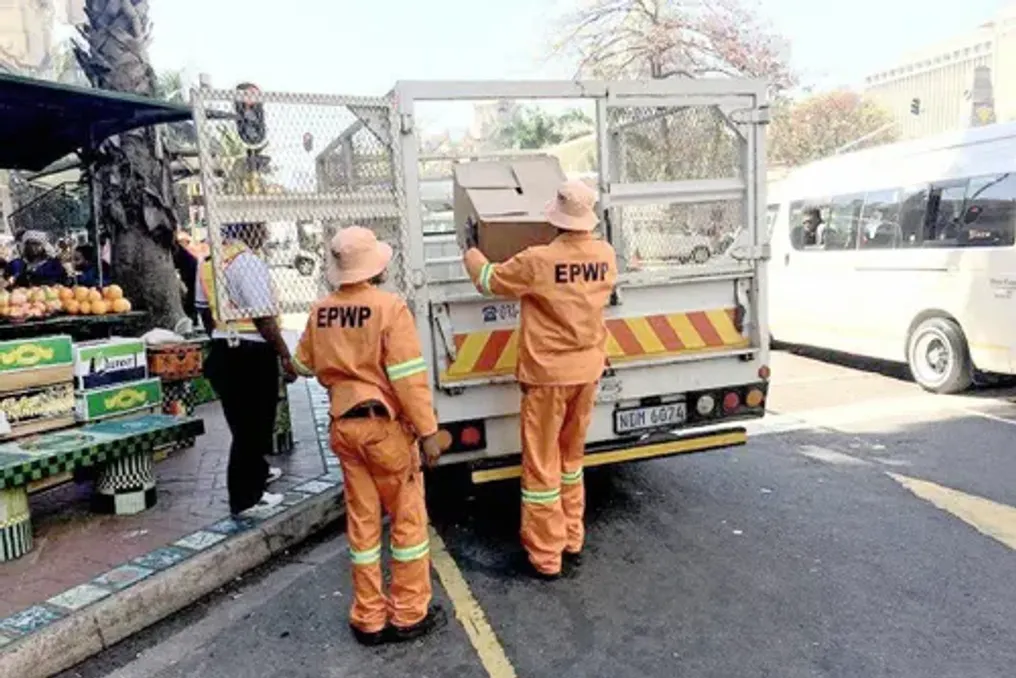
The City of Cape Town attributed the six-week delay in payments to 34 employees of the Expanded Public Works Programme (EPWP) to administrative errors and incorrect bank details. However, both the workers and a community activist rejected this explanation, accusing officials of trying to shift responsibility instead of admitting their mistakes.

Workers engaged in the City's Parks and Recreation Department pool project in the Hanover Park, Mitchells Plain, and Manenberg areas did not receive their wages for six weeks, forcing their families to take out loans to cover basic needs.

Following media inquiries, the City confirmed that 34 participants were affected: 33 were due their first payment on October 10th, and one on October 24th.

Workers dispute the City's explanation

The City stated that all overdue wages would be credited to the workers' bank accounts by Friday, October 30, 2026. The Parks and Recreation Department expressed deep regret over the difficulties faced by EPWP staff and treated the matter with the utmost seriousness.

The delays were cited as being caused by incomplete or unclear identification information, erroneous bank details provided by applicants, and data upload errors. Nevertheless, community activist Yumna Alexander, who was assisting the affected workers, firmly refuted the City's version, insisting that discrepancies in identification and banking information had been resolved earlier.

Activist raises questions about accountability

Alexander questioned how such payment issues could affect workers across five different pools, arguing that the situation pointed to a broader administrative failure. She emphasized that there is documentary evidence because the issue concerns five different pools, not just one.

One of the affected workers also did not accept the City's explanation, noting that it was hard to believe that incorrect personal data caused the delays, as such inconsistencies should have been identified during the initial registration phase. The worker explained that participants were required to provide certified copies of identification documents and certified bank details before being entered into the City's database.

He asked why the alleged discrepancies were not noted and rectified before the workers started, but were raised weeks after the payments were already overdue. Alexander accused the municipality of portraying the workers as incompetent instead of taking responsibility. She urged: 'If you made a mistake, admit it, be honest.'

The activist added that the workers were repeatedly informed of different payment dates, yet the money never arrived. Previously, Alexander clarified that the workers earn 145 rand per day and were forced to borrow money for necessities such as bread, milk, and diapers.

City denies financial mismanagement

Meanwhile, the City insisted that the necessary funds were available and denied allegations of financial mismanagement. The department confirmed that there was no financial mismanagement in this matter.

In response to claims that worker complaints went unanswered, the department apologized for any lack of communication, stating that an immediate response was given as soon as the issue was officially received by the EPWP Unit. It was confirmed that the electronic fund transfer process had been initiated, and internal escalation procedures would be reviewed to ensure complaints reached senior management faster.

Alexander questioned how the municipality could celebrate clean audits while workers providing community services struggled to receive their wages. She insisted that her intervention was not politically motivated but was a matter of humanity.

Popular