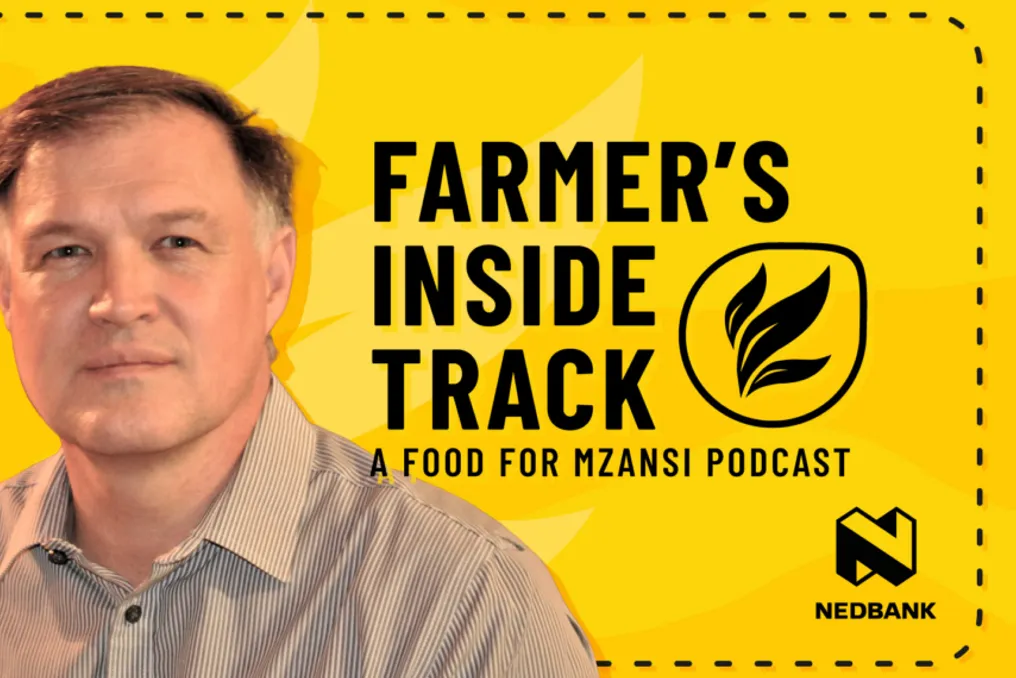
Cobus de Bruyn from Nedbank argues that significant agricultural transformation must go beyond mere land redistribution and focus on creating productive, profitable, and commercially viable farming enterprises. He details the obstacles faced by Black farmers, the necessity of blended finance, and the importance of strengthening partnerships across the agricultural value chain to achieve long-term change.
According to Cobus de Bruyn, Head of Value Proposition for Agriculture Clients at Nedbank, a more inclusive economy in South Africa is necessary to create opportunities for new entrants, develop smallholder farmers into sustainable commercial enterprises, and support the growth of large agribusinesses owned by Black owners. He believes that true transformation should be measured by the success of the farms, not just by land ownership metrics.
Speaking on the Food for Mzansi’s Farmer’s Inside Track podcast, De Bruyn highlighted the progress made since 1994, the ongoing barriers for farmers, and the critical importance of collaboration within the agricultural value chain.
He stated that South Africa needs a more inclusive agricultural economy that can attract new participants and transform small farmers into commercially sustainable businesses while supporting the growth of large-scale agribusinesses owned by Black owners.
De Bruyn identified six drivers for achieving inclusive agriculture: expanding production and stimulating growth, building a broader and more resilient agricultural economy, improving access to finance, markets, and technology, job creation, enhancing resilience and climate adaptability, and boosting South Africa's international competitiveness.
In his view, transformation must build upon existing commercial agriculture while opening real opportunities for farmers across the sector. He emphasized that inclusive agriculture should be measured not only by land transfer or the number of Black farmers, but by how many farmers manage to become productive, profitable, creditworthy, and commercially sustainable.
De Bruyn acknowledged that progress has been made in land transfer in South Africa since 1994. He referenced a 2024 study by Vandile Sikhlobo and Professor Johan Kirsten. According to this study, approximately 19.3 million hectares have been transferred through various mechanisms, accounting for 25% of the country's available agricultural land. These mechanisms included restitution, government land redistribution, private deals, Proactive Land Acquisition Strategy, and government acquisition for agricultural use.
Nevertheless, he countered that land ownership alone does not guarantee long-term economic transformation. Secure title deeds are particularly important as land has the potential to generate wealth across generations, supporting business development and creating additional income.
Addressing this issue, De Bruyn mentioned the argument by Minister of Agriculture Willie Aukamp that transformation cannot be achieved by lifting one part of the sector at the expense of another. He noted that the solution lies in simultaneously uplifting both parts, with the one requiring more attention and resources being accelerated.
He also welcomed President Cyril Ramaphosa's announcement of 2.5 million hectares being transferred to farmers, stressing that careful planning will be required to ensure these lands reach people who can utilize them productively. Nedbank is ready to contribute its expertise to this process, aiming to ensure that transferred land genuinely goes to farmers capable of running operations and that these farmers turn their farms into productive enterprises.
One of the hurdles to transformation, according to De Bruyn, is the terminology used to describe farmers who are still developing their businesses. He opposes the term 'emerging farmer,' believing it risks defining people by what they have not yet achieved rather than recognizing them as farmers. Instead, De Bruyn prefers to refer to them as small, medium, and large commercial farmers. For him, a farmer who produces surpluses and sells them commercially qualifies as a commercial farmer.
He listed several challenges facing farmers, including access to suitable land and secure tenure, delays in title deed transfer, affordable financing, water infrastructure, technical skills, extension services, machinery, production technologies, and market access. However, access to finance remains a particularly acute problem.
De Bruyn reported that commercial banks participated in developing a conceptual document on blended finance with the Department of Agriculture but were largely excluded from this scheme. This limits their ability to finance Black farmers at various stages of commercial development. He explained that a new farmer often lacks the financial backing available to established businesses. Without grants or subsidized loans in addition to commercial financing, growth can slow down. He insisted on the need for access to blended finance to support the government's efforts in implementing transformation.
For De Bruyn, meaningful transformation requires coordinated efforts between the government, organized agriculture, commercial farmers, financiers, and other value chain participants. He stressed that partnerships are crucial for building a sustainable and inclusive agriculture, demanding coordinated action.
He believes that collaboration between commercial banks and the government could yield substantial benefits, especially if they are included in blended finance schemes. Such cooperation could help create new farming enterprises and allow existing African businesses to expand. Partnerships across the value chain can also help farmers overcome barriers in markets, production, and commercial growth.
Nedbank implements this approach through a differentiated inclusive agriculture strategy, investing in resources and processes to support transformation. De Bruyn noted the bank's collaboration with PALS (Partners in Agricultural Land Solutions), under which farmers receive support in training and mentorship, company structuring, legal agreements, and equity arrangements. This partnership also helps farmers gain market access, apply for water rights, and direct loan applications to financiers.
He observed that this collaboration has already yielded significant benefits through transformation projects, allowing the bank to see results on the ground rather than just discussing transformation in theory. Nevertheless, he believes the impact could be greater if commercial banks were included in the blended finance scheme.
Looking ten years ahead, De Bruyn hopes that South African agriculture will reach a point where transformation ceases to dominate the conversation because its results will be evident in thriving farms. His vision is an agricultural sector with active small, medium, and large Black farming operations that can access finance, reach markets, and overcome current growth constraints. For him, the goal is not merely land transfer or increased participation on paper, but building enterprises capable of producing, generating income, creating opportunities, and growing sustainably. He concluded that the path forward depends on the collaborative work of stakeholders to develop agriculture.