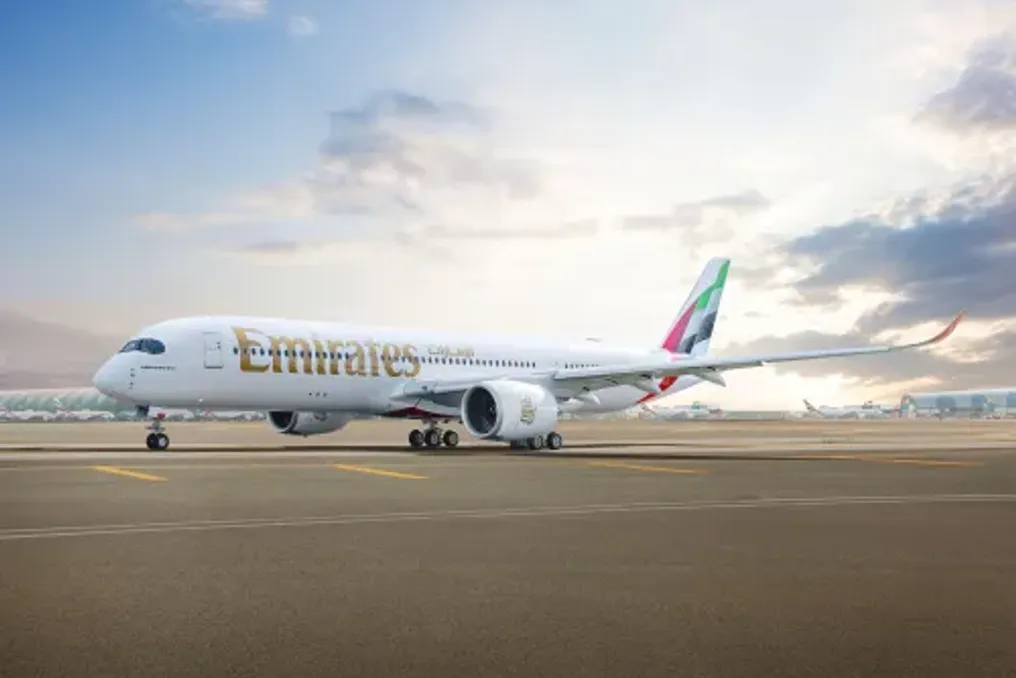
Emirates to introduce A350 aircraft on Durban routes, enhancing long-haul services
Read more
IOL
iol.co.za

Emirates to introduce A350 aircraft on Durban routes, enhancing long-haul services

Passengers from Durban will receive a new option for long-haul flights as Emirates plans to put its Airbus A350 aircraft into service. This aircraft will be used on the daily route between Dubai and KwaZulu-Natal starting March 1, 2027.

The introduction of this airframe will provide the latest aircraft and the acclaimed Premium Economy cabin to King Shaka International Airport, completing the rollout of this configuration across all three South African hubs of the airline.

The A350 will operate on the daily flight EK 775/776 Emirates, offering passengers departing from Durban the opportunity to enjoy an enhanced onboard experience when connecting in Dubai to international destinations.

Popular destinations include Thailand, Indonesia, India, France, and the United Kingdom, as well as other points in the airline's global network. This move follows the introduction of Emirates Premium Economy on flights to Cape Town and Johannesburg in September 2025.

According to the airline, demand for this cabin has been consistently high over the past twelve months, attracting both tourists and corporate passengers. A significant portion of international travel from Durban is related to visiting friends and relatives abroad, and Emirates states that the new aircraft will allow these travelers to enjoy Premium Economy throughout the long journey, including subsequent connections through Dubai.

Afzal Paramabale, Emirates Regional Manager for South Africa, expressed anticipation for meeting passengers from Durban aboard the A350. He stated that the company eagerly awaits welcoming travelers from Durban onto the A350 in the new year, where they can experience the elevated level of onboard amenities and Emirates' signature service, which makes this aircraft a favorite among passengers.

Paramabale also noted that this deployment reflects the airline's commitment to South Africa, which remains an important part of its African network. He added that South Africa is a key point in the African network, boasting some of the world's busiest hubs, and the company strives to continuously improve the travel experience for its customers by offering them more choice, connectivity, and comfort.

The A350 represents the newest type of aircraft in Emirates' wide-body fleet. It features an updated cabin design, onboard technology, and entertainment options with an emphasis on passenger space and comfort.

For passengers from Durban, one of the main innovations will be the introduction of the airline's Premium Economy cabin. This cabin features soft cream leather seats designed to provide extra legroom and recline compared to Economy class. Passengers also gain access to in-seat charging ports, a wooden-finished side table, and a 13.3-inch personal entertainment screen. The cabin configuration is 2-4-2, making it suitable for families or passengers desiring more space on long journeys.

Premium Economy passengers flying from King Shaka International Airport will also have access to a dedicated check-in desk and priority boarding. Baggage allowance includes 35 kg of checked baggage and 10 kg of carry-on luggage.

In Business Class on board the A350, there is a 1-2-1 configuration, ensuring each passenger has direct aisle access. The cabin is equipped with fully reclining cream leather seats, as well as personal mini-bars and wireless charging. A special snack area at the rear of the cabin allows passengers to serve themselves drinks during the flight.

Economy class is decorated in shades of sky blue, bronze, and cream, complemented by lighter wood elements. The aircraft's high ceilings and ambient lighting are designed to create a more spacious and relaxing atmosphere in the cabin.

Passengers on board will have access to Emirates' updated in-flight entertainment system, which offers over 6500 channels of content, including movies, series, music, podcasts, and digital newspapers. Updated navigation, control, and search functions are intended to facilitate finding entertainment content during travel. Furthermore, the A350 allows passengers to connect their Bluetooth headphones to the entertainment system.

Emirates reports that the in-flight dining offering will continue to feature exquisite chef-prepared dishes alongside beverage selections. The airline also offers South African wines on its international routes. Among them are Journey’s End Weather Station Sauvignon Blanc 2025, produced at a family vineyard near Stellenbosch and served in Economy class, and Vilafonté Series C 2016, which is served in First Class.

With the arrival of the A350 in Durban, Emirates expands its latest cabin experience for travelers across all three South African hubs, offering passengers greater choice when planning international trips via Dubai. The aircraft is scheduled to commence operations on the Durban route on March 1, 2027.

Similar stories

IATA призывает авиационную отрасль использовать цифровизацию для повышения удобства пассажиров и финансовой устойчивости
Read more
uzdaily.uz

IATA призывает авиационную отрасль использовать цифровизацию для повышения удобства пассажиров и финансовой устойчивости

The International Air Transport Association (IATA) has issued a strong appeal to the aviation sector, urging it to convert advancements in digital airline retailing, payment systems, and digital identity into concrete advantages for travelers and enhanced financial stability for airlines.

This directive was delivered on October 28th by Sandrine Le Borgne, who holds the positions of IATA's acting Director General, Chief Financial Officer, and Senior Vice President for Corporate Services. She made this statement during the opening of the association's World Financial Symposium and World Passenger Symposium, which took place in Macau, according to IATA.

Le Borgne highlighted the current technological landscape, noting that modern travelers can utilize AI to plan trips, employ digital wallets for payment, and use biometrics to expedite movement through airports. However, she stressed that the current focus must shift to realizing the full potential value of these innovations.

Вызовы для отрасли

She characterized 2026 as a period marked by substantial instability within the aviation industry. This volatility stems from conflicts causing airspace restrictions and route disruptions, a doubling of jet fuel prices year-over-year, and incomplete recovery of aerospace supply chains.

Despite airlines transporting over five billion passengers annually, projections indicate that in 2026, they might only generate US$4.5 per passenger, resulting in a net profit margin of roughly 2%. Le Borgne cautioned that even minor increases in expenses or drops in demand could easily transform profitability into losses.

The integration of artificial intelligence assistants and automated agents is fundamentally altering how consumers search for and compare flight options. IATA recognizes that these shifts present both opportunities and inherent risks for carriers.

Airlines are required to adapt to these evolving conditions while simultaneously ensuring they retain complete oversight of their data, commercial partnerships, and the caliber of information supplied to clients.

Переход к современной розничной торговле

IATA deems the migration toward Modern Airline Retailing, structured around the Offers and Orders framework, as crucial for successfully navigating the shifting market dynamics. Currently, seven airlines are either utilizing or implementing Orders systems, with expectations that over twenty other carriers will adopt them starting in 2027. Technology firms have committed over US$1.7 billion to developing the necessary Offers and Orders functionalities.

Le Borgne asserted that "Offers and Orders are the foundation, and AI is the accelerator." Furthermore, IATA underscored the necessity of incorporating financial planning into the digital transformation process from its very inception.

Given that airlines spend upwards of US$24.5 billion each year on payment processing, new payment solutions, while offering customers more choices, also impact operational expenditures, cash flow management, and financial risk exposure. As airlines move towards Offers and Orders, processes such as revenue accounting, settlement, and reconciliation must be integrated from the start.

IATA suggests that the primary goal should be the elimination of superfluous complexity rather than merely digitizing processes that already exist.

Цифровая идентификация и стандартизация

Biometric identification is becoming a more frequent element of air travel. Nevertheless, many existing biometric systems are confined to operation at single airports or within specific national borders, thereby restricting their wider applicability. IATA proposes a comprehensive, industry-wide remedy known as the One ID concept, which allows passengers to verify their identity just once and subsequently be recognized throughout their entire journey.

Sandrine Le Borgne announced that Hong Kong International Airport and Air New Zealand were among the initial entities to achieve One ID certification. Standards for secure digital passports are already established, with the International Civil Aviation Organization (ICAO) having created specifications for digital travel credentials.

IATA reports that more than eight out of ten passengers would prefer to use a digital passport when checking in for flights. Le Borgne clarified that while digital passports hold transformative potential for international travel, this transformation hinges on governments being ready to issue and accept them, as airlines lack the authority to issue passports.

Перспективы в Азии

The two IATA symposiums marked a first for the organization, being hosted in North Asia. IATA pointed out that Chinese airlines transported a record 770 million passengers in 2025, indicating that China's aviation market still possesses significant room for expansion. Le Borgne commented that "China's leadership is not defined by scale alone. The country is also at the forefront of digital innovation."

She concluded by calling upon the entire aviation industry to uphold and continuously develop consistent global standards as technological progress continues.

Cape Town–Johannesburg route surpasses New York–Los Angeles in passenger traffic in 2025
Read more
iol.co.za

Cape Town–Johannesburg route surpasses New York–Los Angeles in passenger traffic in 2025

The Cape Town to Johannesburg route became the busiest air connection in Africa in 2025, transporting 3.4 million passengers. This figure significantly exceeded the number of passengers on the New York–Los Angeles route in the United States.

According to the International Air Transport Association (IATA) report 'Global Air Transport Statistics for 2025,' which analyzes differences in passenger flow between major domestic air routes worldwide, this superiority of the African direction was established.

The busiest route in South Africa connects two key economic and tourism centers of the country. Nevertheless, it remains smaller in scale than leading global domestic air routes, especially in Asia, where passenger flows are substantially higher.

Leaders of Global Air Transport

In 2025, the busiest airport connection globally was the Jeju–Seoul Gimpo line from South Korea, which accommodated 13.3 million passengers. All ten most popular airport pairs worldwide were domestic routes: nine of them were located in the Asia-Pacific region, and the remaining connection linked Jeddah and Riyadh in Saudi Arabia.

As noted in the report, 'The Asia-Pacific region dominated the ranking of the world's busiest airport pairs, with the route between Jeju International Airport and Seoul Gimpo International Airport (CJU-GMP) remaining the most popular globally, with 13.3 million passengers traveling between these two airports.'

In Latin America, the busiest route was between Bogota and Medellin in Colombia, serving 3.5 million passengers. The busiest connection in Europe was between Barcelona and Palma de Mallorca in Spain, recording 2.1 million passengers.

United States Remains the Largest Passenger Transport Market

The report also ranked countries based on the total number of passengers. The United States maintained its status as the world's largest passenger transport market, registering 890.1 million arriving and departing passengers in 2025. This represents a growth of 1.6% compared to the previous year.

However, despite its status, the US showed the slowest growth rate among the ten largest markets in the world, showing an increase of only 1.6% year-on-year compared to 2024. China took second place as the largest passenger transport market with 776.1 million passengers in 2025, an increase of 4.8% relative to 2024.

China ranked second with 776.1 million passengers, increasing by 4.8% compared to 2024. The UK ranked third with 269.7 million passengers, showing a growth of 3.4%, and Spain recorded 252.7 million passengers, corresponding to an increase of 5%.

Popular