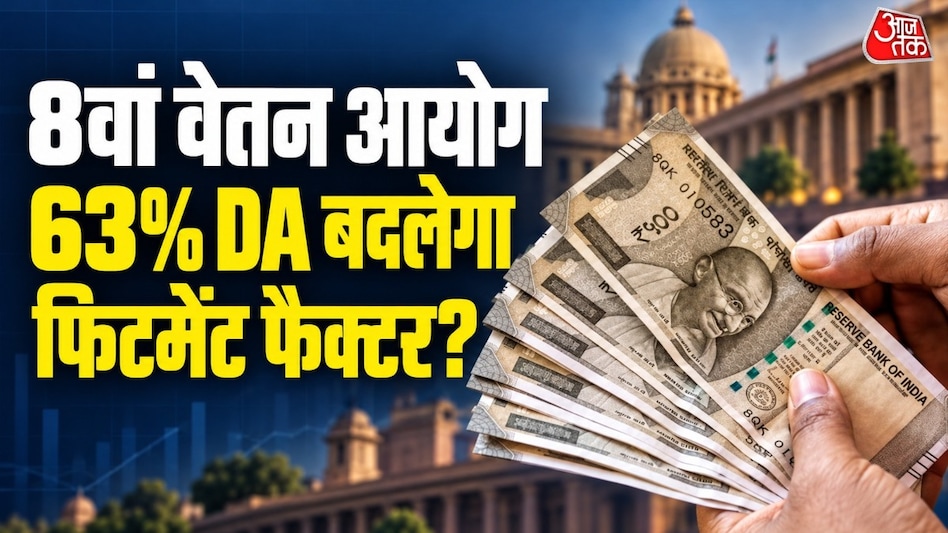
The central government has approved a 3% increase in the Dearness Allowance (DA) for civil servants, raising it to 63% of the basic pay. This change will take effect on July 1, 2026, and employees will receive an advance payment (arrears) for four months from July to October.
The decision was made by the Central Cabinet on Wednesday before the holidays. Simultaneously, the Dearness Allowance for pensioners (DR) has also been increased by 3%, reaching 63% of the basic pension. This will positively affect approximately 48.54 million central employees and 68.71 million pensioners.
Consider an example: a level-one employee with a basic salary of 18,000 rupees previously received 10,800 rupees monthly with a DA of 60%. Now, with a DA of 63%, this amount will increase to 11,340 rupees, representing a monthly increase of 540 rupees. The advance payment for four months will be 2,160 rupees. This is the second DA hike in 2026; earlier in April, the government raised the DA from 58% to 60%, effective January 1, 2026.
The total annual cost of DA and DR for the government will be around 10,016.10 crore rupees.
The increase in DA affects the calculation of salary hikes under the 8th Pay Commission. To understand this, one must grasp the meaning of the fitment factor. The fitment factor is a multiplier used to convert the basic pay from the old pay commission to the basic pay of the new commission. When a new pay commission is introduced, the old DA is adjusted into the new basic pay.
In this process, the DA starts from zero, and the previous indexation is incorporated into the new basic pay. Consequently, the entire fitment factor does not become the actual salary increase for the employee, as part of it is compensated by the existing DA. The actual increase is determined by the portion of the fitment factor that remains after this compensation.
The 7th Pay Commission came into effect on January 1, 2016, when central employees were provided with a DA of 125%. The Commission set the fitment factor at 2.57. Of this, 2.25 was used to compensate for the old DA, and the remaining 0.22 ensured an actual salary increase of approximately 14%. Now, with DA reaching 63%, employees receive the basic pay plus DA, totaling 1.63 times the basic pay. If the fitment factor is less than 1.63, the new basic salary may end up lower than the total of the current basic pay and DA.
To ensure an actual increase of approximately 14%, similar to the 7th Pay Commission, a fitment factor of about 1.86 will now be required. With a DA of 60%, this same level could have been achieved with a factor of about 1.83. Thus, to maintain the previous level of actual salary increase, the fitment factor will also need to be increased after the new 3% DA hike.
For a level-one employee with a current basic salary of 18,000 rupees, the total of basic pay and DA after adding 63% DA will be 29,340 rupees. The difference between the new basic salary at various fitment factors and the current total can be illustrated as follows.
It is important to note that the figures presented in the table should not be considered the total amount payable. Actual salary also depends on other allowances, deductions, and applicable rules. Levels such as 2.57, 2.86, 3.00, and 3.833 are potential values currently being discussed, not final figures approved by the government or the commission.
After increasing DA from 60% to 63% while keeping the same fitment factor, the percentage of actual increase slightly decreases. For instance, with a factor of 1.86, the actual increase was about 16.3%, whereas now it will be about 14.1%. Similarly, with a factor of 2.57, the actual increase drops from approximately 60.6% to 57.7%. The difference between various fitment factors ranges from 2.2 to 4.4 percentage points.
Generally, the higher the fitment factor, the greater the difference in percentage will be visible upon an increase in DA. Therefore, the DA hike should be viewed as immediate relief for employees, but it cannot be assumed to guarantee the same additional actual salary increase under the 8th Pay Commission. The final benefit will depend on the commission's recommendations, government decisions, and the established fitment factor.
If DA increases again by 3% in January 2027, reaching 66%, then to ensure an actual increase of approximately 14%, similar to the 7th Pay Commission, the fitment factor would need to be about 1.90. This indicates that this calculation may continue to change as DA rises.
The 8th Pay Commission, formed in November 2025, is headed by the senior Supreme Court judge Ranjan Prakash Desai. The Commission has been given 18 months to submit its report, so the report is expected by May 2027. Currently, the commission is negotiating with various stakeholders.