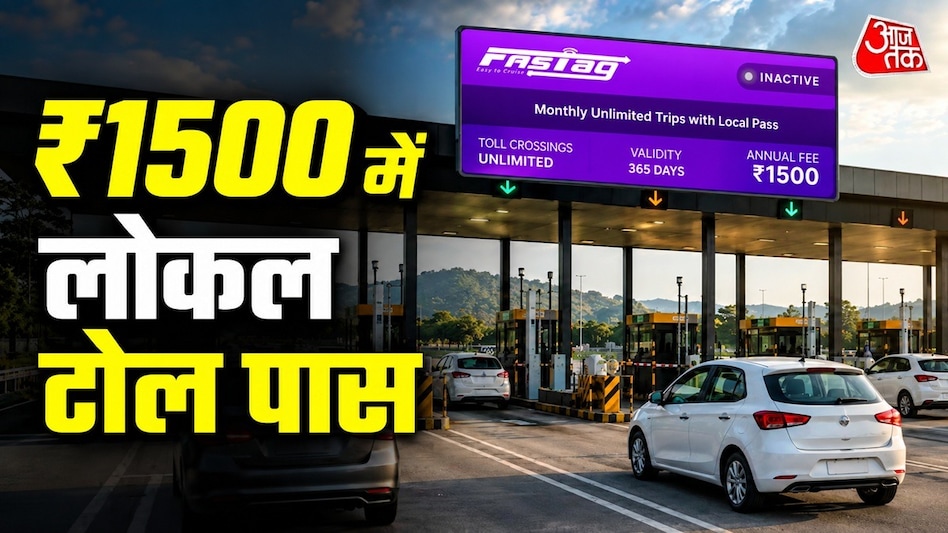
Annual toll pass available for residents near toll plazas starting November 1st for 1500 rupees
Read more
Aaj Tak
www.aajtak.in

Annual toll pass available for residents near toll plazas starting November 1st for 1500 rupees

The government has announced a new service for private vehicle owners residing near road toll plazas. Starting November 1st, they can obtain an annual pass for 1500 rupees. This pass is exclusively intended for private car owners living within a 20-kilometer radius of the toll collection point.

It is important to note that this pass differs from the annual FASTag pass costing 3075 rupees. The 3075 rupee pass is for everyone and covers 200 crossings, whereas the 1500 rupee pass is only available to those who regularly use the roads and are required to pay for passage, provided they live near the toll plaza.

This pass, which will become effective on November 1st, can be obtained online. To do so, you must download the RajmargYatra application, which is available on the Google Play Store and Apple App Store. After logging in with a mobile phone number, select the 'Local Pass' option on the main page instead of the 'Annual Pass.'

Verification requires a DigiLocker account linked to Aadhaar, as well as a valid FASTag and the vehicle's registration number. Furthermore, the name in the RC and Aadhaar documents must match.

After selecting the option, you need to specify the exact toll plaza. Then, complete the verification process and make the payment. Following this, the applicant will be issued a new local annual pass, valid from November 1st. The Ministry of Road Transport and Highways provided information about this pass, clarifying that its purpose is to offer preferential fares to residents living near toll plazas on national highways.

Thus, starting November 1st, non-commercial vehicle owners meeting the criteria can use this pass within 20 kilometers of the toll plaza.

This pass will work in conjunction with a valid and functional FASTag. All established rules must be followed, as the pass does not guarantee usage at every toll plaza; it is valid only at one specific toll plaza.

The cost of the pass is set at 1500 rupees for toll plazas located outside municipal or city boundaries. If the toll plaza is inside these boundaries, the cost will be 3000 rupees. The government reserves the right to review this price annually in April.

It should be noted that this pass is not applicable to national highways or expressways operating under a closed-user toll collection system. It will also not be valid at toll plazas that have a service road or an alternative route of travel.

Similar stories

Differences between the 1500 Rupee Toll Pass and the Standard FASTag Annual Pass of 3075 Rupees
Read more
www.aajtak.in

Differences between the 1500 Rupee Toll Pass and the Standard FASTag Annual Pass of 3075 Rupees

Starting November 1st, the government is introducing a new annual pass at a lower price, intended for owners of non-commercial vehicles, subject to certain conditions.

The new 1500 Rupee pass will be available to vehicle owners who reside within a 20-kilometer radius of toll roads on national highways. This pass is valid for one year and applies to toll roads located outside municipal or city boundaries. However, if the toll roads are within municipal or local city boundaries, the cost of this pass will be 3000 Rupees.

This local pass differs from the standard FASTag annual pass costing 3075 Rupees. The FASTag annual pass is available to all private vehicle owners, allows up to 200 crossings, and is useful for long-distance highway travel without quantity restrictions.

In contrast, the local pass is designed for a specific toll section. It can be purchased regardless of whether you are within the 20-kilometer zone of a particular toll road. The local pass is ideal for those who frequently use the same toll road near their city to avoid high toll charges.

Since this new pass is a subsidized local pass, it is only provided to those who meet the established criteria. It is important to note that this pass cannot be used on all toll roads.

The new pass will become available on November 1, 2026. The government reserves the right to review its prices annually in April. There are usage restrictions for this pass: it will not work on national highways or expressways operating under a closed-user toll collection system. Furthermore, the pass will not be valid on toll roads where service roads or alternative routes exist that allow avoiding the toll payment.

Bridge worth 8.86 crore rupees built in Madhya Pradesh, but access road remains unfinished
Read more
www.aajtak.in

Bridge worth 8.86 crore rupees built in Madhya Pradesh, but access road remains unfinished

A significant gap exists between statements about state development and the actual situation on the ground in the state of Madhya Pradesh. In the Narmadapuram district of Madhya Pradesh, a 308-meter bridge across the Dudhi River was completed, costing approximately 8.86 crore rupees. However, the access road, about a kilometer long, connecting the bridge to the main road, remains unfinished after three years.

The question arises as to why people have not been provided with a way to use the bridge despite the multi-million rupee expenditure on its construction. It is also being questioned who is responsible for this incomplete work.

The situation is related to the village of Umordh in the Bankheri area of Narmadapuram district. The bridge, built over the Dudhi River, was intended to improve transport connectivity between the districts of Narmadapuram and Narsinghpur. There was hope that the bridge would facilitate the movement of residents from surrounding villages, simplify life for farmers, and ensure easy access to medical services when necessary.

Nevertheless, despite the bridge being ready, work on the access road has not been completed. The lack of road surfacing on both sides forces rural residents to face difficulties when approaching the bridge. During rains, the dirt road turns into mud and swamp, and after drying, it becomes riddled with potholes.

It is expected that this bridge will benefit approximately 40–50 villages in the Narmadapuram and Narsinghpur districts. Despite this, residents continue to experience inconvenience due to the unfinished access road for three years. The question arises regarding the reasons for the construction delay: is it due to insufficient coordination between departments or awaiting administrative approval?

There is also a question about what steps have been taken to eliminate any technical or administrative obstacles. The main question is why people cannot reap the full benefits of the bridge despite the millions of rupees spent.

Keshav Raidas himself, a senior official of the Bridge Construction Department, stated that information about this problem has been forwarded to the government. A decision will be made at the government level regarding which department should carry out the construction of the access road to the bridge.

This raises another question: why has it still not been determined who will build the road if the bridge itself has been ready for three years? Will they have to wait years to determine responsibilities for building roads and bridges in government projects? For now, the bridge stands over the Dudhi River, but the path to it remains incomplete. Residents are still forced to contend with mud and potholes. Now, all that remains is to wait for the government and relevant departments to determine responsibility and begin constructing the access road, as the true benefit of development will only be realized when there is a path to the bridge.

24th PM Kisan payment of 2000 rupees to be released on October 30; farmers need to check status.
Read more
www.aajtak.in

24th PM Kisan payment of 2000 rupees to be released on October 30; farmers need to check status.

For farmers awaiting the 24th installment under the Prime Minister's Farmer Welfare Scheme (PM Kisan Yojana), there is good news. The Ministry of Agriculture announced on October 23 that the next payment will be made on October 30. This payment will transfer 2000 rupees to the bank accounts of eligible farmers.

However, the release of the installment on October 30 does not guarantee that funds will reach every farmer's account. The payment may be delayed if the farmer has not completed electronic verification (e-KYC) or if any errors are found in their account data. Therefore, farmers should check their status promptly.

Which farmers might not receive the 2000 rupees? To receive funds under the PM Kisan Yojana scheme, farmers must keep their information up to date. Completing e-KYC is particularly important. If you have not yet completed e-KYC, your payment may be suspended. Furthermore, farmers are advised to check their beneficiary status to ensure the accuracy of their record under this program.

There are three ways for farmers to complete e-KYC. If your mobile number linked to Aadhaar is active, you can use the One-Time Password (OTP) method. e-KYC can also be completed by scanning your face through the mobile application.

How to perform e-KYC using OTP via mobile phone? If you wish to complete e-KYC yourself, you need to follow the specified steps. e-KYC can also be done using facial recognition without using OTP, utilizing the PM Kisan app.

Before the installment is released on October 30, be sure to check your status. If e-KYC is not completed, it should be finished, and if errors are found in the account data, contact the relevant official or service center for correction.

Popular