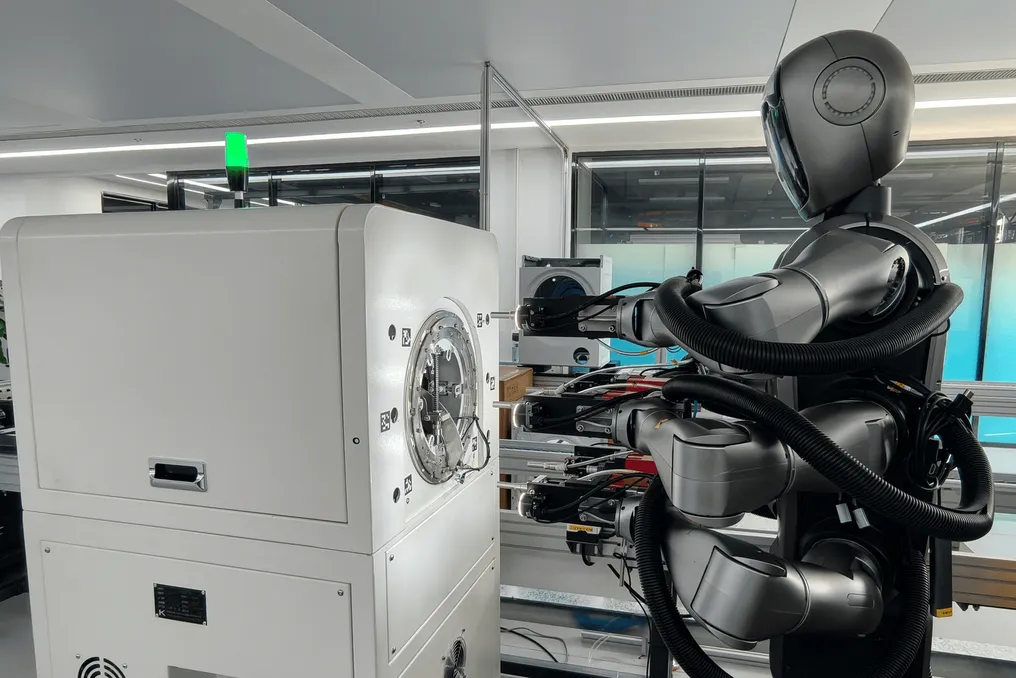
The six-armed humanoid robot MIRO U from Midea has worked at a washing machine manufacturing plant in Uxi over the past three months, where it performed the installation of screws on the rear panel of 100,000 such machines.
These figures were presented by the head of the embodied robotics innovation center at KUKA during a media tour organized by the Guangdong Department of Industry and Information Technology in mid or late October, according to a report by Time Finance published in QQ News.
At the Midea Global Innovation Center laboratory in Shunde, Foshan, journalists observed MIRO U screwing in bolts at an average speed of six bolts in about 10 seconds, with a reported success rate of 99.8 percent.
Midea, which owns the German robot manufacturer KUKA, considers the six-armed solution practical. Two-armed humanoid robots possess flexibility, but their efficiency is only about 30 percent of human efficiency, which is insufficient for a home appliance production line. The use of six arms on one machine allows its productivity per square meter to match that of skilled workers.
Midea first introduced MIRO U in December 2025 as the third generation of its humanoid robot lineup. This wheeled robot is capable of autonomously climbing vertically and rotating 360 degrees in place. The company follows an innovative approach: robots are first tested at its own washing machine manufacturing plants in Jingzhou and Uxi, as well as at the logistics warehouse in Wuhan, before being offered to external customers.
MIRO U is part of a broader provincial trend. According to a report, by September, more than 2,000 humanoid robots had been deployed in Guangdong's manufacturing companies operating in real production environments, and it is expected that this number will exceed 3,000 by the end of the year.
Other examples from the tour demonstrate the transition of humanoid robot work from demonstrations to measurable tasks. At the headquarters of X Square Robot in Shenzhen, a two-armed robot turns parcels so that their labels face up, sorting over 1,800 packages per hour. The company AI² Robotics reports that its robots are used in semiconductor display, automotive, and biopharmaceutical enterprises, but managers still consider full-scale implementation a distant future.
The head of Huayan Robotics noted that solutions that perform well in simulation often lose accuracy in real workshops due to changes in lighting, component variations, vibration, oil pressure, and cycle time constraints.
Official Guangdong data shows that in 2025, the province produced 336,300 industrial robots, accounting for 43.5 percent of the national volume, and the Pearl River Delta is capable of creating prototypes within 48 hours and delivering small batches within seven days.