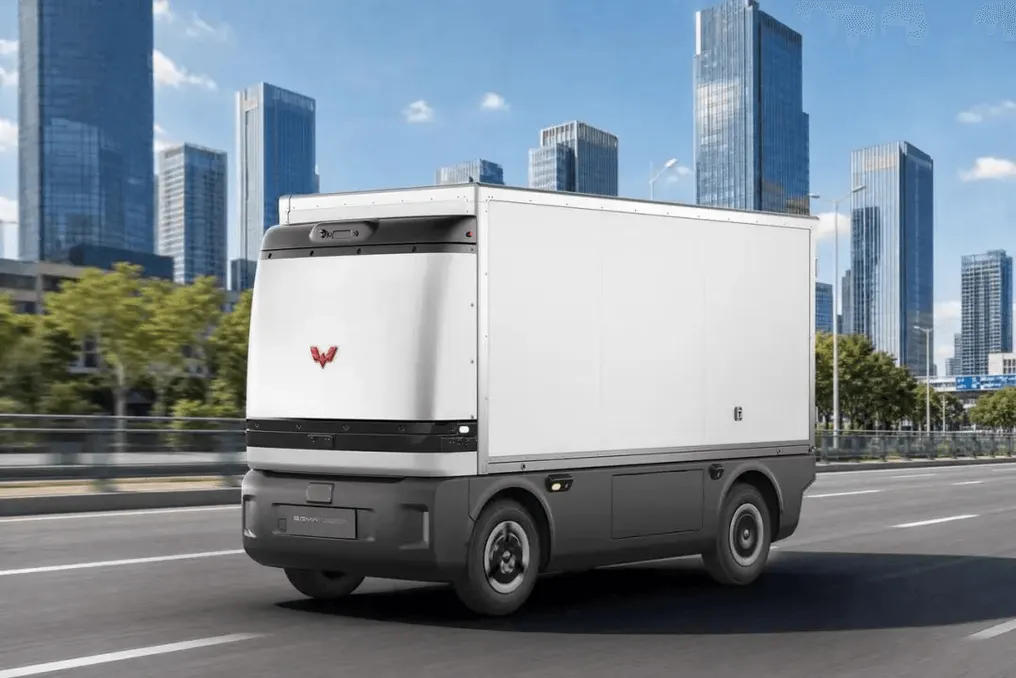
SAIC-GM-Wuling announced its intelligent equipment strategy on October 29th and introduced the first product under this strategy—an autonomous logistics vehicle designed for last-mile delivery. This move allows the automaker, known for its affordable cars and minivans, to enter the autonomous delivery market.
The vehicle is built on an architectural chassis equipped with drive-by-wire braking, steering, and motion control systems. According to Wuling, this ensures dynamic safety comparable to passenger cars. The cargo compartment is modular and can be fitted with a closed container, a fenced cargo platform, or a refrigerated box; furthermore, the cabin and cargo area are separated, allowing goods to be loaded using a forklift.
Technical specifications include a payload capacity of 6 cubic meters, a total range of 200 kilometers, and a total mass of 1850 kilograms. It uses a 16.2 kWh lithium iron phosphate battery, which can charge from 30 to 80 percent in approximately 0.58 hours. The maximum speed is 60 kilometers per hour, and the maximum incline is 18 percent. The vehicle has a turning radius of 4.7 meters and a water crossing depth of 300 millimeters. It is certified to IP55 standard and operates in temperatures ranging from minus 20 to plus 50 degrees Celsius.
The control system was developed in-house by the company. It does not require high-definition maps, relying instead on simplified mapping, a large model trained on the company's passenger car driving data, and cloud-loaded routes. This allows the vehicle to be quickly configured and dispatched for multi-point deliveries with a single command. Wuling asserts that it can be used on permitted city roads as well as in closed industrial parks and campuses for courier delivery, retail servicing, cold chain transportation, and internal material movement within enterprises.
Wuling leverages the advantages of its scale as an automaker. The vehicle utilizes the same battery, electric drive, and supply chain as the company's passenger models and is manufactured on automotive assembly lines that serve both standard mass production and small bespoke batches. The company emphasizes its national service network, comprising over 2800 service points and 15,000 technical specialists, providing 24/7 support and remote monitoring for the fleet.
It is reported that the vehicles are already in operation with several partners, including operators, technology providers, and end-users. A framework agreement has been signed with the intellectual mobility division of China Merchants Group. Under this agreement, Wuling supplies the vehicles, along with warranty, battery, and transmission maintenance, while the partner is responsible for local regulatory access and operation. Additionally, the national standard for road testing and demonstration of intelligent connected vehicles, effective July 1st, establishes unified rights and responsibilities on the road for autonomous delivery vehicles.