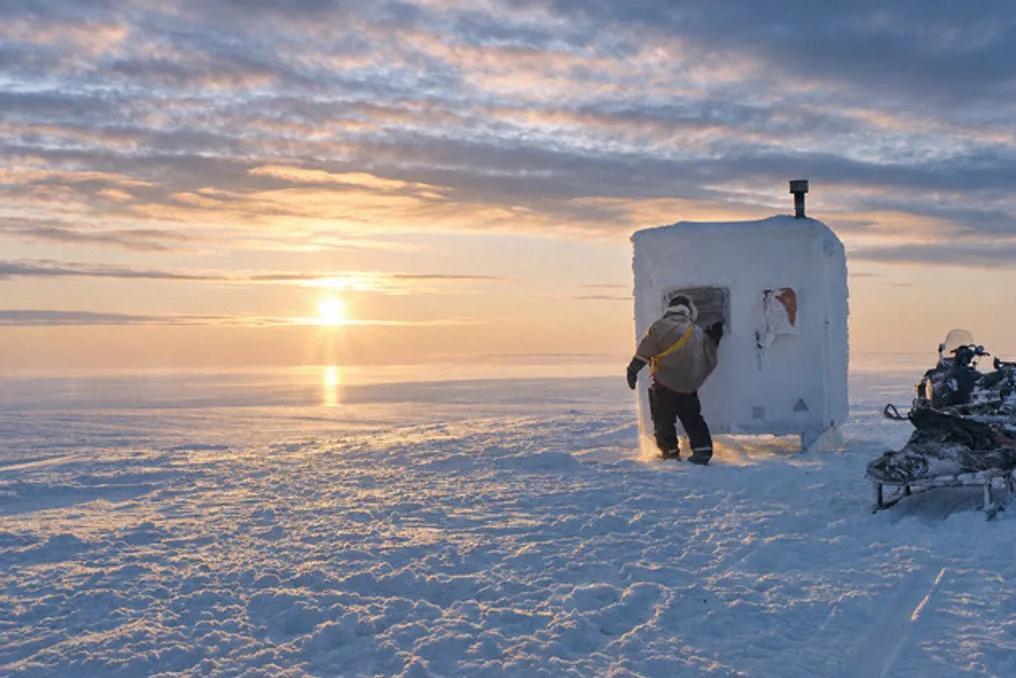
The documentary film 'The Human Shelter: Expedition into What Makes a Home' is an exploration of the concept of home. Filmed by Boris Bertram and funded by IKEA, the film analyzes modern lifestyles in Norway, Iraq, the United States, Nigeria, Japan, Uganda, and Svalbard, questioning the role of housing in the future. Through personal stories and visual imagery, the documentary connects the idea of home with landscape, movement and settlement, time, migration and safety, vulnerability and nature. It raises questions about how homes are built by displaced groups and when shelter turns into a home.
Portraits, stories, and shelters presented across four continents give the public insight into answers to these fundamental questions within an hour-long cinematic journey. Over more than two years, Boris Bertram traveled to nine countries to gather local perspectives on building shelters and the feeling of home. One goal was to shape the idea of the future home in the face of climate change, globalization, and migration.
Two important conclusions were drawn during this process: everyone can poetically speak about home, and poetry becomes a source of strength. Thanks to the cinematography of Henrik Bon Ipsen and Adam Filp, viewers can contemplate the diversity of landscapes and understand the complex geographical contexts marked by isolation, life away from civilization, and urban daily life.
The film's methodology was inspired by the approach of Danish poet and filmmaker Jørgen Leth and his concept of 'the presence of chance.' Locations are chosen to surprise the audience; each chapter has a central story, and all participants are invited to share their feelings and reflections on home and belonging.
Seven chapters of the film showcase the views of Sean Anderson, curator at MoMA in New York; Elle Maria Eyre, artist and nomad of the Sámi people from Finnmark; Kim Bindsted, professor at the HI-SEAS Mars research station funded by NASA; Suhada, a 13-year-old poet from a UNHCR refugee camp in Kurdistan, Iraq; Johan Karlsson, a designer of refugee shelters at Better Shelter; Yuri, an artistic photographer from Tokyo; Andri Snar Magnason, an Icelandic writer; and Godfrey Kato, an eco-activist from Uganda.
Boris Bertram notes that the documentary is fundamentally about people and the meaning of human existence. He explains that after numerous trips to conflict zones, the idea arose to create a film that would explore how we build homes in the most remote corners of the world, where the planet faces the greatest challenges related to climate change, migration, and resource scarcity. Thus, they aimed to accumulate new knowledge on how to build better homes in the future.
Boris Bertram, a Danish film director, producer, and educator, works at Zentropa Film in Copenhagen. His filmography focuses on conflict resolution and humanism in times of war, natural disasters, migration, and population displacement. In addition to 'The Human Shelter,' Bertram has directed award-winning films such as 'The Photographer of War,' 'Bush,' 'Blair and Fogh – The War Campaign,' and 'Tankograd.' His work is supported by the Danish Arts Foundation, and beyond cinema, includes video installations and documentary series. He is the showrunner, director, and screenwriter of the Norwegian documentary series 'Putin's Shadow War' (2023), produced by DR, NRK, SVT, and YLE.
Boris Bertram also emphasizes that shelter is our first concept of home—a physical place where we, as humans, must first feel safe and protected. In extreme living conditions, the body itself can become a shelter. For example, a person living on the street often uses their body to protect against the environment and nature, adopting a fetal position.
The film 'The Human Shelter,' which explores what constitutes home, premiered at MoMA in New York in 2020 and was presented by UN-Habitat as part of its global 'Housing for All' campaign in 193 countries. The film will also be shown in Copenhagen on October 29th during the presentation of COBE Notes: Edge Conditions. 'The Human Shelter' is available for free viewing on ArchDaily from October 29 to November 29, 2026. Subtitles are available in six languages (English, French, Arabic, Chinese, Russian, and Spanish) by clicking the subtitle icon in the Vimeo player.