Tencent's WorkBuddy adds remote control feature to monitor AI tasks from mobile devices
Read more
TechNode
technode.com

Tencent's WorkBuddy adds remote control feature to monitor AI tasks from mobile devices

Tencent's artificial intelligence agent platform, WorkBuddy, has released a remote control feature supported by the Tencent Edge One team. This new capability allows users to connect to a computer logged into the same account using a mobile application. Users can view the desktop in real-time and intervene in operations if necessary.

Unlike traditional remote desktop tools, which primarily focus on device-to-device access, the WorkBuddy feature is specifically designed for AI agent workflows. Users gain the ability to monitor the agent's actions in real time and intervene if tasks deviate from course or require manual confirmation.

To use this feature, the mobile application must be updated to version 2.7.0 or later, as well as the macOS desktop client to version 5.9.3 or higher. After connecting, the computer screen is displayed in a pop-up window on the app's home page or at the top of the dialogue, allowing monitoring of the agent without leaving the current chat.

If an agent encounters an issue while performing a task, users can intervene directly from their phones. For example, if an account is not authorized or the connector authorization has expired, users can attempt to resolve the issue on mobile devices instead of returning to their computers.

For manual control, users can press the full-screen mode button, which switches the phone interface to landscape orientation and activates the ability to control the desktop via touch input. The interface provides three options: Control, Keyboard, and Mouse, which support actions such as switching windows, returning to the desktop, and text input. A virtual mouse is also available for more precise clicking and scrolling in small areas of the screen.

Regarding security, Tencent states that the feature limits each device to one authenticated mobile device simultaneously. Screen data and control commands are transmitted over an encrypted channel. The platform does not record user input or store video recordings of remote control sessions. Network traffic generated by remote control is deducted from the device's data usage and does not consume WorkBuddy AI agent token quota.

To get started, users need to enable the remote connection option for devices logged into the same account in WorkBuddy settings, install the necessary remote control component, and grant screen recording and accessibility permissions. Once configured, users can connect remotely while the computer remains powered on and WorkBuddy is online.

In practice, this feature helps solve a common problem in AI agent workflows—the need for human intervention during task execution. AI agents are already capable of performing multi-step tasks, such as document organization and data collection, but they can still encounter authorization requirements, permission requests, or operational errors. Remote control gives users the ability to monitor progress and make adjustments from their phones without being tied to their desks.

However, this feature may offer more than just a way to control computers from a phone. It could potentially introduce a more flexible model of human-AI collaboration, where AI handles routine work, and users intervene to make decisions and correct errors at critical moments. Rather than striving for completely autonomous execution at all costs, maintaining human oversight might be a more practical approach for AI productivity tools at the current stage of development.

Nevertheless, a smartphone cannot fully replicate the computer experience. Remote access may be convenient for simple tasks, such as approving permissions or switching windows, but its effectiveness in more complex workflows involving data processing and multiple windows remains to be seen. The feature is currently available for trial use by all users. Tencent reports that future versions will include more enterprise-oriented capabilities, including role-based permission management and audit logs.
Similar stories

Tencent introduces Buddy One, unifying office applications through the WorkBuddy agent and Tencent Drive
Read more
pandaily.com

Tencent introduces Buddy One, unifying office applications through the WorkBuddy agent and Tencent Drive

At the Tencent Global Digital Ecosystem Summit held on October 29th, the company unveiled Buddy One—a system that connects productivity applications for individual users with a unified AI agent. Concurrently, Tencent launched a new cloud storage product called Tencent Drive, designed to function as the storage layer for this agent configuration.

Buddy One integrates tools such as Tencent Docs, Tencent Meeting, Tencent Drive, and the ima knowledge tool, all operating based on the WorkBuddy agent. Users receive a single account for all applications and a shared pool of artificial intelligence credits. Tencent announced that future updates will include shared memory across these applications, along with the addition of new products.

In practice, users connect their accounts via the WorkBuddy PC client, starting from version 5.9.0 or later. After this setup, users no longer need to manually instruct the agent where to search or where to insert context within an application. The query initiates a search across all authorized documents, meeting recordings, and user knowledge bases, and the response indicates which application each source originated from.

Credits acquired or earned in WorkBuddy are converted into Buddy One credits, which are valid across all systems: WorkBuddy, Tencent Docs, ima, and Tencent Drive. The Buddy One VIP plan costs 700 RMB per month and includes premium WorkBuddy level, Tencent Meeting Pro subscription, Tencent Docs premium membership, shared credits, and 1 TB of storage.

Tencent Drive is of particular interest to developers. The company describes it as a cloud storage solution built specifically for agents. In addition to hosting shared storage for WorkBuddy, Tencent Docs, and other Tencent applications, it can connect to supported third-party agents and applications via a Command Line Interface and Model Context Protocol. This allows a user to draft something in one AI tool and continue working on it in another without re-uploading files. The WorkBuddy knowledge base feature already operates based on Tencent Drive.

For enterprise clients, Tencent Drive functions on Tencent Cloud Object Storage, providing end-to-end encryption, offsite disaster recovery, and VPC deployment. Administrators can set granular access rights for both employees and AI tools. Furthermore, Tencent has increased the storage capacity in the corporate version of WorkBuddy from 5 GB to 50 GB per user.

Tencent also announced further expansion of the WorkBuddy architecture, enabling companies to integrate their own agents, third-party agents, and external messaging systems. Dougson Tong, Head of Tencent's Cloud Division, noted that the choice of model, agent, and messenger must remain with the enterprise.

Alibaba's Amap Model Introduces Humanoid System Learning Full-Body Tasks from Human Movements
Read more
technode.com

Alibaba's Amap Model Introduces Humanoid System Learning Full-Body Tasks from Human Movements

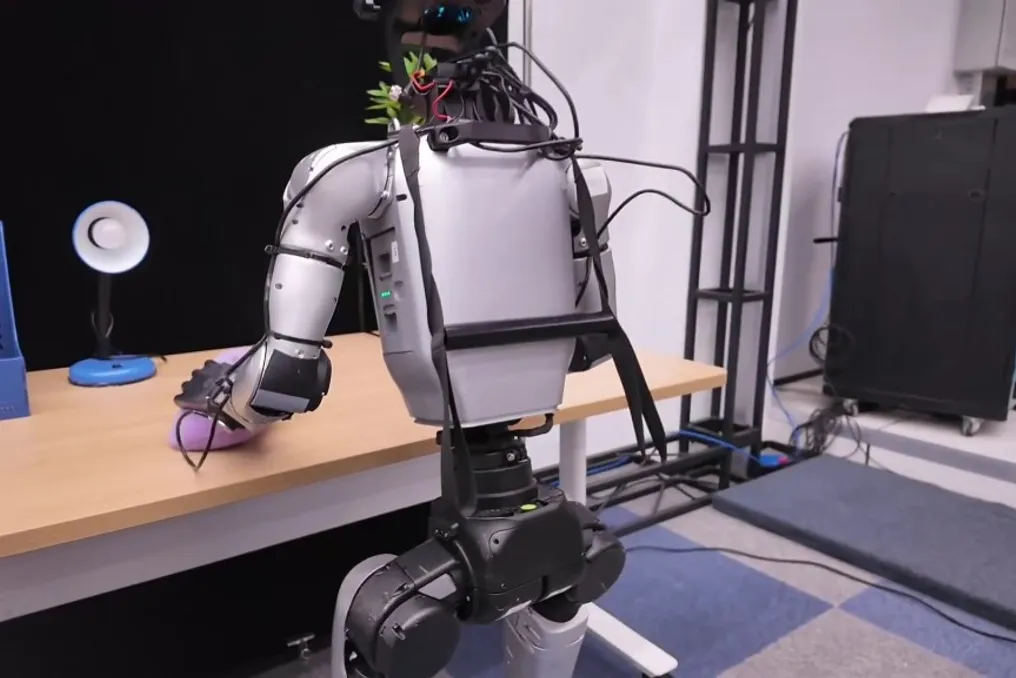
Alibaba, in collaboration with Alibaba Token Hub, has introduced the λ0 model. This foundational model is designed to train humanoid robots in coordinated movements and manipulations by utilizing demonstrations shown by humans.

The system learns from first-person video recordings that are synchronized with body and arm movements. This enables robots to perform more complex tasks, combining walking, posture correction, and two-handed operations.

Researchers created the HumanVerse dataset, which includes 500 hours of recordings of people performing various actions in real-world conditions. This approach reduces the need to collect demonstrations through robot teleoperation.

During testing, the team demonstrated that λ0 achieved 62.5% success rate in tasks related to locomotion and manipulation in the real world. The project also provided researchers with configuration code for data collection equipment and data samples.

Tencent grants access to Yuanbao search for developers to create AI models and agents
Read more
technode.com

Tencent grants access to Yuanbao search for developers to create AI models and agents

Tencent has opened up its Yuanbao search system to external developers and enterprises via the Tencent Cloud platform. Consequently, the search infrastructure previously used by the company's proprietary artificial intelligence products has been transformed into a commercial service.

This was announced on October 20th. The offered service combines publicly available web information with Tencent's proprietary content ecosystem and is designed to provide information extraction capabilities for large language models and AI agents.

Tencent stated that Yuanbao Search possesses an index containing hundreds of billions of records and processes hundreds of millions of queries daily. The system supports over 50 internal business projects, including WorkBuddy, ima, and Tencent Video.

The search engine is integrated with 157 information sources across 13 different sectors, including finance, healthcare, law, and travel. Furthermore, it provides near real-time information updates, such as for news, weather forecasts, and market prices.

Popular