There is a considerable risk of weakening in an ocean current system vital for regulating Earth's climate by the end of this century, yet most governments ignore this threat in their climate adaptation plans.
Of the 91 national plans submitted to the United Nations Framework Convention on Climate Change, only two address the possibility of these currents collapsing, and neither establishes concrete actions to deal with such a scenario.
This warning was published in an article in the journal Nature Sustainability, resulting from research conducted by scientists on how nations are preparing for potential changes in Atlantic Ocean circulation.
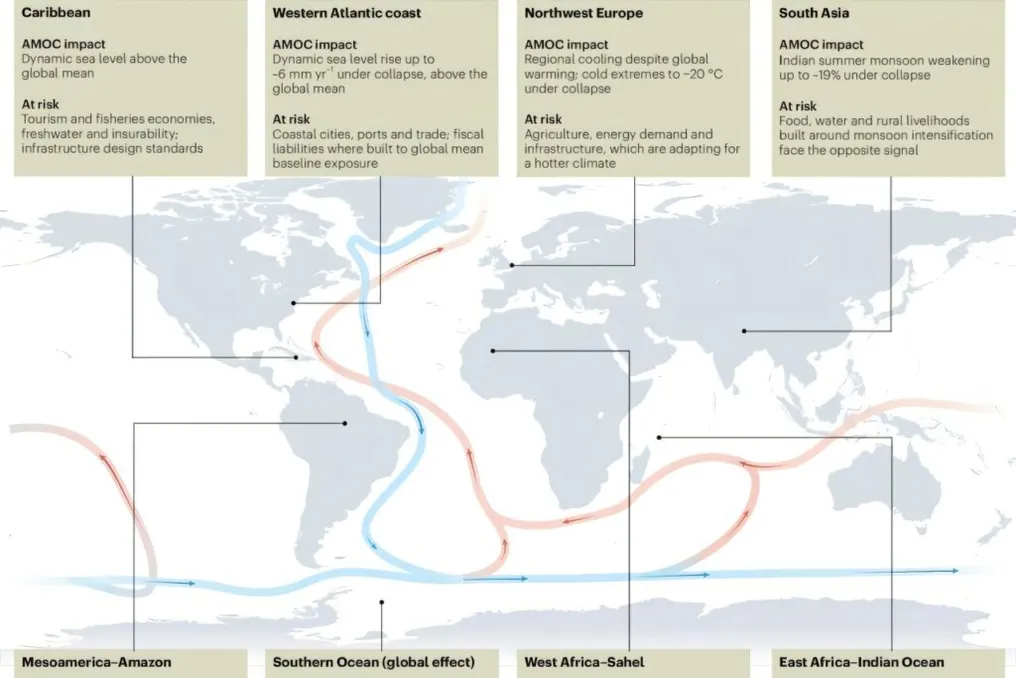
The system in question is known as the Atlantic Meridional Overturning Circulation, abbreviated as AMOC. It operates like a maritime conveyor belt, carrying warm surface waters towards the north of the Atlantic and returning colder waters to the south in deep layers.
This movement is responsible for redistributing heat across the globe, influencing temperatures and precipitation patterns in areas far from the ocean. With increasing global warming, the circulation has shown signs of weakening and may continue to lose strength throughout this century.
Scientists emphasize that a total collapse is considered unlikely before 2100. A recent study cited by the authors projected that, under an intermediate emissions scenario, the intensity of the AMOC could decrease by 50% by the end of the century.
A significant slowdown in circulation could generate notable climatic transformations in various regions. For example, in Northern Europe, reduced heat transfer from the tropics could intensify episodes of extreme cold during winter. Climate simulations with a non-operational AMOC indicated the possibility of temperatures as low as -20°C in London, England.
The impacts could also reach areas dependent on monsoon rains. Tests conducted with climate models suggested an average weakening of 29% in West African monsoons and 19% in Indian summer monsoons if the circulation were interrupted.
Such changes raise risks related to water supply and food production in areas dependent on these rains. Furthermore, other studies cited in the article point to a greater danger of severe droughts in parts of Central America, West Africa, and the Amazon region.
Fishing and sea levels would also be subject to changes. Alterations in ocean temperatures and the distribution of water masses would have implications for coastal communities, fish stocks, and sea-level rise defense infrastructure.
The researchers suggest five measures to integrate the AMOC risk into climate planning: identifying the most susceptible countries and investments; conducting tests using simulations that consider circulation collapse; prioritizing flexible solutions adaptable over time; maintaining continuous monitoring of ocean currents; and revising global climate projections.
The purpose is not to precisely determine when or if a collapse will occur, but rather to assess whether current decisions will remain effective under different climate scenarios.
The authors also warn that preparation for this risk should not detract resources allocated to addressing already visible problems, such as heatwaves, droughts, and floods. The accelerated reduction of greenhouse gas emissions remains crucial.
Historically, the AMOC has undergone major variations. Research shows that the system was close to a near-total shutdown approximately 17,500 years ago, after the coldest period of the last ice age. This history proves that profound changes are possible, although it does not define the timing or occurrence of a new interruption.