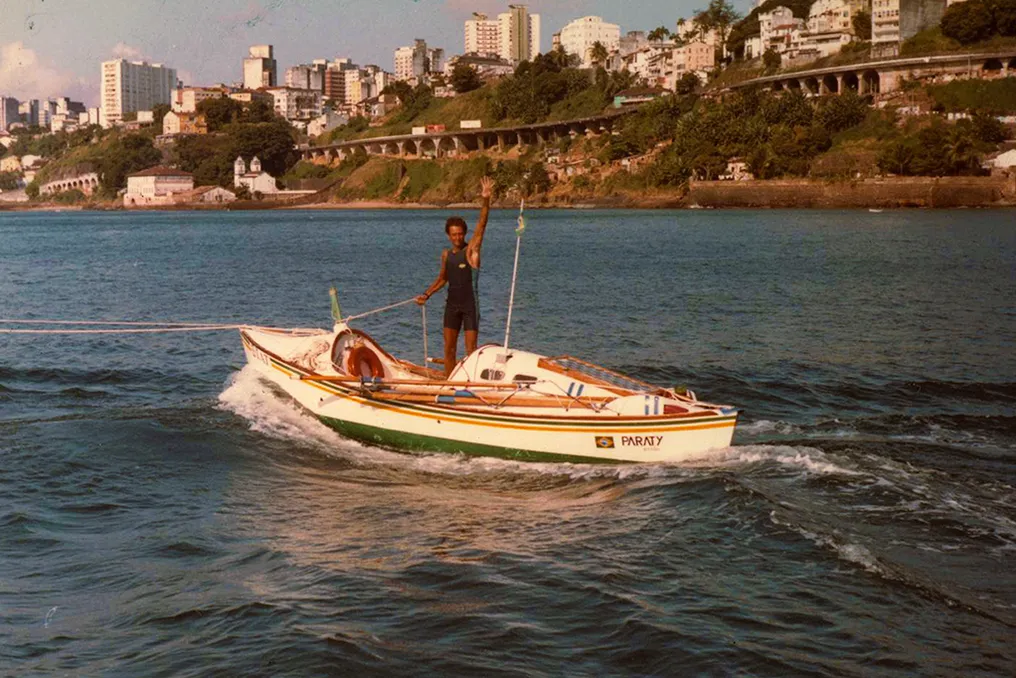
In 1984, Amyr Klink completed the first solo rowing crossing of the South Atlantic, departing from Namibia and arriving in Bahia. During this significant expedition, he remained isolated for one hundred days, dedicating approximately eight hours daily to rowing. Throughout the journey, he relied exclusively on star-based calculations to determine his location, communicating by radio only a few times a week, without the aid of GPS or the internet.
The preparation for this adventure was as complex as the crossing itself. Initially, Amyr needed to design a vessel suitable for his needs: it had to be light enough to facilitate rowing, yet robust enough to carry all the necessary supplies and water for the entire route. Furthermore, it was crucial that the boat be stable, as capsizing in the ocean would mean certain death.
He collaborated with naval engineer José Carlos Belford on the boat's design, who raised doubts about the possibility of a vessel completely immune to capsizing. The solution found was a mechanism that allowed the boat to automatically return to its original position after flipping, similar to a 'john boat.' During the voyage, Amyr experienced three capsizings near the African coast, and in all instances, the boat stabilized itself.
Food management also required creative solutions. Amyr transported 275 liters of water and had to restrict his consumption to less than three liters per day. To achieve this, he used dehydrated foods that could be prepared using seawater. Throughout the crossing, he faced physical and technical challenges, in addition to interacting with various marine animals, documenting everything in a diary that later served as the basis for the bestseller 'One Hundred Days Between Sky and Sea.'
More recently, the story has been adapted for the cinema in the film '100 Days,' directed by Carlos Saldanha and starring Filipe Bragança, who plays Amyr. The release of the movie is scheduled for October 29. In an interview given to Superinteressante, Amyr Klink shared other details of his historic crossing and commented on the cinematic adaptation.
Amyr Klink expressed appreciation for Carlos Saldanha, stating that during initial meetings, he made it clear that the director had complete creative freedom. He was extremely impressed by the historical rigor of the team, which sought to recreate details considered essential. Klink mentioned that although he himself did not wear body adornments, he wore a necklace with a gold cross gifted by Natália Falzoni during the crossing. In the film, Filipe Bragança received a chain and T-shirts identical to those worn on the trip.
The boat used in the production is a replica commissioned by Iphan (National Institute of Historical and Artistic Heritage), a faithful copy that undertakes voyages. Klink described the effort involved in the production, citing his visit to the set in Paraty and the pool built in São Paulo, classifying the process as an act of heroism due to the patience required.
He reflected that Filipe Bragança might have suffered more than him, as the production built a wave-generating machine, causing the actor to splash water on his face, something that did not happen to Klink.
Klink reported that the period of the crossing was personally complicated, as he had to hide his activity from his family; only his mother was aware and supported him, assisting with translating survival manuals into Swedish, German, and French. His relationship with his father was tense, as the father was described as a difficult and violent man. The father reacted with indignation upon reading in the newspaper O Estado de S. Paulo about the intention of a Brazilian named Amyr to cross the Atlantic by rowboat, which led to a temporary rift. Reconciliation occurred in the middle of the Atlantic, facilitated by amateur radio operators who located the father.
Klink highlighted that while he admired failed attempts at crossing the North Atlantic, none had been made in the South Atlantic. He admitted to being afraid of dying at sea, which motivated him to plan everything meticulously. He observed that the errors of other rowers were often simple, related to malnutrition, lack of route planning, or ignorance of astronomy, and not to the distance or the 15-meter waves.
For Klink, the work was as rewarding as the journey, allowing him to learn astronomy and navigation without relying on GPS or the internet, transforming the initial project into a positive experience. He emphasized that the relentless pursuit of perfection is dangerous, but one must start. The greatest risks, according to him, did not come from the ocean, but rather from the bureaucratic obstacles imposed by the apartheid regime in South Africa and Namibia.
South African authorities showed disapproval upon learning of a Brazilian's attempt to leave Southern Africa heading towards Brazil without an engine or sail, resulting in a series of bureaucratic problems. Although he planned to take only the bare minimum, he prioritized comfort and efficiency, keeping supplies at about one-third of the boat's total weight. He received support from nutritionists from Paraná, who developed an innovative diet where he cooked with seawater, overcoming the challenge of excess salt through dehydrated and freeze-dried foods without sodium chloride.
Klink participated in the construction of the boat and brought photovoltaic panels, as well as technical navigation books, planks, and almanacs for astronomical calculations. However, while in Namibia, he received a copy of 'One Hundred Years of Solitude' by Gabriel García Márquez in English. This book was damaged by a shark that hit the rudder, an event that made him fear shipwreck.
By speaking with other sailors, such as Gérard d’Aboville, he learned about shark behavior. Initially, they just rubbed against the boat, but later began to attack it. Klink discovered that the problem was the hull's anti-fouling paint; the sharks removed this paint, allowing barnacles to grow, and started hitting them to attract golden fish, using them as bait. He had to invent a method to remove the crustaceans without damaging the paint.
Near the Brazilian coast, he spotted a group of beaked dolphins, which were actually protected humpback whale calves surrounded by a circle of adult whales—a moment he titled 'The Whale Nursery' in his book. After the crossing, Klink specialized in trips to Antarctica. In his early visits, he spent an entire summer there, and in more recent trips, suffered severe burns while bathing naked under the sun, highlighting the notable change in ultraviolet radiation action.