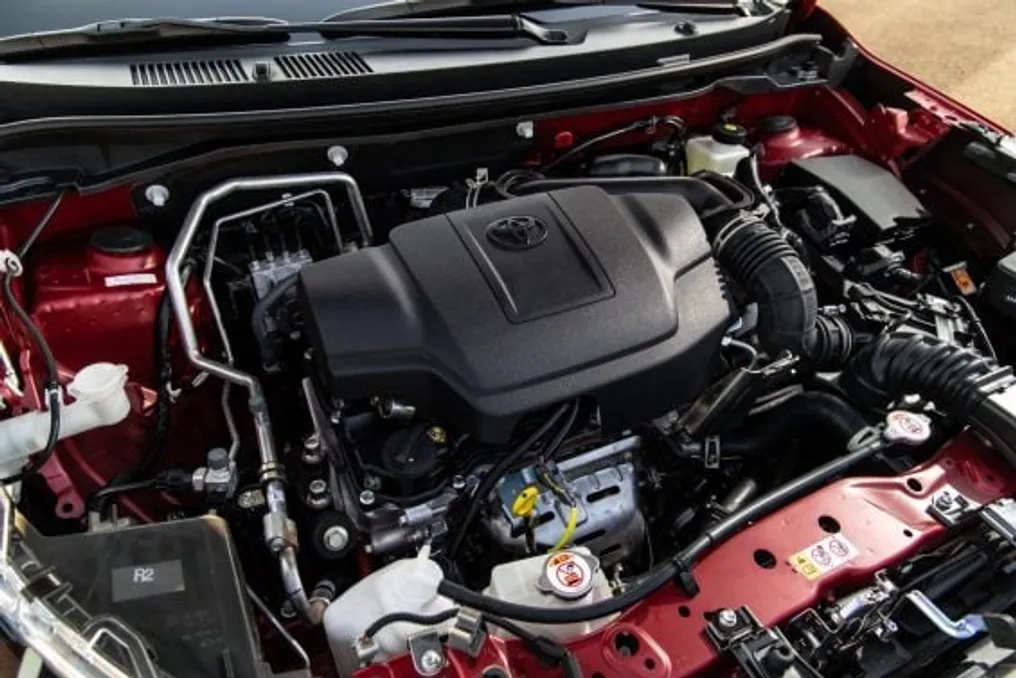
Toyota plans to generate billions in revenue by selling combustion and hybrid engines to other automakers
Read more
AutoPapo
autopapo.com.br

Toyota plans to generate billions in revenue by selling combustion and hybrid engines to other automakers

While much of the automotive industry is reducing investments in internal combustion engines, Toyota has chosen to transform this technology into a new and significant source of revenue. The Japanese manufacturer intends to commercialize its engines and hybrid systems to other automakers, aiming to generate approximately R$ 9 billion annually from this venture by 2032, according to Automotive News.

This goal represents a threefold increase over the estimated revenue of R$ 3 billion that third-party supply should generate in 2026. The first deliveries of this new engine line are scheduled for 2027.

The new engine family consists of three alternatives, all with four cylinders: a 1.5 naturally aspirated model, a 1.5 turbo, and a 2.0 turbo, all of which have the capability to operate integrated with hybrid systems. The 1.5 engine will be used to replace the units currently installed in models such as the Yaris and Corolla. The 1.5 turbo offers power equivalent to an existing 2.5 naturally aspirated engine, and the 2.0 turbo promises to surpass the performance of the 2.4 turbo that equips large SUVs and trucks of the brand in the United States.

Developed already considering electrification, these engines present physical advantages, being 10% smaller in volume and height. This dimensional reduction allows for a lower hood height, which contributes positively to aerodynamics and gives designers greater flexibility.

According to Toyota itself, the adoption of the new 1.5 engine results in a 12% fuel economy saving in a sedan.

The first expected buyers are traditional partners of the company, including Mazda, Subaru, and Suzuki, in addition to Daihatsu, which is a Toyota subsidiary. These five brands together move about 16 million vehicles annually.

It is important to note that this partnership does not imply abandoning the internal projects of these automakers; for example, Mazda continues to develop the Skyactiv-Z engine and a hybrid system for the CX-5, while Subaru maintains its focus on boxer engines, characterized by opposed horizontal cylinders.

For Toyota, this strategy serves to distribute development costs across a larger number of units and make its engines more competitive against competition from China. In turn, the other manufacturers benefit by gaining access to innovative mechanics without having to bear the full cost of creating them from scratch. Additionally, Toyota has also developed the 4.0 V8 engine, but for now, it is not part of the sales plans for other brands.
Similar stories

Toyota requests that vehicles produced in Japan, the United Kingdom, and Turkey receive European certification
Read more
autopapo.com.br

Toyota requests that vehicles produced in Japan, the United Kingdom, and Turkey receive European certification

Toyota has expressed a desire to alter the guidelines that the European Union is developing for the automotive sector. The Japanese automaker is requesting that cars manufactured in Japan, the United Kingdom, and Turkey be considered European, in addition to asking for less stringent emission reduction targets.

These suggestions were formally presented by Toyota Motor Europe last Friday, the 16th, in Brussels. The proposals aim at two initiatives of the bloc: the Industrial Accelerator Law and the Automotive Package, which deals with the revision of carbon dioxide (CO2) goals.

According to the European Commission's proposal, an electric vehicle will only be eligible for public subsidies if it has 70% European components, excluding the battery. Although Toyota agrees with this principle, it advocates for expanding the 'Made in Europe' label to include its trusted partners.

The company argues that excluding these countries would cause harm to investments, job creation, and technological development. With the inclusion of these nations, the potential market would expand to approximately 31 million vehicle units, given the brand's direct interest, which owns factories in the United Kingdom and Turkey.

Additionally, the manufacturer suggests that the requirement for European content be implemented gradually, reaching 70% over a three-year period, and that its validity only begins in 2030. It also asks for the minimum percentage to be 70% of total sales volume, in contrast to the 85% currently under debate, and that hydrogen-powered cars be temporarily exempt from this rule.

Toyota bases its request on the claim that consumer acceptance of 100% electric vehicles is occurring at a slower pace than required by Brussels. The brand estimates that in 2030, about 45% of sales will be allocated to electric cars, while current standards demand more than 55%.

To mitigate this divergence, the company proposes a five-year deadline for meeting the goals, covering the period from 2028 to 2032, and a 90% cut in emissions in 2035, instead of the currently established 100%. Another point raised is the possibility of accounting for points through the use of renewable fuels and low-carbon steel.

In contrast, in Brazil, the policy of protecting national industry follows a different path: the import tax applied to electric cars was raised to 35% in July, after four adjustments. In Europe, the Commission's proposals are still awaiting deliberation by the bloc's members and the European Parliament.

Popular