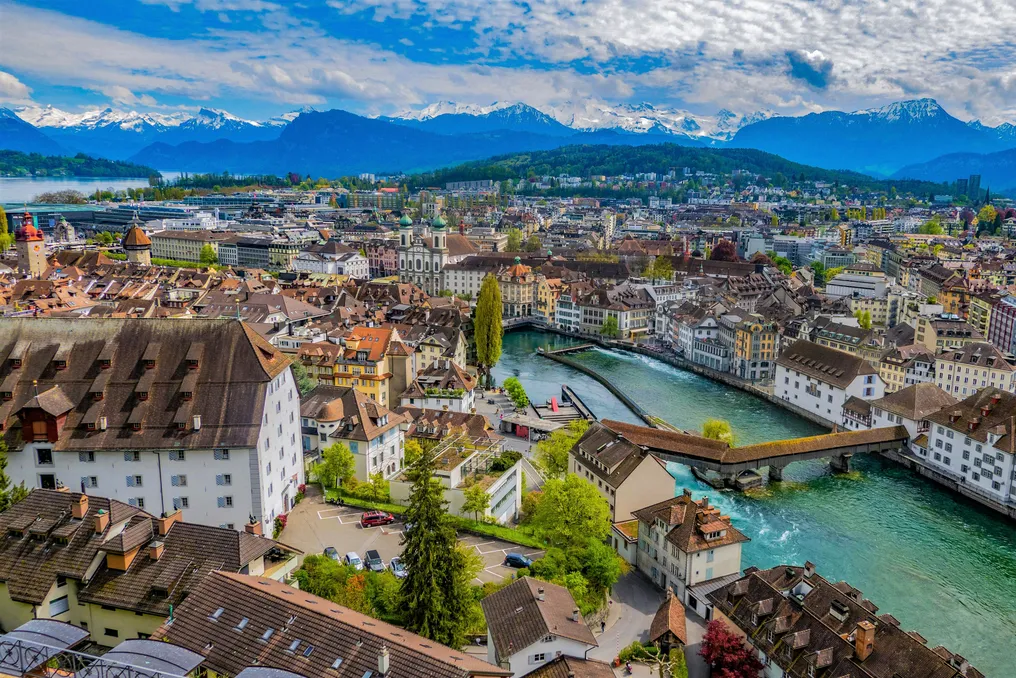
Lucerne, known as Luzern in German, is a charming medieval city located in the central region of Switzerland, situated southwest of Zurich. This destination offers a rich historical area characterized by ancient buildings, facades ornamented with frescoes, and pleasant squares.
The city is easily accessible, being only an hour by train from Zurich, reachable both by direct trains from the airport and from Zurich's central station. Furthermore, Lucerne serves as one of the main access points to the Alpine region and Central Switzerland.
For those planning a visit, four main attractions in the city have been highlighted.
The Kapellbrücke Bridge
Built in the 14th century as part of Lucerne's defenses, the Kapellbrücke is an iconic symbol and postcard of the city. This beautiful wooden bridge, considered the oldest in Europe, crosses the Reuss River diagonally, connecting the New Town to the town hall quay in the Old Town.
At one end of the bridge is the octagonal Water Tower, erected around 1300. This tower served multiple purposes, including surveillance, torture chamber, prison, and municipal archive. Beneath the wooden roof of the bridge, which is decorated with colorful pots during spring and summer, there are painted panels narrating Swiss history and the lives of the region's patron saints. The pedestrian crossing is 204 meters long and free of charge, with 24-hour access.
Mount Pilatus
The Löwendenkmal, nicknamed the 'Lion of Lucerne', is another notable attraction. Located in a tranquil park in the city center, near the Glacier Garden, a famous natural monument, visitors can observe the monumental sculpture carved directly into sandstone in front of a reflecting pool. This work was created by Bertel Thorvaldsen in the early 1820s and depicts a dying lion, wounded by a spear and resting on a shield bearing the fleur-de-lis of the French monarchy. The writer Mark Twain described this memorial as 'the saddest and most touching piece of stone in the world,' as it honors approximately 750 Swiss guards who died in Paris during the French Revolution in 1792.
Known as the 'Dragon Mountain', Mount Pilatus rises to an altitude of 2,128 meters and is surrounded by local legends about flying creatures on its most remote peaks. Despite the myths, the location is relatively accessible, being about 10 kilometers south of Lucerne and dominating the landscape near Lake Lucerne.
Pilatus is world-famous for hosting the steepest rack railway on the planet, with a gradient reaching 48%. The ascent to the summit takes between 60 and 80 minutes and can be made using cable cars departing from Kriens, a small municipality in the Canton of Lucerne, or by the rack railway itself, which starts its journey in the village of Alpnachstad. Upon reaching the top, visitors are treated to a 360-degree panoramic view, encompassing up to 37 snow-capped alpine peaks.
Swiss Museum of Transport
Opened in 1959, the Verkehrshaus – Swiss Museum of Transport is one of the most sought-after and popular museums in all of Switzerland. Located approximately two kilometers from the historic center of Lucerne, this attraction receives about one million visitors annually. It stands out for its vast and complex collection dedicated to all types of imaginable transport: land, rail, maritime, air, and space.
In the museum, historical trains and locomotives are exhibited, as well as the world's first tourist submarine, named 'Auguste Piccard', developed in 1964. The visitor experience also includes simulators, the largest planetarium in Switzerland, and a cinema with the country's largest screen. It is important to note that the attraction is suitable for all ages, offering flight simulators, water rides, and interactive exhibits that appeal to both children and adults.