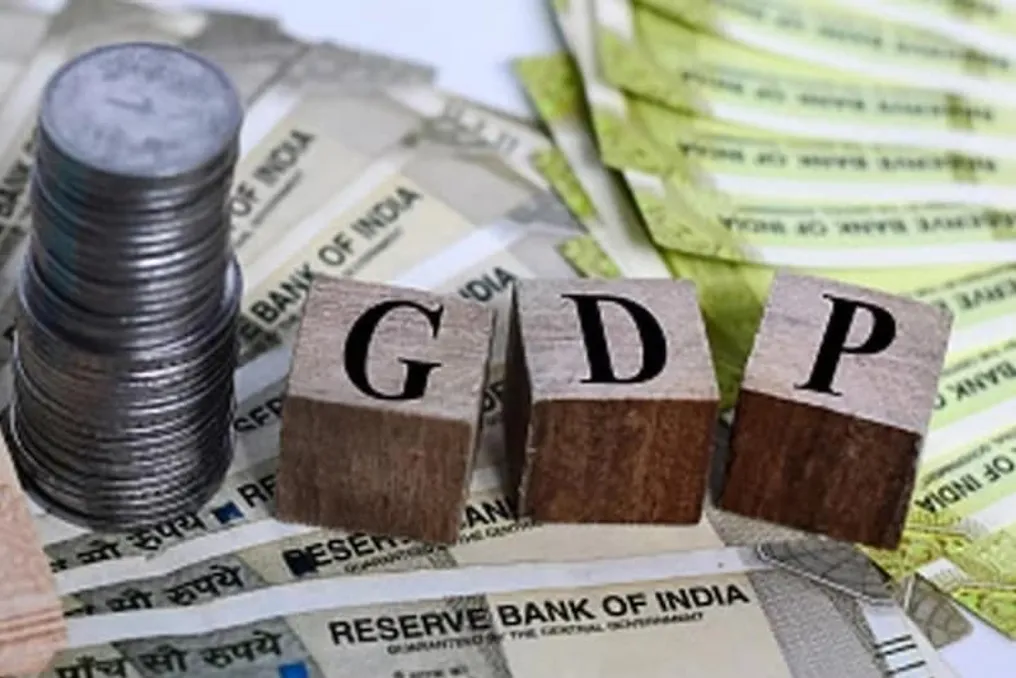
Ministry of Finance forecasts India's GDP growth at 7.35% in the second quarter
Read more
Aaj Tak
www.aajtak.in

Ministry of Finance forecasts India's GDP growth at 7.35% in the second quarter

According to the latest monthly economic review by the Ministry of Finance, the gross domestic product (GDP) growth rate for the country is projected to be 7.35% in the second quarter of the current fiscal year (FY27), covering the period from July to September.

This optimistic forecast comes against the backdrop of an impressive 7.8% growth demonstrated by the economy in the first quarter. The Ministry of Finance's Nowcasting Model indicates sustained growth in the country's economic activity.

There is a continuous improvement in the manufacturing and industrial sectors, which stimulates production. The increase in demand for electricity and other forms of energy suggests rapid development of commercial and industrial activities in the country.

Furthermore, stability has been noted in data on port cargo movements, sales in the automotive sector, and GST collection, which confirms strengthening domestic demand.

Despite the strong internal position of the economy, the report warns of several external and global risks. Geopolitical tensions in the Middle East and disruptions in sea transport via the Mediterranean route are causing fluctuations in crude oil prices, posing a threat of increased raw material costs.

In light of global uncertainty, the Ministry has raised its inflation forecast for the calendar year 2026 from the previous 3.7% to 4.7%. There is also concern related to weather risks, particularly due to El Niño, which could affect soil moisture during rye sowing and consequently food prices.

Despite these global difficulties, India's external position remains quite stable. Thanks to the policies of the Reserve Bank of India (RBI) and capital inflows, the country's foreign exchange reserves are stable and currently sufficient to cover imports for about 10.3 months.

The RBI is actively working on monetary and liquidity management to maintain the stability of the Indian rupee and the currency market amid global turbulence. The Ministry of Finance's forecast clearly shows that thanks to strong domestic demand, investment activity, and government reforms, the Indian economy maintains its status as one of the world's fastest-growing leading economies, despite global uncertainty.

Similar stories

Can Modi's plan reach the $10,000 threshold and avoid the middle-income trap?
Read more
iol.co.za

Can Modi's plan reach the $10,000 threshold and avoid the middle-income trap?

At the recent Bloomberg New Economy Forum in New Delhi, global economic discussion centered on the $10,000 figure. Economists use this per capita adjustment to determine when a developing country overcomes the 'middle-income trap' and achieves structural stability.

For India, which approaches a century of independence in 2047, reaching this level is a critical moment that will determine whether the country becomes a global superpower or remains an economy of unrealized potential. The ambition embodied in Prime Minister Narendra Modi's 'Viksit Bharat' (Developed India) initiative is significant: to raise per capita income from approximately $2,500 to a five-digit level within two decades.

Although the McKinsey Global Institute predicts that India could become the world's second-largest economy by purchasing power parity by 2050, a critical question remains: can this hyper-diverse nation scale its aggregate economy while ensuring growth for its poorest citizens? The answer depends on mobilizing two key factors—youth and women.

Economists consistently point to India's demographic dividend as the primary driver of growth. The country annually graduates over a million engineering students and has long exported highly skilled technical professionals, historically contributing to significant 'brain drain.' However, a substantial institutional shift is occurring: multinational corporations are increasingly relocating core research and development to Indian territory through Global Capability Centers (GCCs). By retaining domestic human capital, India is transforming from the world's back office into a leading hub for AI alignment, semiconductor design, and green energy technologies.

Nevertheless, GDP growth driven by the technological elite is an incomplete indicator. India will not meet its 2050 projections if half its population is left behind; currently, female labor force participation is critically low compared to G20 partners. Integrating women into the formal economy through safe urban transport, digital banking, and vocational training is not only a social imperative but also the most direct economic catalyst for increasing GDP.

India's structural challenge is that it is not a homogeneous nation-state but a continental education, representing a vibrant mosaic of over 130 languages, hundreds of different tribes, and modern tech billionaires. Consequently, its economic momentum largely depends on decentralized private sector innovation rather than top-down directives.

Even if the political architects of the 2047 goals no longer guide the process, the infrastructure plan laid today will define tomorrow's reality. If India can align its youth with modern economic infrastructure, the $10,000 vision will be realized. However, the inability to implement strict local governance necessary to support vulnerable populations threatens to create a deeply divided society: a ultra-modern state built upon an illiterate lower class.

In development economics, the 'middle-income trap' halts nations when their advantage in low-wage production disappears before their innovation sector matures. Reaching a per capita income of $10,000 means the nation has successfully built high value-added domestic supply chains, triggering a cumulative effect on domestic consumption. This requires bringing poor segments of the population into the formal economy. India is laying the foundation through Digital Public Infrastructure, which formalizes the informal sector, ensuring a direct flow of capital into banking systems. Combined with GCCs anchoring high-value research domestically, the tools for structural transformation are ready for deployment.

To permanently secure its geopolitical destiny and avoid the stagnation that plagued other emerging giants, India must democratize its economy and urgently bridge the stark disparities between its wealthy metropolises and agrarian regions. If the fruits of innovation remain concentrated in the hands of a few, the $10,000 benchmark will remain an illusion. Ultimately, while unprecedented aggregate economic power is within India's reach, ensuring fair and widespread individual prosperity remains its greatest test.

Goldman Sachs warns of serious risks for developed markets and India amid interest rate hikes
Read more
www.aajtak.in

Goldman Sachs warns of serious risks for developed markets and India amid interest rate hikes

Goldman Sachs has expressed concern regarding potential major threats associated with changes in interest rates. According to a Global Investment Research study, an increase in interest rates by 100 basis points, or 1%, could lead to a 0.6% decline in the GDP of developed markets next year. This is attributed to increased pressure on consumer inflation, domestic spending, corporate investment, and government financing due to high borrowing costs.

The study, conducted by Goldman Sachs economists Joseph Briggs and Johan Alan, detailed the impact of high interest rates on four sectors: housing, consumer spending and credit, corporate investment, and government borrowing and deficit.

An analysis of the situation in India was also conducted, noting that the country may face serious consequences. Weak economic activity could negatively affect demand for Indian products, including machinery, engineering goods, and the automotive sector. However, it should be noted that Goldman Sachs' forecasts are based on developed economies and do not provide a direct assessment of the impact on India's exports.

According to Goldman Sachs estimates, a 100 basis point rise in interest rates could cause an average decrease in business investment in developed countries by 1.8%. The strongest impact may be felt in the Netherlands, Sweden, and Germany, where the drop in investment could be 3.5%, 3.1%, and 2.1%, respectively.

Rate increases may prompt companies to postpone factory expansions, equipment purchases, and other capital expenditures. If European companies reduce investments, Indian suppliers serving these markets will have to face reduced orders and revenue pressure.

This risk is relevant to the Indian machinery sector, which maintains strong export growth. Data from the industry organization EEPC India shows that engineering product exports grew by 18.21% in the first quarter of the 2027 fiscal year compared to the previous year, reaching $46.38 billion, up from $39.24 billion the year before.

Goldman Sachs asserts that rising interest rates increase the cost of repayment for consumer loans, leaving families with less money for discretionary spending. Goldman Sachs forecasts suggest that a 100 basis point rate hike will lead to an average decrease in consumer spending in developed countries by 0.2%. The economies of Australia, Sweden, and Canada will be most affected in this regard.

Real estate investment also presents a risky area. The report suggests that a 100 basis point increase in bond yields could lead to a decline in US housing investment by approximately 8% over the next one to two years.

Governments may face increased interest expenses when refinancing existing loans and as rates rise. This will depend on the structure of government debt repayment and the increase in borrowing costs due to high interest rates.

Goldman Sachs estimates that the combined effect of these four factors could lead to a 0.6% reduction in the GDP of developed nations next year. For India, the key question is whether export growth will slow down due to weak investment and consumer demand in major export markets, and whether it will put pressure on the revenues of companies operating significantly abroad. These assessments represent a hypothetical view based on a 100 basis point interest rate increase, not a prediction that rates will necessarily rise by exactly that amount.

Popular