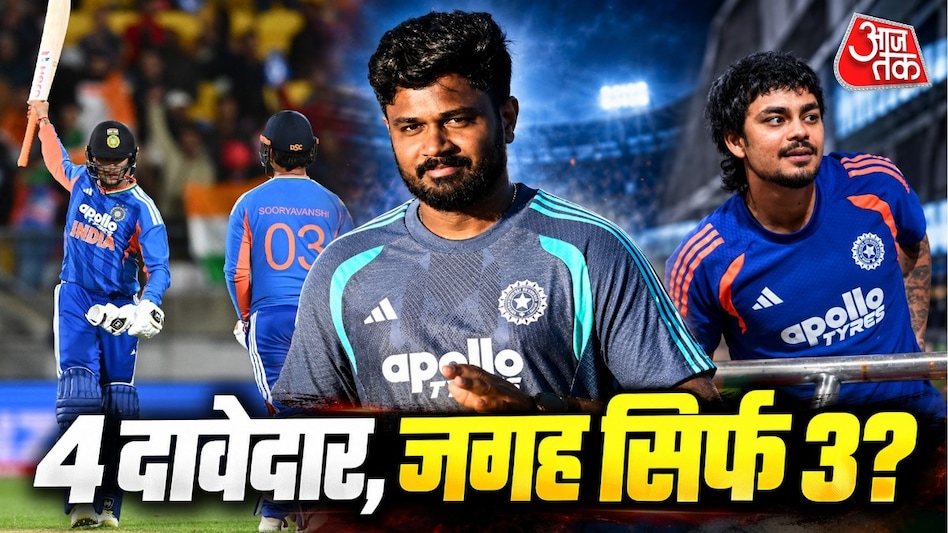
The Indian team faces a complex dilemma: how to integrate players in excellent form while accounting for the possible return of Ishan Kishan. The questions concern not only the on-field lineup but also the order of play and rotation policy.
In the third T20 match against New Zealand, the Indian team demonstrated powerful play, giving the opponents no chance. Abhishek Sharma scored 113 runs off 38 balls, and Vaibhav Suryavanshi showed his strength in the squad, allowing India to reach a target of 199 runs in just 13.2 overs.
Thanks to this impressive victory, India gained an undisputed 3-0 lead in the five-match series. However, amidst this success, a difficult question has arisen: if Ishan Kishan recovers and returns to the team, whose place will be taken?
As soon as the wait for Ishan Kishan's return ends, the Indian team may face a selection problem. On one hand, there is Abhishek, capable of changing the course of the match with his explosive playing style. On the other hand, there is Vaibhav, who was fielded at the start in the third T20. Sanju Samson is also a key player who scores runs.
Deciding to drop Abhishek will be difficult given his recent performance. Dropping Vaibhav would call into question the plan to consistently give opportunities to the young batter at his preferred position. Excluding Sanju is also not easy, especially if he is strengthening his position by scoring runs.
The question of Ishan's return is also important. When the player becomes available after recovery, the team management must decide on his inclusion and the role of the other players. The real task is not just choosing one name, but creating a combination that maximizes the strengths of all players.
In the third T20, while Ishan was absent, Vaibhav Suryavanshi got a chance to bat at the top. This sparked a new discussion about the order of play. Vaibhav's main strength is attacking bowlers at the beginning of the innings. Previously, there were doubts about experimenting with his placement at the third position.
However, if the team plans to continue using Vaibhav at the start, it will have to reconsider the batting order of the remaining batsmen. In the third T20 against New Zealand, Sanju Samson batted at the third position. Now, if they maintain the plan with Vaibhav at the start, Sanju may be forced to adapt to a different role.
The situation is complicated by the question: should Sanju give up his preferred position for Vaibhav? Will the team management change the batting order to keep the Abhishek and Vaibhav duo? And will it become harder for Sanju to secure a spot in the squad after Ishan's return?
There is currently no definitive answer to these questions. Nevertheless, it is clear that one player's return may require a review of many aspects of the batting order.
The most important question in this situation relates to the Indian team's rotation policy. India has scheduled 16 T20 international matches from August to December: 3 against Afghanistan, 5 against West Indies, 5 against New Zealand, and 3 against Sri Lanka.
There could be a scenario where the team management predetermines how many matches each player will get, who will rest, and what each player's role will be. If players were informed in advance that they could take a break after four or five matches, the decision to exclude a player would not be based solely on their performance.
This could bring two advantages to the team. Firstly, it would reduce the pressure on key players who play constantly. Secondly, players' roles would remain clear during experiments with alternative squads.
Nevertheless, rotation does not mean that players must be excluded, even with good performance. Management must make decisions based on physical condition, form, opponent, and strategy. But having a preliminary plan could significantly simplify explaining any changes.
There are about two years until the T20 World Cup. This gives the Indian team time to test various batting order options, evaluate players in their roles, and make changes if necessary.
Therefore, the current selection crisis cannot be seen merely as losing a spot for one player. It is also an opportunity for the team management to develop a future strategy. Does India want to promote the Abhishek and Vaibhav duo at the top? What position will benefit Sanju the most? What will his role be after Ishan's return?