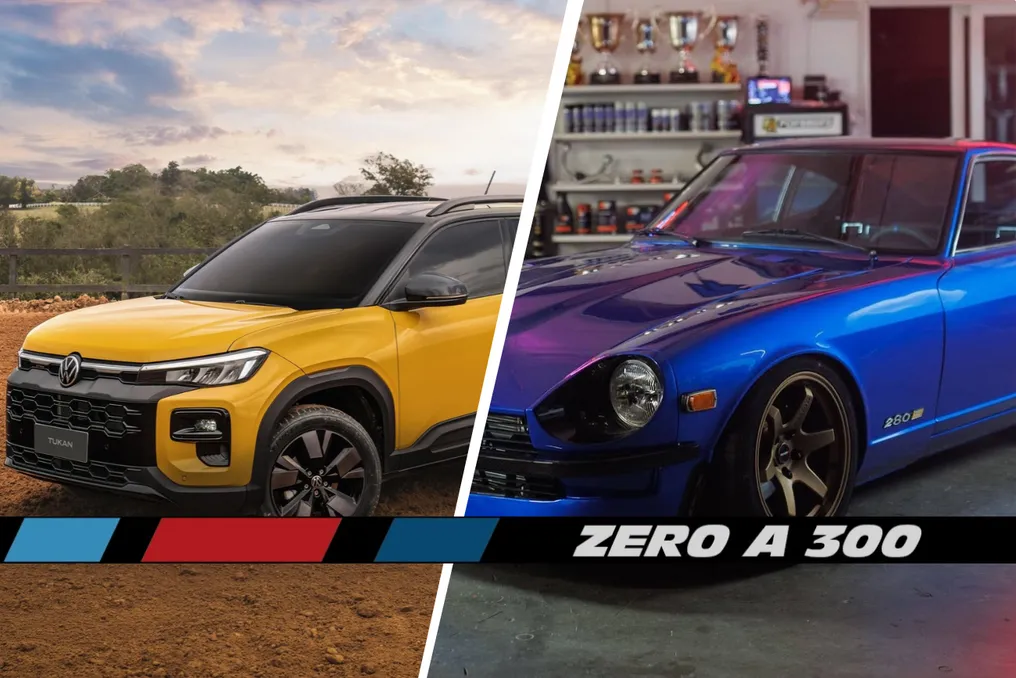
The Volkswagen Tukan, the automaker's long-awaited monocoque pickup truck, has finally received a launch date. Ricardo Ploguer, Vice President of Product Development for Volkswagen South America, announced at an event in Germany that the vehicle will be introduced in early 2027.
In Brazil, the Tukan will be offered in four configurations: two double-cab and two single-cab. When exhibited in Barretos (SP), the pickup was seen in the Extreme variant, featuring a double cab and premium trim, and the Robust variant, focused on work, characterized by unpainted bumpers and stamped steel wheels without hubcaps.
During the same event in Germany, VW also presented the Tukan Magnet, its more economical double-cab option. Compared to the Extreme, this Magnet version eliminates the glossy black paint on the grille and replaces the 17-inch wheels with a 16-inch set. The displayed model had body-colored mirrors, side steps, and front LED lighting, although it was not confirmed whether these items would be standard or optional.
The name for the intermediate single-cab version, which is above the Robust, has not yet been officially announced by Volkswagen, despite examples seen in tests bearing the 'Iron' emblem. So far, the press has only had access to the exterior of the Tukan, leaving the dashboard design a mystery. However, since the pickup uses the MQB-A0 platform, shared with the Taos, T-Cross, and Nivus, a similar internal architecture is expected.
Regarding mechanics, complete details are unavailable, but it is known that the VW Tukan will debut with a 12V mild-hybrid system for the more expensive versions, while the Tukan Robust should retain the 1.6 MSI engine from the Saveiro.
Possibility of Chinese electric vehicle in Brazil
Continuing the topic of the Volkswagen event in Germany, the manufacturer mentioned the possibility of forming a partnership with Chinese companies to introduce a more affordable electric model to the Brazilian market. The goal would be to compete directly with the BYD Dolphin Mini, one of the main drivers of entry-level electric vehicles in the country.
Other brands are already moving in this sector: it is speculated that Chevrolet will bring the Wuling Bingo Pro under the name Joy EV, and Stellantis is evaluating the Leapmotor A05 and B03X models to create its own entry-level electric vehicle in Brazil.
For Volkswagen, the chances of collaboration lie in its current partnerships in China, such as Saic, FAW, and JAC. Two of these companies have ties to Brazil: Saic assisted in the development of the VW Taos (derived from the Chinese VW Tharu) and supplied the platform used in the future Amarok; and FAW is involved in the project for the future hybrid VW Taos, scheduled for 2028 in Brazil. The connection with JAC is currently limited to China, but it is relevant because they are responsible for the entire line of electric vehicles built on the MEB platform sold by VW in China.
Although the project is still in the initial stages of development and the final solution is not defined, the plan is for it to be ready and available for sale within the next two years.
Nissan adapts V6 biturbo engine to classic Datsun 240Z
Nissan will present at SEMA in Las Vegas a reinterpretation of the first Z, the Datsun 240Z, originally launched in 1969. This project, named Datsun S30 Concept, was developed in collaboration with Formula Drift three-time champion Chris Forsberg, combining the classic sports car body with the mechanical package of the contemporary Nissan Z.
The original inline six-cylinder engine was replaced by the three-liter, twin-turbo V6 VR30DDTT from the modern Z. This engine was equipped with Garrett PMAX turbos, Nismo intake and intercooler, and mated to the new Z's six-speed manual transmission, which includes a dual-disc clutch and Nismo R200 locking differential. The exact power output of the unit was not disclosed, but the original Z engine reaches 400 hp (405 hp) in the standard version.
In addition to the engine, the S30 received suspension improvements, including adjustments, new anti-roll bars, and revised geometry, along with modified steering and Wilwood brakes with six-piston calipers in the front and four in the rear. The body maintained the original proportions but featured carbon fiber hood, fenders, bumpers, and tailgate, along with 17-inch Nismo forged wheels. The interior features OMP racing seats, analog instruments, and a sports steering wheel.
The Datsun S30 Concept will be displayed alongside two other Nissan projects for SEMA: a Z prepared for the SCCA Touring 2 category and a 300 hp Sentra Spec-V with a manual transmission and competition components.
BAIC confirms B30 hybrid for Brazil in 2027
BAIC, the Chinese manufacturer that began operations in Brazil in August with the Arcfox T1 and T5 electric vehicles, confirmed the launch of its first hybrid model in the country, the B30. This SUV, inspired by robust designs like Defender/Wrangler and focused on off-road use, is scheduled to arrive between March and April 2027.
Known as the BJ30 in other markets, the vehicle has a length of 4.73 meters, a wheelbase of 2.82 meters, and a ground clearance of 220 mm. Its powertrain combines a 1.5-liter turbocharged gasoline engine with two electric motors, one on each axle, utilizing a two-speed DHT transmission. The manufacturer announces a total power of 409 hp from the three motors, but has not yet specified the effective combined power of the unit. According to factory data, it can accelerate from zero to 100 km/h in 6.9 seconds.
BAIC is also working with Bosch on developing a flex hybrid version for the Brazilian market, but this is only expected to launch in 2028. In the future, the brand plans to introduce the B60, a larger SUV that will use electric propulsion supplemented by a combustion engine acting as an autonomy extender. Sales prices have not yet been disclosed.
Alpine does not rule out combustion engine for new A110
It is common for manufacturers to announce new sports cars as fully electric, promising to replicate the experience of a combustion engine car. After public reaction, some companies reconsider, opting to keep the traditional engine. Alpine is the focus of this discussion.
The French company had previously indicated that the next generation of the A110 would be exclusively electric. However, it seems the company took into account enthusiast feedback, who considered it a waste to transform such a well-designed car, as seen at the Paris Motor Show, into a battery-only vehicle.
Philippe Krief, Global Head of Alpine, and Nicola Burnside, Brand Director in the UK, stated that the manufacturer has not ruled out the possibility of including a combustion engine in the structure of the new car, aiming to facilitate its commercialization in various global markets. In an interview with TopGear.com, Burnside clarified that the brand's new architecture, called APP (Alpine Performance Platform), was designed to offer flexibility. Although the brand is fully committed to the initial electric launch, believing it can elevate the status of the sports car, she emphasized that it is not closing any doors.
If the 100% electric path is followed, engineering guarantees the maintenance of the lightness and agility that defined the coupe. Burnside confirmed that the new electric A110 will have a maximum weight of 1,500 kg and will maintain the low driving position of the current model, thanks to an arrangement that distributes batteries between the front and rear around the driver, preventing the feeling of being on a heavy block. Additionally, the APP platform was designed to support various body types (such as convertibles and 2+2 versions) and unique engine configurations at the rear or dual.
The executive invited the most rigorous critics to test the battery model before passing judgment, summarizing the French manufacturer's goal for the future: 'My vision is that we become the electric brand of choice for petrolheads.'