Electric Plant Co. develops Bud sensor for analyzing plant electrical activity
Read more
Design Indaba
designindaba.com

Electric Plant Co. develops Bud sensor for analyzing plant electrical activity

Electric Plant Co. has created the Bud sensor, designed to record the subtle electrical activity of plants, transforming this data into practical information for maintaining nature's health.

Small probes attached to the plant stem capture its electrical activity. This activity allows for insights into the plant's hydration status, the level of environmental stress exposure, and its physiological responses. The Bud sensor is integrated with the company's artificial intelligence model named Bombadil.

Bombadil was trained on an extensive dataset—over four million hours of electrical signals collected from more than 1400 plants belonging to 100 different species. By analyzing these signals, Bombadil can assess seven indicators of physiological stress, including photosynthesis efficiency and the temperature difference between the plant's leaves and the surrounding air.

This enables specialists to gain a more immediate understanding of the internal processes within the plant and its reaction to the external environment. The company's goal is to use electrophysiology to strengthen plant health, helping people recognize the needs of living systems before visible signs of distress appear.

The application of this technology in agriculture can help farmers make more precise decisions regarding irrigation, timely detect stress, and utilize water and other resources more efficiently. In urban design and landscape architecture, plant sensory technologies can influence the management of trees, parks, green roofs, and other urban living infrastructure.

Data on plant stress can guide maintenance work, optimize water distribution, and contribute to protecting urban vegetation from rising temperatures and unpredictable weather. Healthier urban ecosystems, in turn, promote increased biodiversity, improve human well-being, and create more comfortable public spaces.

As climate change increases pressure on food systems, water reserves, and natural habitats, understanding plant reactions to the environment can help communities make more informed ecological decisions. Electric Plant Co. provides actionable analytical data to support the flourishing of nature.

Similar stories

How to Grow Plants in Glass Bottles According to Vastu Principles: Plants for Attracting Prosperity
Read more
www.aajtak.in

How to Grow Plants in Glass Bottles According to Vastu Principles: Plants for Attracting Prosperity

The popularity of using plants to decorate living spaces is rapidly growing. Notably, some types of plants do not require soil and large pots to grow; they can be easily cultivated in glass jars or bottles. These plants allow a home to become green and beautiful even in small spaces. Furthermore, in Vastu teachings, some plants are associated with luck, prosperity, and positivity. According to beliefs, placing such plants in the house in the correct direction helps create a pleasant atmosphere.

Let's look at three types of plants that can be grown in water and used to decorate your home.

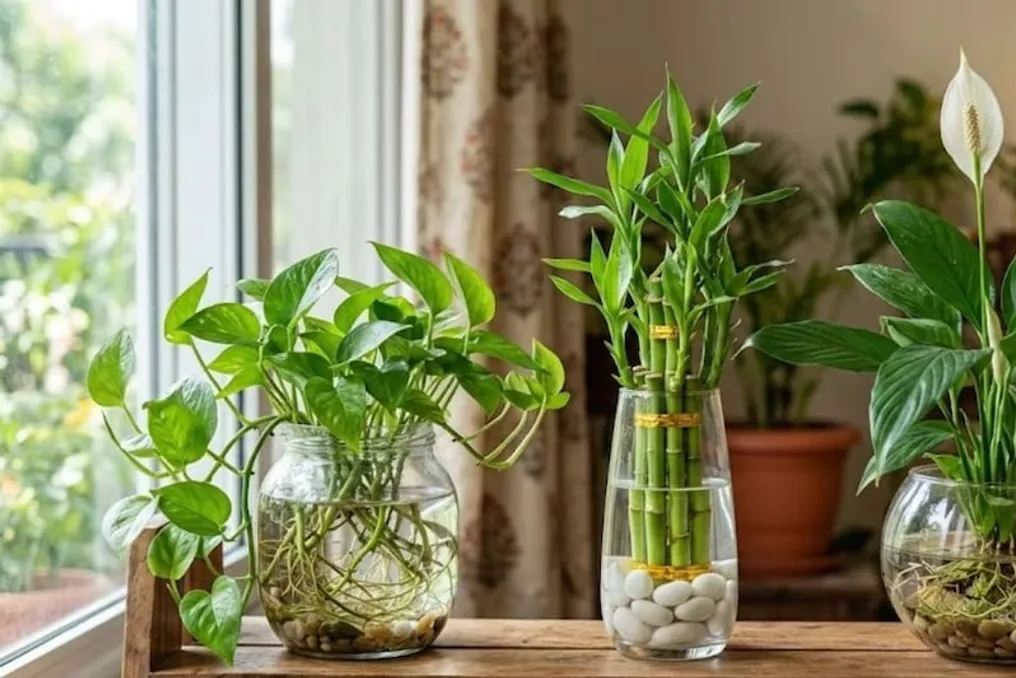
The Money Plant is a popular choice for homes. Its fast-growing leaves and stems enhance the appearance of the dwelling. In Vastu and Feng Shui, it is considered a symbol of wealth, prosperity, and success. It is believed that having a green money plant in the house supports positive energy and brings happiness.

Growing this plant in water is quite simple: place a healthy cutting of the money plant in a jar of clean water. It is important that the node of the plant is in the water, which allows the roots to develop. According to Vastu, the southeast direction is considered favorable for the money plant. To maintain the plant's health, regularly change the water and remove yellow or dry leaves. The financial benefits mentioned in Vastu are based on religious beliefs.

Lucky Bamboo is very popular for decorating homes and offices due to its attractive stalks and green leaves. In Feng Shui, it is associated with luck, success, and abundance. It is believed that its presence creates a positive environment and motivates development in life.

Lucky Bamboo can also be grown in water instead of soil. To do this, pour clean water into a tall glass container and place the plant's roots in it. Small decorative stones can be added to the container to support the plant. According to Vastu and Feng Shui beliefs, it is best placed in the east or northeast. When caring for it, you should monitor the water quality and change it regularly, as well as clean the container. The plant should be in a place with sufficient light, but without direct intense sun.

The Peony Lily is known for its bright green leaves and white flowers. This plant can add beauty to the living room, study area, or a well-lit spot. In Vastu, it is associated with peace, purity, and harmony.

Peony Lilies can also be grown in water, but first, the roots must be carefully cleaned of soil. Then, the roots are placed in water. Care must be taken to ensure that the leaves are not submerged in the water and that the plant receives enough diffused light. According to Vastu, it is favorable to place the peony lily in the north or east. However, one cannot rely solely on direction; the plant's needs for light, temperature, and watering must also be considered. Additionally, the peony lily should be kept away from pets and small children, as it can be harmful if ingested.

The method of growing plants in water can be useful for residents of small apartments and studios. However, constant care is required to keep the plants in a green state.

  • Use clean containers: Using a glass jar or bottle makes it easier to observe the condition of the roots.
  • Change water regularly: Change the water immediately if it becomes dirty or starts to smell unpleasant.
  • Monitor lighting: Provide the plants with enough light according to their needs. Direct intense sunlight can damage the leaves of many houseplants.
  • Check roots: If the roots start to turn black or rot, remove the damaged parts and clean the container.
  • Understand plant needs: Not all plants grow equally well in water. Choosing the right plant is crucial.

Do Water Plants Really Bring Wealth and Happiness?

In Vastu and Feng Shui, plants such as the Money Plant, Lucky Bamboo, and Peony Lily are associated with positivity and prosperity. Their real benefit lies in improving the aesthetics of the home, the feeling of connection with nature, and maintaining greenery around.

Students Use Artificial Intelligence to Monitor Insects Contributing to Biodiversity Conservation in Piauí
Read more
g1.globo.com

Students Use Artificial Intelligence to Monitor Insects Contributing to Biodiversity Conservation in Piauí

Students at the Paulo Freire Full-Day State Education Center (Ceti) in Guarabás, southern Piauí state, developed a project that combines biology and artificial intelligence (AI) knowledge to aid in the conservation of organisms vital for ecological balance and agriculture.

The project, named PolinizAI, functions as a monitor for pollinators and bioindicators, such as fireflies. Students participate in fieldwork, taking photographs, cataloging information, and gathering testimonies from local residents and veteran farmers in the region.

Bioindicators reflect specific ecosystem conditions, including pollution and degradation, as they are sensitive to environmental impact. Teacher Amanda Sousa explained that through 'offline AI, we work on organizing and comparing this data to understand patterns. The classroom content is related to what they observe where they live.'

According to the Piauí State Secretariat of Education (Seduc), the project arose from the need for regional residents to better understand observed climate and environmental changes. After completing data collection, the team plans to create a website so that students, teachers, and farmers can continue to track and monitor regional biodiversity records.

Student Fernanda Maia explained the goal of creating the website: 'The idea behind the website is to gather what we are researching and make this information accessible. We want it to help other people learn about the region's pollinators and track the records so the work continues and benefits the community.'

Startup develops AI model to analyze plant electrical signals and determine their needs
Read more
olhardigital.com.br

Startup develops AI model to analyze plant electrical signals and determine their needs

The startup Electric Plant has introduced Bombadil, an artificial intelligence model capable of interpreting the electrical signals emitted by plants and determining their needs. This technology uses sensors attached to stems to collect data on approximately 125 species. The gathered information can help producers optimize watering and fertilizer application.

The company notes that these sensors cost tens of dollars, whereas traditional tools can cost thousands. The system potentially has the capacity to increase agricultural productivity and reduce water consumption by 20% or more. To bring this technology to market, the startup secured $11.2 million in a seed funding round.

Electric Plant's technology is quite simple: a device resembling a flash drive with an antenna and having a height comparable to a mobile phone connects to the plant stem. The idea is for this device to reach the cambium—the secondary protective tissue of the plant located just behind the bark of the trunk or stem. Upon connecting to this layer, the device detects microvolts emitted by the plant and collects the corresponding data.

Bombadil then analyzes this information and transmits it to another connected device. Justin Mast, co-founder and CEO of Electric Plant, stated in an interview with TechCrunch: 'This is the most diverse model ever created regarding biological electrical signals. No one has ever done anything like this in the animal kingdom.'

According to the startup's data, this information can be useful for farmers and caretakers to accurately determine the plant's needs. With such an increased level of accuracy in necessary care, it is possible to achieve water savings and increase production efficiency. This innovation aligns with the new trend toward a more technological approach to agriculture and plant care.

Recently, John Deere also developed its 'JD' chatbot, which is based on data collected directly during harvesting, promoting more personalized work, as well as increasing efficiency and mitigating environmental impact.

Popular