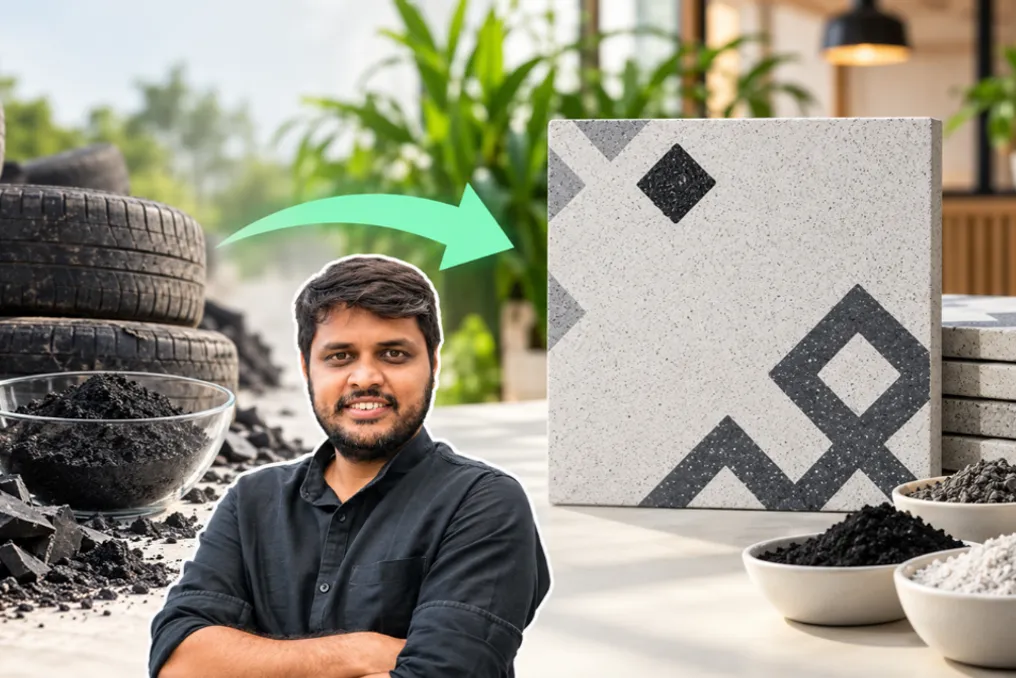
In conditions of air pollution, which often shrouds cities in a gray haze, there is an idea to transform this pollutant. Instead of remaining waste, the pollution can be collected, processed, and used as building material for homes and workplaces.
Architect Tejash Sidnal from Mumbai is exploring this possibility through his company Carbon Craft Design. He converts recovered carbon into architectural tiles, giving a second life to the polluting substance and rethinking methods of manufacturing building materials.
The idea came to Sidnal during his architecture studies when he became interested in biomimicry—an approach based on nature's inspiration to solve human problems. He began to question what makes society healthy, paying attention not only to large buildings but also to basic needs for clean air, water, and food.
This led him to a contradiction: the construction industry itself contributes significantly to global carbon emissions, yet the materials used to create our living spaces are rarely viewed through the lens of pollution. The question arose: can a carbon waste that contributes to this problem become part of the solution?
In 2020, Sidnal founded Carbon Craft Design to turn this question into a tangible innovation—the creation of Carbon Tiles.
How are carbon wastes turned into tiles?
Black carbon is formed as a result of incomplete fuel combustion and other carbonaceous materials. When released into the atmosphere, it contributes to air pollution and climate change.
Carbon Craft Design obtains recovered carbon waste from industrial processes, including tire recycling and pyrolysis at factories. The material is cleaned and treated, then mixed with cement, recycled marble powder, and marble chips.
The resulting mixture is then pressed using hydraulic presses to form tiles with unique geometric patterns. Unlike traditional ceramic tiles, which usually require energy-intensive firing in high-temperature kilns, Carbon Tiles are made by pressing and harden at room temperature.
According to the startup's data, this production process consumes approximately one-fifth of the energy required to manufacture standard fired tiles. The company also claims that every square meter of its tile prevents the emission equivalent to 25 kg of carbon dioxide.
By integrating recovered carbon into a durable building material, the startup aims to give waste a useful application instead of allowing it to increase the burden on environmental pollution.
Science, Craftsmanship, and Creativity
For Sidnal, sustainable development is not just about developing a new material; it is also about rethinking the production process and who performs that production. Carbon Craft Design collaborates with ceramic artisans in Morbi, Gujarat, a region known for its tile industry.
Relying on traditional artisanal skills, the craftsmen manually create the characteristic geometric patterns of the tiles, lending the material individuality and detail. This partnership merges material science research with established craft skills. Environmental issues are addressed through the use of recovered carbon and low-energy production, while the artisans' expertise helps create tiles suitable for modern architectural spaces.
The result is a product that combines ecology and aesthetics—which is crucial in an industry where materials must be not only functional but also visually appealing.
From Architect's Ideas to Exhibition Halls
Transforming an ecological concept into a commercially viable product requires more than just a promising material; it also requires consumers willing to use it. Carbon Craft Design has collaborated with major brands such as Adidas, developing tile patterns for their exhibition halls. Such projects demonstrate how recycled materials can find their place in commercial interiors where design and durability are as important as sustainability.
The startup has also received support from impact-focused investors, including Social Alpha and Pilani Innovation Entrepreneurship Development Society, and participated in climate-focused accelerators. Among its achievements are the Lexus Design Award India in 2020 and participation in the No Waste Challenge organized by What Design Can Do and the IKEA Foundation in 2021.
These milestones reflect a growing interest in materials that are re-examining the traditional path from resource extraction to production and disposal.
It is impossible for one material to solve the climate crisis. Construction must continue to work on reducing emissions across the entire supply chain, energy consumption, and the life cycle of buildings, while innovations like Carbon Tiles must prove their durability, safety, and environmental benefit at scale.
However, Sidnal's work offers a tangible starting point. By recovering carbon waste, reducing the energy consumption in tile production, and collaborating with traditional artisans, Carbon Craft Design unites pollution management, sustainable production, and local craftsmanship. The idea is simple and powerful: what once contributed to an environmental problem can become part of the spaces where people live every day. Perhaps this is where a cleaner future begins—not only by preventing waste but also by studying its potential before it is thrown away.