Rooibos seeds, an indigenous plant of South Africa, are being prepared for an unusual journey beyond Earth. As part of a scientific study aimed at examining the influence of space conditions on the growth of this plant, 17,346 seeds will be delivered to the International Space Station (ISS).
From the harsh landscapes of Cederberg to the ISS, one of South Africa's most unique local plants is preparing to take a giant leap in space science. The 'Rooibos in Space' initiative has reached a new stage, as 17,346 rooibos seeds are ready to join South African school and university science projects on a trip to the USA before the planned orbital launch.
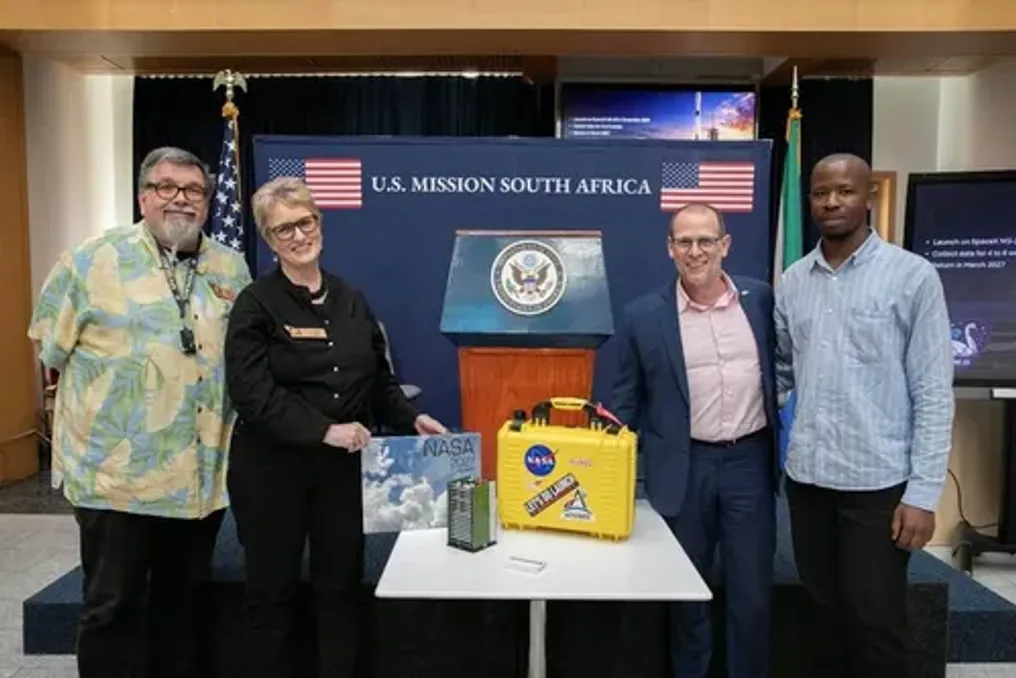
The seeds, weighing approximately 74.2 grams in total, will be transported to Voyager Technologies in Texas, where the experiment for the space flight will be prepared. This stage was marked by a farewell event organized by the US Consul in Cape Town, Allison Areias.
For a plant closely linked to South Africa's heritage, this mission provides an opportunity to study how rooibos reacts to an environment vastly different from its natural growing conditions.
The experiment will subject the seeds to microgravity and cosmic radiation, after which they will return to Earth for further analysis. The seeds were divided into three groups: untreated, scarified, and scarified with protective agricultural coating. Scarification involves weakening or damaging the seed coat to facilitate water penetration and support germination.
The different treatment methods will allow researchers to compare how the seeds function after exposure to space conditions. The experiment will be housed in a specialized Nanolab—a compact standardized laboratory module designed for conducting research in space. These 'plug-and-play' type modules allow experiments to be conducted without the need for large, custom-built equipment.
The Rooibos Nanolab is scheduled to go to the ISS aboard the commercial cargo ship Cygnus NG-25. The mission launch is currently expected between December 2026 and January 2027, due to changes in Voyager and NASA flight schedules, which led to the postponement of the experiment from its originally planned October date.
The seeds are expected to spend four to six weeks in space before returning to Earth.
After returning, the experiment will continue in South African soil, bringing together researchers and students to determine whether time in space affected the plants. Schools in the Cederberg region, the natural habitat of rooibos, as well as Parklands College, will participate in planting the space-exposed seeds alongside control seeds left on Earth.
Over eighteen months, students and researchers will monitor and compare the germination rates, growth patterns, and development of the plants as they mature. The results obtained may provide insight into how rooibos seeds react to unusual space conditions while also giving young people the opportunity to participate in real scientific investigation.
Student participation is central to this initiative, which aims to develop practical skills in science, technology, engineering, and mathematics (STEM). The broader project already includes the involvement of schools and educational events, including a national mission badge competition that invited youth aged 12 to 18 to design a badge representing the mission.
For Kirill Ngkwala, a rooibos seed specialist, preparing the experiment provided a rare opportunity to combine practical knowledge of rooibos seeds with advanced space research. Ngkwala noted: 'Working with the seeds from preparation to Nanolab assembly was an incredible experience.' He explained that the seeds were prepared under various conditions so that researchers could compare their performance with seeds left on Earth. He added: 'It is exciting to think that something as uniquely South African as rooibos is now part of a space experiment.'
David de Villiers, Director of the South African Rooibos Council (SARC), called this stage an exciting development for the plant and for South Africans following the project. He stated: 'The scientific goal is to study what happens to rooibos seeds when exposed to conditions outside of Earth, opening up new opportunities to study this unique South African plant.' The initiative was conceived by SARC and developed in collaboration with MaxIQ Space.
The mission will mark the first time that seeds of an indigenous South African plant will be sent into space for such research. Rooibos is uniquely adapted to the Cederberg region, where its natural habitat has shaped its place in South Africa's agricultural heritage. By sending its seeds beyond Earth and returning them for observation, the project explores how the plant responds to conditions different from those it experiences in its natural environment. The results are yet to be seen, but the initiative has already created an opportunity to link South African agricultural knowledge, space science, and classroom learning. For participating students, the experiment takes science out of textbooks and into live research. And for rooibos, a plant rooted in the Cederberg, this journey offers a new way to explore its potential, starting on Earth, going into space, and ending back home where the next phase of discoveries will unfold.