Casap raised $56 million to help banks combat AI-driven customer fraud
Read more
Ventureburn
ventureburn.com

Casap raised $56 million to help banks combat AI-driven customer fraud

Banks are facing a growing number of fraud cases originating from their own customers rather than hackers. In response, the New York-based startup Casap has raised $56 million to support banks in countering this issue. The company closed a re-priced Series B round on Wednesday, led by Base10 Partners.

Strategic investors included Experian and Synchrony, while Emergence Capital and Lightspeed Venture Partners participated in the follow-on round. This new capital brings Casap's total funding to $90 million.

First-party fraud, often called friendly fraud, is straightforward: an individual makes a purchase and then disputes the transaction, claiming they did not make it. While this can sometimes be an accidental error, it is more often not.

The figures demonstrate a rapid rise in the problem. According to a survey by Casap and Cornerstone Advisors, first-party fraud accounted for 36% of all reported fraud cases in 2024, up from 15% the previous year. Investor Primary estimates annual losses at over $100 billion.

Banks express serious concern. Two-thirds of surveyed institutions expect further growth in fraud losses by 2026. Moreover, nearly half of them do not know how many false claims their tools actually detect.

Ron Shevlin from Cornerstone noted a worrying fact: more than a third of Americans claim to have committed first-party fraud or know someone who has.

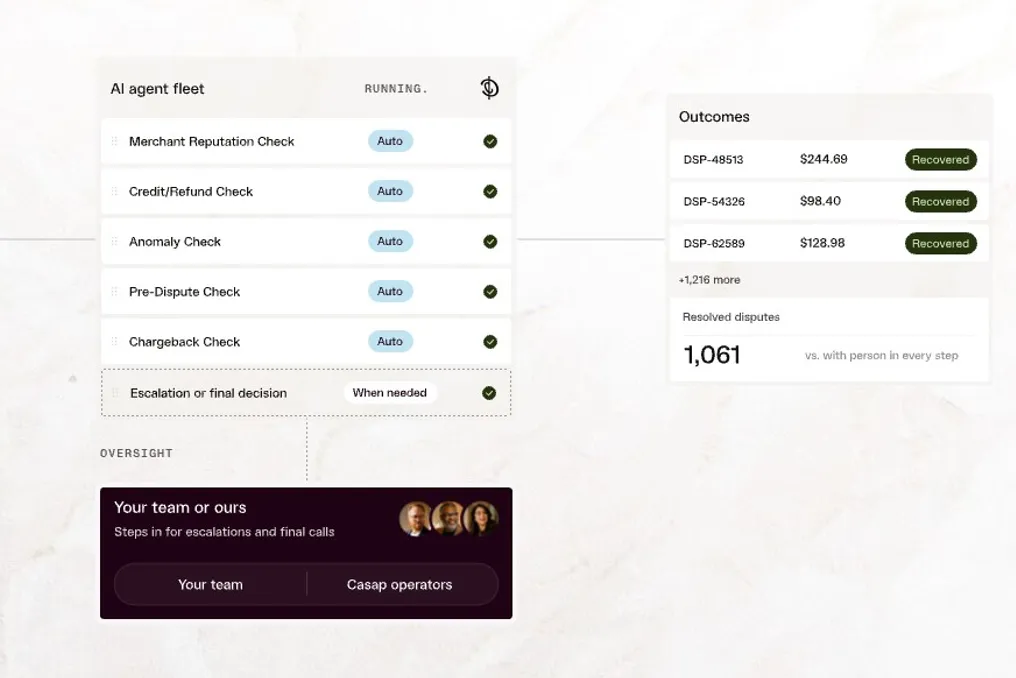
The dispute resolution process is slow and costly. A single case can take up an employee's time for 45 minutes and stretch over 90 days. Casap aims to change this situation using its AI agents, which manage the dispute from start to finish.

These agents handle application intake, investigation, decision-making, evidence collection, refunds, and customer communication. The agents adhere to each bank's specific rules, and cases requiring human judgment are escalated to a person.

The results, according to Casap, are hard to ignore. Clients report a reduction in first-party fraud losses by 51%. Dispute resolution time is cut from a potential 90 days to just eight days. Furthermore, about 73% of cases are resolved automatically, and human processing time is reduced to one or two minutes. Chargeback rates have also improved: Casap reports a 96% success rate compared to the industry average of around 60%.

Casap was founded by CEO Shanti Shanmugam and co-founder Cissy Peters. Shanmugam previously worked at Robinhood, and Peters worked at Chime. They first met on Facebook and started building Casap in their spare time.

Since then, the company has grown rapidly. About a year ago, Casap raised $25 million in a Series A round. Since then, revenue has grown tenfold, exceeding the initial goal by more than double. Casap now serves over 100 banks, credit unions, fintech companies, and processors.

Experian plans to study consumer intent signals and first-party fraud jointly with Casap. Synchrony is using the technology to support the transition of its customer service. Kelly Shaw of Synchrony Ventures stated that Casap helps resolve disputes faster and stop first-party fraud.

Banks face a difficult choice: tighten dispute controls and annoy honest customers, or be lenient, allowing fraudsters to get paid. Adeemi Ajao, Managing Partner at Base10, believes Casap is breaking this dilemma.

Casap has demonstrated that AI agent technology can change this trade-off. This is why this round is important. Casap is now moving beyond just disputes to cover fraud, collections, claims, and complex exceptions—some of the most expensive tasks in finance.

For clients, this could mean faster refunds in case of a genuine error. For banks, it means lower losses, and for fraudsters, it means the possible end of free opportunities.
Similar stories

Hyphenate raises $45 million in Series A round to create financial management AI agents
Read more
ventureburn.com

Hyphenate raises $45 million in Series A round to create financial management AI agents

Hyphenate, formerly known as Maximor, has raised $45 million in a Series A round led by Nexus Venture Partners. The New York-based company was renamed at the beginning of October. This capital injection brings the total amount raised to $54 million.

The company's core idea is to use artificial intelligence to perform financial operations beyond simple communication. Hyphenate was founded by two Microsoft veterans: CEO Ramnandan Krishnamurthy and co-founder Ajay Krishna Amudan, who spent significant time in finance and corporate transformation at Microsoft, including restructuring the company's internal financial platform.

The company began operations in 2024. In September 2025, it secured a seed round of $9 million, supported by Foundation Capital alongside Gaia Ventures and Boldcap. Angel investors included Arvind Srinivasan, CEO of Perplexity, and Tien Tsuo, founder of Zuora.

The renaming to Hyphenate occurred in early October 2026, referencing financial processes such as Order-to-Cash and Procure-to-Pay, where each process is linked by a hyphen. Krishnamurthy explained that 'the multi-hyphenated approach is not limited to one track.'

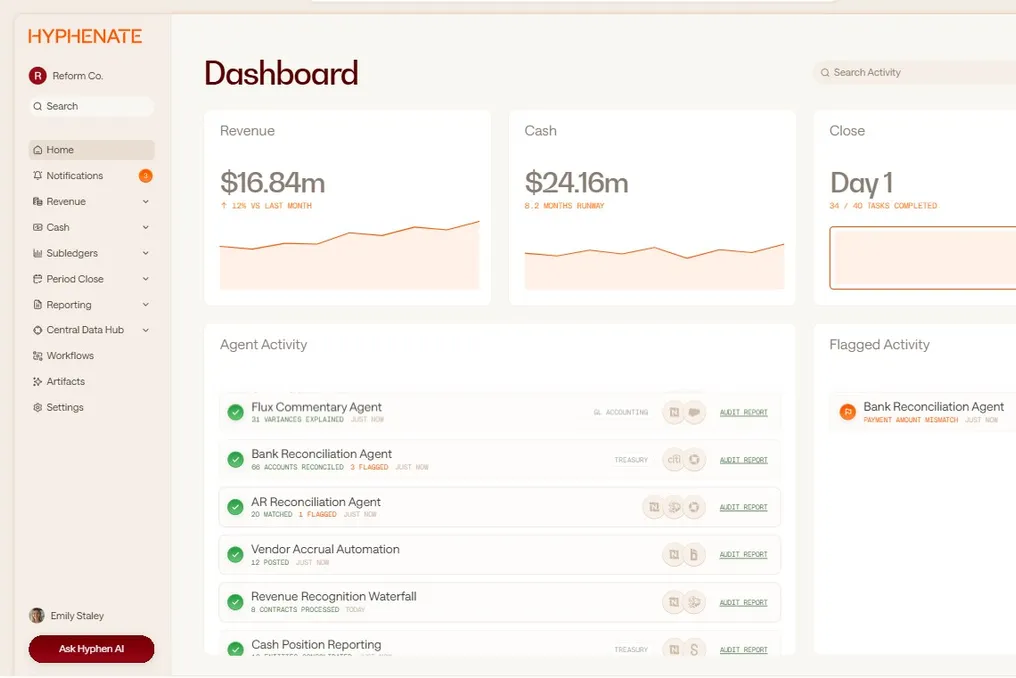
Hyphenate does not require a complete replacement of existing ERP systems. Its agents operate on top of already used systems, such as banking and settlement systems. They are capable of making entries in accounting books, reconciling bank statements, and processing invoices.

The system also handles invoice sending and approval collection. This is comparable to a junior accountant who never misses deadlines. If a situation requires human judgment, the agent flags it in Slack. All actions are recorded, providing auditors with a clear trail.

The platform covers five key areas: order-to-cash, treasury, general ledger and period close, procure-to-pay, and reporting. The company claims that about 98 percent of transactions are processed entirely without human intervention. Furthermore, payment is based on actual work performed, not on the number of licenses.

Investors decided to allocate $45 million based on performance metrics. Hyphenate reports an 86-fold revenue growth since its seed round. Clients show high loyalty: on average, they use six modules, and 40 percent expand their cooperation within the first year.

Examples of successful implementations include one cybersecurity firm that launched in less than four weeks and reduced its cash staff from twenty to five people. Additionally, a private investment holding with over thirty subsidiaries managed to reduce audit findings from seven to zero in six months.

It should be noted that these figures are provided by the company itself and have not yet undergone independent verification. Previously, according to software leasing firm Rently, the platform allowed month-end closing to be reduced from eight to four days. Nevertheless, this explains Nexus's quick decision.

Many small and medium-sized enterprises still use Excel for closing financial reports, which is a slow, error-prone process that leads to end-of-month losses. Hyphenate bets that clients are looking for more than just another dashboard.

Hyphenate's offering presents low risk for CFOs because it allows testing AI agents without the need to invest in migrating the entire system. These investments signal capital movement into functional AI solutions. For founders, this proves that an audit trail can gain trust in a skeptical industry. Hyphenate is interested in further advancing pricing, margin, and capital decisions, allowing financial teams to save time on reconciliation and dedicate more time to business management.

Popular