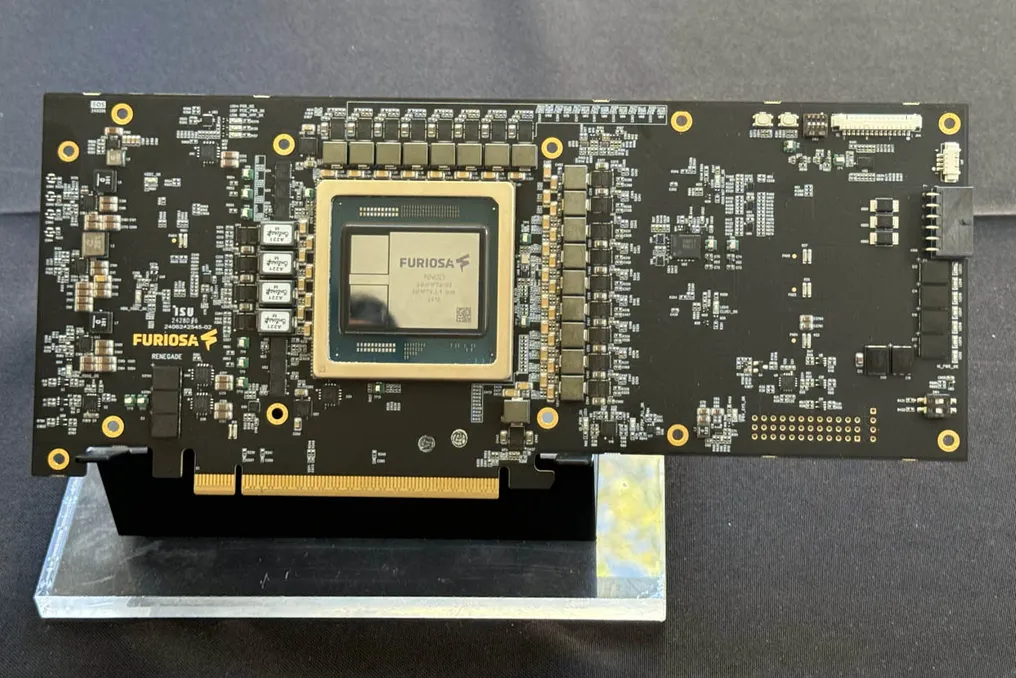
FuriosaAI raises $620 million to compete with NVIDIA and address data center power consumption issues
Read more
Ventureburn
ventureburn.com

FuriosaAI raises $620 million to compete with NVIDIA and address data center power consumption issues

Seoul-based company FuriosaAI announced on Wednesday that it has raised a Series D funding round of $620 million. The company aims to challenge NVIDIA and solve the bottleneck in data center energy consumption.

Thanks to this round, FuriosaAI's valuation reached $2.9 billion, approximately four times its previous valuation of $735 million. Notably, FuriosaAI reportedly turned down an offer from Meta for $800 million in 2025.

The South Korean National Growth Fund contributed the largest share with $280 million, which is part of the government's strategy to develop the domestic semiconductor industry. International investors added another $110 million, with the American company Infinitum being the largest among them and reportedly leading the round. Cisco Investments, QUDA Capital, NeoFort Holding, Jericho Capital, and Worldline Capital also participated.

Existing shareholders invested $125 million, including NAVER, Korea Development Bank, DSC Investment, and Kakao Investment. The Export-Import Bank of Korea made its first direct investment contribution to the startup. This Series D round is the largest ever raised by a South Korean semiconductor company.

FuriosaAI specializes not in AI training chips, but in inference chips. As more companies adopt AI, demand is shifting specifically to this area. The company's flagship chip, RNGD (often pronounced as Renegade), is built on the Tensor Contraction Processor architecture.

This processor reduces the energy consumption associated with data movement performed by Graphics Processing Units (GPUs). FuriosaAI claims that its 180-watt air-cooled RNGD card provides throughput comparable to a GPU that consumes twice or even more energy. In tests with LG's EXAONE models, RNGD demonstrated 2.25 times higher performance per watt than the GPU-based system it was compared against.

The transition to using this chip should also be straightforward, as it supports PyTorch and Hugging Face models and serves as a replacement for vLLM. RNGD entered mass production in January at TSMC. LG uses its EXAONE models on RNGD, while Upstage employs it to provide live search summaries for millions of users. Furthermore, Samsung SDS launched a cloud service based on this chip in July.

According to Young Joong Park from NAVER Ventures, the company has passed the 'technology proof' stage and moved to 'business proof.' Thanks to early success, FuriosaAI plans to scale up with new capital. The company intends to produce 20,000 RNGD chips this year and over 40,000 in 2027. A third-generation chip is also under development in collaboration with Broadcom.

Although NVIDIA still dominates the AI chip market, power supply remains a limitation. Networks and cooling systems are strained by the growing appetite of AI. This changes the calculations for data center operators: if a chip allows serving more users at the same power level, there is no need to build a new power plant. This also has geopolitical significance, as South Korea seeks to have its own champion in AI chips, and the government actively supports this initiative.

Nevertheless, challenging NVIDIA's position is an extremely difficult task. Real tests will lie in product execution and adoption. Reports indicate that FuriosaAI is considering an IPO as early as 2027, after which it will become clear whether this 'rebel' is a true market player.


Similar stories

Sand.ai raises $200 million in Series A+ round to compete with Kling and Seedance using open AI video
Read more
ventureburn.com

Sand.ai raises $200 million in Series A+ round to compete with Kling and Seedance using open AI video

In ten months, Sand.ai has transformed from an early-stage project into one of the most discussed artificial intelligence startups in China. The company raised $200 million in a Series A+ round, aiming to become a unicorn valued at over $1 billion. Cornerstone Capital and Wangsu Science & Technology led this round. New investors include Times Capital, Panlin Capital, Orient Securities Capital, Pudong Venture Capital, and Shanghai Guofang.

Sand.ai has raised approximately $300 million in funding and is now targeting competition with video generation giants—Kling and Seedance. The company was founded in 2024 by Chao Yue, who previously worked as a senior research scientist at Microsoft Research Asia. His prominence stems from the joint development of the Swin Transformer model, which won the best paper award at the ICCV conference.

This experience shaped the company's strategic decision: Sand.ai chose an autoregressive approach to video, while most of the industry favored diffusion models. Chao later admitted that the team underestimated the complexity of the chosen path.

In May 2025, Sand.ai released the open-source project MAGI-1, which won the Physics-IQ video continuation benchmark. Then, in August 2026, a preliminary version of MAGI-2 was presented—a mixture-of-experts model with 114 billion parameters. Because it is only active about 6 billion times per pass, its cost remains low. The distilled MAGI-2 model can generate a 10-second video in 1080p resolution for approximately 0.5 yuan.

According to BigGo Finance data, the cost per second of video is about one-tenth the cost of mainstream models. Developers also point to the MagiAttention library, used by Tencent's Hunyuan team and supported via NVIDIA's NeMo AutoModel. This is a quiet but significant endorsement. Furthermore, there is a product side: the AI video creation application VidMuse generated $10 million in annual recurring revenue within two months.

It is important to note that many AI labs demonstrate impressive examples but struggle with product sales. Sand.ai demonstrates the ability to do both, which is exactly what investors are currently looking for.

Wangsu is not just providing financial support; 300 million yuan ($45 million) of capital from this company, a giant in CDN and edge computing, is directed toward this project. Wangsu is interested in collaborating with Sand.ai on low-latency edge video inference. Given clients such as ByteDance, Tencent, and JD.com, this partnership could provide Sand.ai's models access to very large customers.

The raised funds will be used for model research, training, inference infrastructure, product improvement, and expansion into overseas markets. In a broader context, the AI video race in China is accelerating as major players already have their own platforms. Kuaishou recently raised about $2.9 billion, valuing the company at $18 billion. ByteDance's Seedance reportedly generates over 1 billion yuan in monthly revenue.

Sand.ai is choosing a different path: it is independent, open-source, and operationally economical. This is attractive to developers and brands that do not want to depend on competitors' platforms. Nevertheless, risks exist: foundational models continuously consume capital, and early successes can quickly fade. However, if MAGI-2 meets expectations, Sand.ai could become a neutral choice in the AI video sphere, which warrants close monitoring.

Fractile raises £577 million to challenge NVIDIA's monopoly on AI chips
Read more
ventureburn.com

Fractile raises £577 million to challenge NVIDIA's monopoly on AI chips

Despite market reactions to the massive expenditures in artificial intelligence, investments in AI hardware continue to grow. In a Series C round, the British chip manufacturer Fractile raised £577 million, causing significant resonance in the European tech scene.

Fractile's latest funding round is aimed at challenging NVIDIA's absolute dominance in the semiconductor sector. Attracting such a large amount of capital in such a short period demonstrates the huge investor demand for AI infrastructure. These funds will be used to actively expand the company's engineering centers in London and Bristol, where leading robotics and silicon design specialists are being hired.

For end-users, this means that the bottleneck in AI computing power may begin to ease. Increased competition, in turn, contributes to lower costs for running advanced AI systems, which will positively affect software accessibility and the improvement of consumer tools.

Fractile is not just opposing NVIDIA; the company is using a completely different technical approach. While NVIDIA built its empire based on Graphics Processing Units (GPUs), Fractile is developing AI inference chips based on Static Random-Access Memory (SRAM). This is highly significant because the inference phase requires fast and massive computations. SRAM provides extremely fast data access, significantly reducing the time taken to generate AI responses.

Instead of competing where NVIDIA already dominates, Fractile aims to change the principles of AI memory operation. Success in this area could lead to AI energy efficiency and speed surpassing current market standards.

Raising over half a billion pounds is only possible with serious buyers, and Fractile has secured a major initial supply agreement with Anthropic, the research lab behind Claude. This serves as strong endorsement, as Anthropic is essentially betting that Fractile's architecture will surpass the industry standard by 2027, when the chips enter data centers.

This partnership confirms the viability of the European chip market, showing that major AI labs are actively seeking alternatives to the NVIDIA monopoly, needing efficiently scalable hardware. Although NVIDIA maintains significant influence in the market, Fractile's large Series C round proves that the industry is tired of depending on a single supplier. This is a major sign of confidence in British deep technology, demonstrating that European startups can compete at the highest global level with sufficient capital, radical engineering solutions, and strategic partners.

AI startup Simplismart raises $14 million from Dallas Venture Capital and Nvidia
Read more
yourstory.com

AI startup Simplismart raises $14 million from Dallas Venture Capital and Nvidia

Simplismart, a startup in the field of artificial intelligence inference infrastructure, has successfully closed a Series B funding round, raising $14 million. The round was led by Dallas Venture Capital, with participation from NVIDIA, Accel, Shastra VC, and Micromax among others.

The company plans to use the raised funds to further develop its AI inference platform, expand partnerships with cloud providers, and pursue sovereign AI initiatives. Additionally, Simplismart intends to strengthen its presence in both the North American market and other global arenas.

Simplismart develops software that connects AI models with Graphics Processing Unit (GPU) infrastructure. Its modular inference engine allows enterprises to customize models according to speed, cost, and performance requirements. The company's orchestration platform manages the deployment and scaling of systems in both cloud and on-premise infrastructure.

Amritaanshu Jain, co-founder and CEO of Simplismart, noted that the team spent four years creating the software layer between the model and the GPU, helping clients optimize workload operation and deployment. He added that this funding will enable the platform to reach more enterprises and cloud providers worldwide.

The company reported that its annual revenue growth has increased 14-fold over the last six months. Simplismart's clients include companies such as HeyGen, Higgsfield, InVideo, Shiprocket, Apna, and Ema, which use the platform to run production tasks in AI applications for video, voice, multimodality, and enterprise use.

As part of its offering to cloud providers, Simplismart collaborates with NVIDIA to deploy AI infrastructure. Unlike inference providers who buy or reserve GPU capacity and resell it, Simplismart does not own computational infrastructure. Instead, it provides a software layer that enables third-party GPU farms to execute AI production tasks, positioning itself as a tool for data centers.

Thanks to this platform, cloud providers can offer managed AI services under their own brands without having to build the basic software stack from scratch. Deakar Puskoor, Managing Partner at Dallas Venture Capital, stated that Simplismart is rapidly becoming a global player that facilitates more efficient operation of enterprises with AI tasks and allows cloud providers to turn GPU power into scalable services. He emphasized that they are supporting this fast-growing company due to its proven technical expertise in solving a critical need in the AI infrastructure ecosystem and the strong execution capabilities of the founding team.

Popular