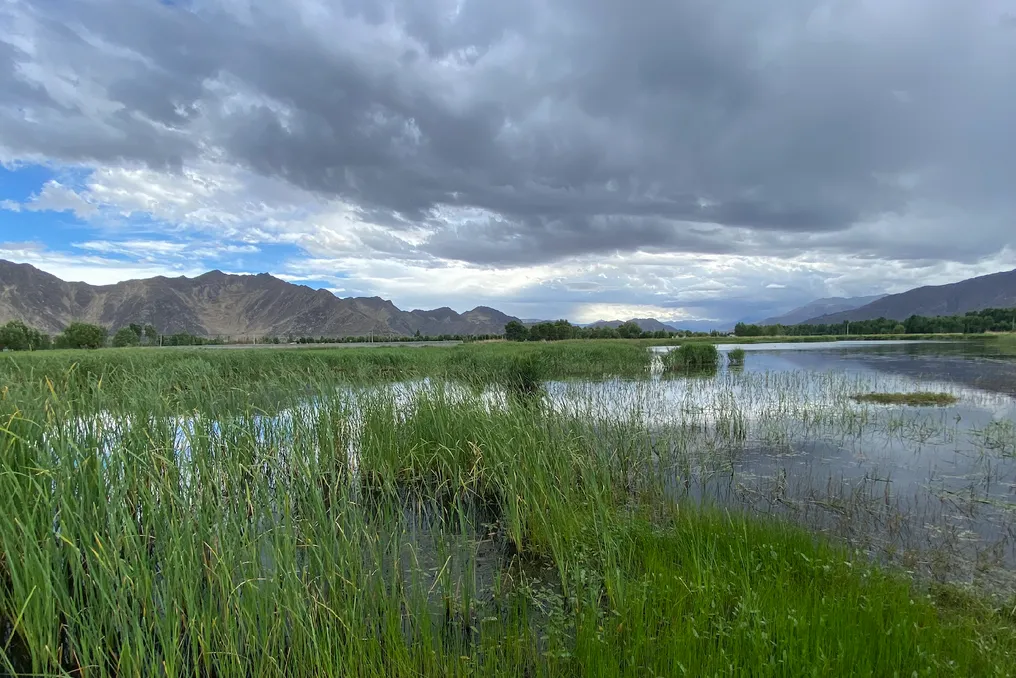
In the context of the UN Biodiversity Conference COP17, which calls for turning global commitments into real actions, ecosystem restoration has been recognized as a key element in protecting biodiversity and enhancing ecological resilience. China presents its integrated restoration method, combining targeted intervention with natural recovery, and also shares experience in international cooperation on biodiversity conservation.
The results of China's efforts are already visible on the ground. Ecological restoration methods include coordinating interconnected landscapes, enhancing nature's self-recovery capacity, and exchanging knowledge through international partnerships.
Over many decades, China has expanded forest resources, promoted pasture restoration, strengthened wetland protection, and combated desertification. These steps have contributed to global greening, improved soil conservation, and carbon sequestration. Furthermore, they have formed an approach that views nature as a single network, rather than isolated patches.
At the core of this approach is the understanding that mountains, rivers, forests, agricultural lands, lakes, meadows, and deserts form a single community of life. Restoration planning is carried out at the level of river basins and landscapes, taking into account water and soil resources, and relying on inter-regional and interdepartmental cooperation.
In the upper reaches of the Ujiang River in Zhejiang Province, eastern China, the restoration of terraces alongside traditional agriculture links mountain conservation with agricultural production. In the Yellow River delta, controlling invasive plants and opening tidal channels create conditions for the recovery of local species. Both examples demonstrate how practical intervention can work harmoniously with natural processes.
The 'Three Norths' afforestation program illustrates the importance of continuity. Through long-term planning, it ensures sustained efforts in sand control, water resource management, and land reclamation. The combination of landscape planning, continuous investment, and locally adapted measures connects individual projects with regional conservation goals.
As restoration work progresses, there is an increasing emphasis on the quality, integrity, and long-term sustainability of ecosystems. Climate change, extreme weather events, and human activities continue to affect restoration conditions. It is necessary to comprehensively address issues of biodiversity conservation, ecosystem functioning, and their capacity for self-renewal so that restored ecosystems can adapt, resist disturbances, and continue to provide services.
This requires combining targeted intervention measures with the natural process of recovery. The team proposed a concept called 'minimal intervention for ecosystem self-recovery.' It explores how identifying key barriers to recovery and intervening in the right places, at the right time, and with appropriate intensity can help ecosystems restore their capacity for self-organization and repair.
The practical implementation of these ideas requires comprehensive monitoring, research into ecological mechanisms, and continuous evaluation. Restoration planning must consider water availability and soil condition, limiting interventions to local ecological limits. Inter-regional cooperation, stable funding, and long-term management can link scientific research with practical implementation and adaptive management, allowing measures to be adjusted as ecosystems respond.
China also contributes to global conservation through practical experience, joint research, and capacity building. The Shan-Shui Initiative, recognized as one of the first UN Flagship Restoration Programs, provides lessons on coordinating large-scale restoration in the long term.
Along the coasts of the Yellow Sea and Bohai Bay, China's World Heritage wetlands link local habitat management with conservation along the East Asian-Australasian Flyway. In Tiaojini, Yancheng, Jiangsu Province in eastern China, the '720' bird sanctuary provides resting spots for waterfowl when tidal waves inundate their feeding grounds. Protecting such sites helps maintain the migratory route that extends far beyond China.
In Mauritania, where straw is scarce, Chinese researchers and local partners have adapted sand stabilization methods to local conditions, combining nylon sand barriers with water-saving irrigation and training in maintenance and operation. The exchange of technical knowledge alongside practical skills contributes to capacity building for sustained operation. The value lies in developing solutions jointly with local partners and equipping them with the means to manage these solutions over the long term.
The International Mangrove Center in Shenzhen, Guangdong Province in southern China, serves as another platform for sharing research experience and international training, supporting cooperation in coastal ecosystem conservation and restoration. Such partnerships integrate expertise from different regions into common efforts to protect biodiversity, while also creating opportunities to compare methods and study the response of various landscapes to restoration.
China exchanges ideas and practical approaches at wetland meetings and biodiversity conventions, as well as at the Global Environmental Governance Conferences (Nansen), the Asia Philanthropy Forum, and the Chunguangzong Forum. The University Alliance on the Flyway expands this exchange through joint research, monitoring, and training. Young Chinese representatives have also presented local conservation stories on the world stage.
These efforts give practical meaning to COP17's call to action. By combining integrated restoration, scientific inquiry, and international cooperation, China can contribute to long-term biodiversity gains and strengthening ecosystem functions, while also helping to develop approaches suitable for diverse environments and needs.