A question arises about the future of professionals if all work is performed by artificial intelligence. For example, upon first employment, an employee can use AI to instantly create reports, write code without lengthy debugging, or analyze data in spreadsheets, allowing tasks to be completed quickly and saving the company time.
However, this scenario raises doubts: if AI takes on all the work, why do companies need employees?
Merrill Fernando, a former Microsoft employee, stated on October 27 that companies require fewer people and more AI agents for more efficient operation. According to Fernando, who founded his own company three months after leaving Microsoft, the slowdown in work pace was due to numerous management levels and organizational structure.
Although Fernando's statement concerned Microsoft's internal operations and does not prove that the buyout program was launched because of AI, it came at a time when companies are assessing how much work small teams can accomplish with the help of AI.
No one becomes an expert on the first day. A young analyst learns by creating tables, finding errors, and figuring out the reason for discrepancies in figures. Another example is a software engineer who spends hours writing code, dissecting systems, and finding bugs. A marketer learns by testing failed campaigns, and a journalist learns by checking documents and determining why the first paragraph of a story is often incorrect.
Most of these tasks are routine. While this can cause frustration, it is here that people develop judgment skills. They learn to identify suspicious figures, ask the right questions, understand when a source is unreliable, and why an answer that seems correct might be wrong.
As a person invests mental effort into solving a problem, they begin to recognize patterns. Now imagine AI performing this work until a new employee arrives. The report is ready in advance, the code is already written, and the data analysis has been conducted. What should the new employee do before understanding how to start working?
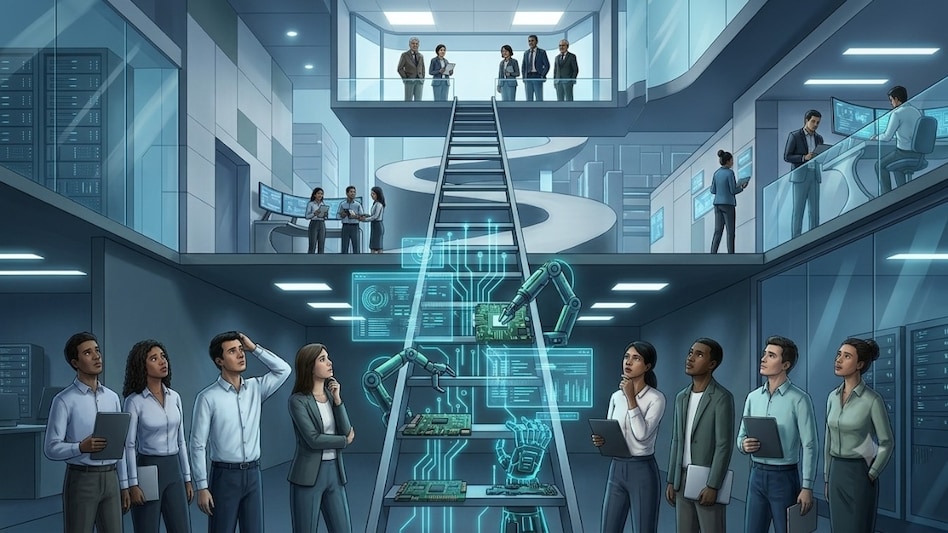
With the increasing use of AI, work methods in companies are changing. Many tasks previously performed by junior staff are now solved using AI. This helps companies operate with smaller staff but simultaneously creates difficulties for young people seeking employment.
Kevin Snyder, President of Goldman Sachs in the Asia-Pacific region, noted in October that young specialists are starting their careers by managing AI agents. Japan is not included in this trend in his region. Previously, employees gained experience in entry-level positions and then gradually moved on to greater responsibilities; this process is now changing.
According to a study by Anthropic, the developer of Claude AI, published in October 2026, the proportion of junior staff in technical departments decreased from 21% at the beginning of 2025 to 14%. Furthermore, the share of junior technical hires dropped from 27% to 9%.
Nevertheless, these data alone do not prove that the cause of this decline is solely AI, as companies' hiring needs and business requirements are also changing. Nevertheless, it raises the question: how will young people gain experience if entry-level tasks disappear? Junior positions are not just a way to get a first salary; it is through these tasks that employees learn and prepare for future roles such as engineers, analysts, and managers.
The application of AI is not limited to one area; it finds its place in all industries. This trend is also observed in startups. According to a report by Elevation Capital, 52% of company executives surveyed were pausing hiring or reducing team sizes in certain departments. These departments include engineering, marketing, customer support, and operations.
Thanks to AI, small teams can perform functions such as coding, information analysis, content creation, and responding to customer inquiries. This allows startups to start with fewer people and reduce costs. However, if many companies do the same, opportunities for newcomers may decrease, which could lead to a shortage of experienced personnel in the future.
Now the main question arises: if a young specialist cannot gain experience, how will they reach management positions? AI is capable of performing many tasks very quickly, but employees need to understand whether the provided answer is correct. Experience includes learning from mistakes during work, understanding problems, and making complex decisions.