
Ashwini Vaishnaw calls PLI scheme successful: 12 million jobs and ₹3.25 lakh revenue
Read more
Aaj Tak
www.aajtak.in

Ashwini Vaishnaw calls PLI scheme successful: 12 million jobs and ₹3.25 lakh revenue

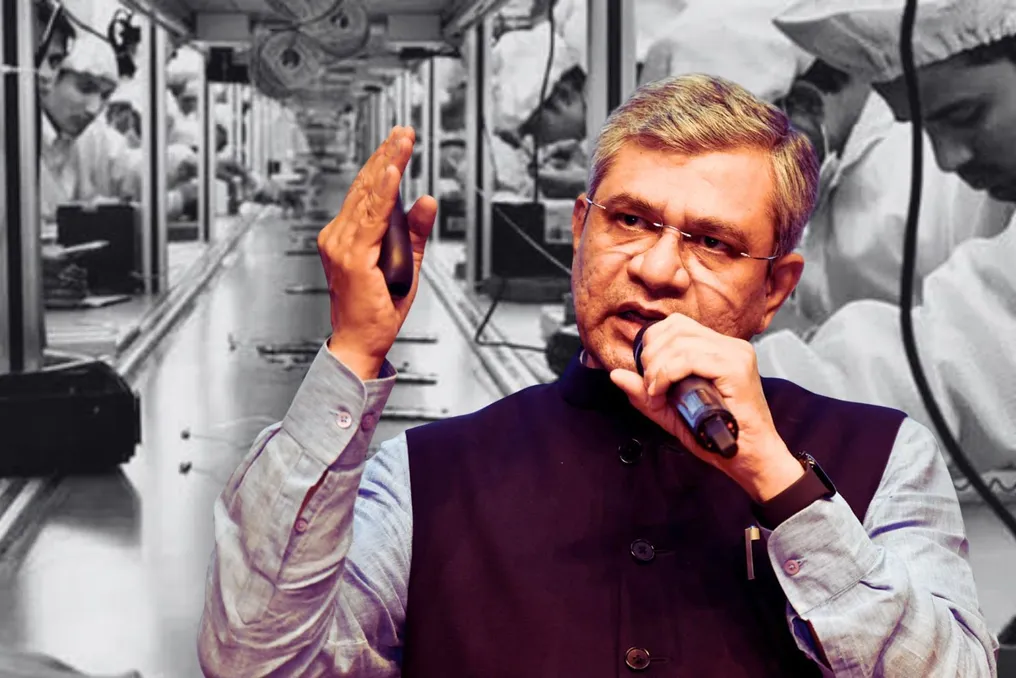
The discussion about iPhone production in India goes beyond simply manufacturing one type of phone; it tests the country's ability to scale up new factories, jobs, and exports with the support of government incentives. The central government provided financial support to mobile companies through the Production Linked Incentive (PLI) scheme to increase production volumes.

According to Electronics and IT Minister Ashwini Vaishnaw, the government has allocated ₹19,000 crore in incentives for mobile manufacturing. As a result, this sector has generated ₹25,000 crore in direct taxes and ₹3 lakh crore in GST collection. He also noted that 25 lakh people are employed in electronics manufacturing, of whom 12 lakh work directly in mobile manufacturing.

However, there is another side to this story: the question is whether India imports components for assembling phones or is gradually starting to produce the parts and technologies that constitute the true value of the device. This debate is important for understanding the progress of the 'Make in India' and 'Made in India' concepts.

PLI stands for Production Linked Incentive. Simply put, it is a program that provides financial incentives to eligible companies for increasing domestic production. The goal of this scheme is to help companies set up factories in India, increase output, invest capital, and make India a more attractive manufacturing hub compared to other countries.

For example, if a company manufactures mobile phones in India and meets the program's criteria, it can receive incentives according to established rules. This increases the economic benefit for the company when expanding production in India. The government expects that in return, investments will come in, jobs will be created, production will rise, and exports will be stimulated. Thus, the state does not directly cover the cost of every phone but encourages companies that increase production according to specific conditions.

A few years ago, most of India's mobile phone needs were met through imports. Now, the situation has changed significantly. According to government data, in 2014–15, about 75 percent of the country's demand for mobile phones was covered by imports, whereas in the fiscal year 2024–25, this figure dropped to approximately 0.02 percent.

Mobile phone production has also accelerated. Government data shows that in 2014–15, the country produced about ₹18,000 crore worth of mobile phones, while in 2024–25, this volume grew to approximately ₹5.5 lakh crore. Over the same period, the total production of electronic goods increased from ₹1.9 lakh crore to ₹11.3 lakh crore.

The PLI scheme played a key role in this transformation. Thanks to it, companies received incentives for large-scale mobile device manufacturing in India. Furthermore, existing factories in the country have expanded, and foreign companies' supply chains have begun shifting towards India.

The most discussed example of these changes is the iPhone from Apple. The company and its manufacturing partners are increasing production in India. This allows India to increase its share in the global electronics supply chain. According to a recent Bloomberg report, about one in four iPhones produced globally is now manufactured in India. This indicates that India is not only producing phones for the domestic market but is also becoming part of the production system that meets global demand.

One factor driving Apple to increase production in India is the desire to reduce dependence on China. Companies refer to this strategy as 'China plus one,' which means establishing factories and supply chains in other countries alongside those already in China to lessen reliance on any single nation. For India, this can translate into opportunities such as investment, job creation, acquisition of technical expertise, and export growth.

Official data is crucial for assessing the results of the PLI scheme. According to information presented to parliament in July 2025, by June 2025, investments under the PLI scheme for large-scale electronics manufacturing reached ₹12,390 crore. During this period, total production reached ₹8.44 lakh crore, and exports under this scheme amounted to ₹4.65 lakh crore.

Furthermore, according to government data provided as of March 2026, the total investment under the scheme reached ₹20,587 crore, and production reached ₹11.61 lakh crore, with exports totaling ₹6.43 lakh crore. These figures reflect the overall achievements over the entire period of the scheme, not just the results for one year. Export growth means that phones manufactured in India are sold in other countries, allowing the country to secure its place in global markets and encouraging companies toward large-scale production.

What benefit does the PLI scheme bring to India? Debates regarding government support for mobile manufacturing have recently intensified. A Bloomberg video report asked how India can benefit if many expensive and critical iPhone components come from abroad.
Similar stories

Vaishnav defends India's PLI scheme for iPhone production, highlighting growth and tax revenue
Read more
yourstory.com

Vaishnav defends India's PLI scheme for iPhone production, highlighting growth and tax revenue

India's Minister of Electronics and IT, Ashwini Vaishnaw, defended the government's Production Linked Incentive (PLI) scheme for the mobile sector in response to criticism raised in a Bloomberg Opinion video, which questioned India's manufacturing model compared to China.

He stated that iPhone assembly in India is yielding significant results. In 2025, approximately 55 million units of iPhones were assembled in the country, representing a 53% increase from 36 million devices in 2024. According to a Bloomberg report, India now accounts for roughly a quarter of Apple's global iPhone output.

The rise in production has strengthened India's position as an alternative manufacturing base to China. Despite skepticism about whether assembling foreign components ensures true high-tech independence, the government points to the financial successes of the PLI scheme, including tax collections amounting to 3.25 lakh crore rupees and the creation of 1.2 million new jobs.

Ashwini Vaishnaw provided data indicating that the government disbursed incentives worth 19,000 crore rupees, while direct tax revenues reached 25,000 crore rupees. Furthermore, the sector generated 3 lakh crore rupees in GST collections. Vaishnaw also noted that electronics manufacturing provided 2.5 million jobs, of which 1.2 million are in mobile phone production. He concluded his statement with a sharp remark: 'Cope harder!!'

Despite the impressive figures, which serve as an argument for continuing support for domestic production, tax revenues and job creation are only part of the overall picture. Expanding India's role in Apple's supply chain is a significant development. According to The Times of India, Apple has begun assembling all variants of the iPhone 17 lineup, including Pro and Pro Max models, in India.

Nevertheless, final assembly differs from local manufacturing of all components. India remains dependent on imports of critical parts such as processors, memory chips, displays, camera lenses, and batteries. This is significant because the economic value generated by production partially depends on the share of the supply chain operating domestically.

The current government impetus towards developing production faces a more complex challenge: transforming large volumes of production into a deep domestic electronics ecosystem. This requires expanding local component manufacturing, attracting more suppliers, and strengthening research and design capabilities. Such steps could help India move beyond mere final assembly and secure a more substantial place in global electronics supply chains.

Министр торговли обсудил с поиском профессий, устойчивых к ИИ, и секторах для глобального лидерства Индии
Read more
yourstory.com

Министр торговли обсудил с поиском профессий, устойчивых к ИИ, и секторах для глобального лидерства Индии

The commerce ministry is currently identifying professions that are less susceptible to artificial intelligence (AI) to prepare for rapid technological changes and capitalize on opportunities for India to become a global leader, according to Union Minister Piyush Goyal.

The minister stated that the strategy will concentrate on industries where AI can boost efficiency without necessitating the replacement of human employees, while utilizing India's substantial reservoir of skilled personnel, young demographic, and established traditional competencies.

Speaking to Indian science and technology researchers and students in Germany on Friday, the minister explained that his ministry has begun work on determining these AI-proof professions. He emphasized the necessity of national planning for the millions of citizens, focusing on sectors where AI can enhance efficiency rather than substitute the human workforce.

When questioned about the goals of this initiative, Goyal mentioned that India possesses the potential to assume global leadership in several fields, such as tourism, handicrafts, handloom, and culinary arts, by leveraging its large pool of skilled individuals and youthful population. He stressed that in these specific sectors, human creativity and traditional skills retain significant value.

He added that no amount of AI can replicate the value of Indian handicrafts and handloom, noting that there are numerous areas where India holds unique strengths that will be prioritized and simultaneously developed to improve the quality of life for its 1.4 billion residents in the future.

Regarding governmental support, Goyal indicated that assistance would be provided where needed, though incentives would not be mandatory for every single activity. He described the approach as a combination of various efforts, including those driven by the government, the private sector, individuals, and market opportunities, with the overarching aim being to bolster India's inherent strengths and generate opportunities that benefit its 1.4 billion people.

Furthermore, Goyal discussed methods to encourage Indian researchers, engineers, and scientists working overseas to return and contribute to the nation's progress. He requested that the researchers and students present in Germany advise on their needs and how the country can better support young researchers and its talented engineering and scientific communities to come and serve in India.

Goyal observed that his conversations revealed that attracting talent is not solely dependent on financial rewards, but critically relies on establishing a supportive environment for innovation and research. He plans to consult with government colleagues, educational bodies (both public and private), academia, and leading research institutions and industries in India to establish robust partnerships among industry, academia, and researchers.

Looking ahead at global economic trends, Goyal noted that developed nations will increasingly need to collaborate with emerging economies across Asia, Africa, and Latin America, as these regions are expected to be the drivers of future growth.

He concluded by mentioning the presence of approximately 330,000 people of Indian descent in Germany, alongside nearly 60,000 to 70,000 students. Goyal shared that this enthusiastic Indian student community appears eager to bring their knowledge back to India, shifting their focus from merely seeking employment in Germany to contributing to India's growth narrative, as he sees the primary action occurring there.

Popular