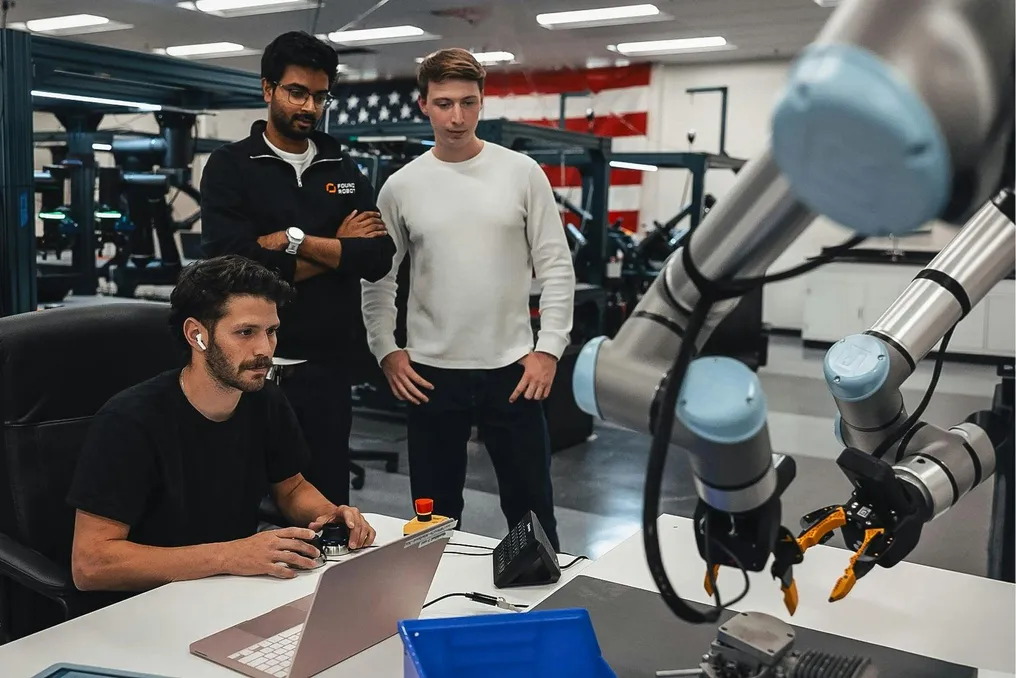
Foundry Robotics raises $100 million to build America's first AI-powered assembly factory
Read more
Ventureburn
ventureburn.com

Foundry Robotics raises $100 million to build America's first AI-powered assembly factory

Foundry Robotics, based in Emeryville, California, announced on Wednesday that it has raised a Series A round of $100 million. These funds are intended for the construction of what the company calls America's first autonomous assembly factory. Additionally, the capital will be directed towards expanding its robotics, engineering, and operations teams, as well as implementing additional artificial intelligence models.

Founded only this year, Foundry is demonstrating a rapid pace of development. Founder and CEO Adarsh Kulkarni has experience with robotics; previously, he was a fourth employee at Ghost Robotics, working on bipedal robots for the US armed forces, and later became the first head of the robotics department at Scale AI.

Co-founder Emmanuel Lamakkiya possesses deep knowledge of manufacturing, having led the Model Y program at Tesla, overseeing the production of approximately 1.5 million vehicles annually. Anup Karmakar, a former software lead at Tesla, also joined the team. The team also includes veterans from the military who have experience working at Raytheon and Northrop Grumman, highlighting their ability to scale production.

Unlike most robotics startups that sell the robots or software themselves, Foundry owns and operates factories independently, offering a manufacturing-as-a-service model. The company installs AI-supported robotic cells at its sites. The FoundryOS system connects these robots, the factory, and cloud services. Each production cycle feeds data back into the models, allowing the system to continuously improve.

For clients, this means faster and more consistent production. Foundry claims it can take a product from design to release in a matter of weeks, eliminating the need to create a new production line or costly equipment retooling. For defense contractors awaiting components, this could shorten program timelines by months.

The company's main specialization is complex electromechanical assemblies such as drones, satellites, wire harnesses, and underwater vehicles. The list also includes components for autonomous vehicles, ground robots, and data center equipment. The new 130,000 square foot facility in Emeryville increases the company's production capacity twentyfold.

In addition to Marlinspike, early investors in the round returned, including Khosla Ventures and Red Glass Ventures. New participants include SE Ventures, Wing VC, and Axiom Ventures. Existing investors Hanabi and Zero Shot Fund maintained their positions. This funding round ranks among the top 3% of registered Series A rounds in US deep tech, a rare achievement for such a young company. Earlier reports indicated initial funding of about $14 million, making the current round a significant leap.

Marlinspike's Managing Director, Mislav Tolusik, noted that manufacturers urgently need in-house production capacity. He also believes that Foundry quickly secures contracts with clients. Duane Fortingham, President of HII Unmanned Systems, stated directly that 'production capacity is a national bottleneck for deploying unmanned systems.' This is where Foundry fits in.

Kulkarni insists that factories capable of reviving American manufacturing must be designed from scratch, not merely repaired. The company's mission is to revitalize US industry. Foundry is not alone in this endeavor; Arda Industries launched this month with $232 million in funding. Maven Robotics also raised $100 million in a Series A round in September. Investors clearly see a shift, but big claims require proof. An 'autonomous factory' is only valid if it delivers reproducible results at scale, and Foundry now has the funds to demonstrate this.

Similar stories

BioGeometry raises $100 million to scale AI models that develop drugs from scratch
Read more
ventureburn.com

BioGeometry raises $100 million to scale AI models that develop drugs from scratch

Beijing-based company BioGeometry has raised $100 million in a Series A+ extension round, increasing the total Series A funding by over $100 million. The startup develops artificial intelligence models capable of finding new promising drug compounds in weeks rather than years, which could potentially change the economics of drug discovery.

China Life Capital led the latest round. BioGeometry, which has been operating for about four years, uses its AI models to search for novel molecular compounds. Existing shareholders, including Shanghai Biomedical Industry Fund, which participated in the first round, also contributed additional funds. Participants in the round included China Development Venture Capital, Reliance Investment, and Guofang Venture Capital, as well as several biomedical industry players; Dacheng Wealth Capital also increased its stake. Index Capital served as the exclusive financial advisor.

China Life Capital called BioGeometry 'a benchmark company in China's AI-based biotechnology industry,' noting that this represents progress compared to 2024, when the company closed a pre-A round led by Jiangmen Ventures with participation from Zhipu AI and Gaorong Capital.

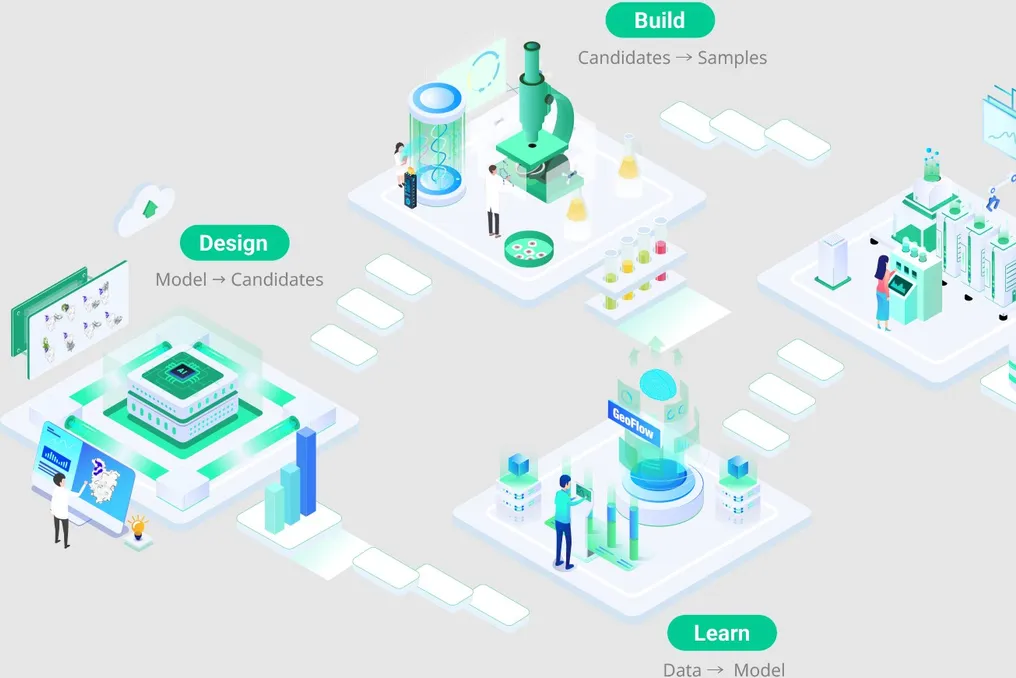
BioGeometry's work is based on two AI engines, each functioning at a different scale. The GeoFlow model works with molecules; it is an atomic model that predicts biomolecular structures and creates new ones from scratch. The first version of GeoFlow, launched in June 2024, demonstrated alignment with AlphaFold 3 in predicting protein complexes. Its capabilities then grew: version V2 appeared in April 2025 and became the first Chinese AI model capable of performing de novo antibody design.

Version V3 was introduced in October 2025 and added a generation, evaluation, and optimization cycle. When working with over twenty targets, it achieved an average hit rate of 20% and found promising compounds within three weeks. A larger version, V4, is under development. The other engine, GeoCell, focuses on the cellular level. This is a virtual cell model that predicts how cells react to genes, drugs, or combinations, helping teams select targets, diseases, and suitable patients.

These two models are integrated using an AI agent that connects them to an automated laboratory, ensuring that every experiment provides new knowledge to the system.

The new capital will be used to upgrade GeoFlow and GeoCell, as well as to expand high-throughput automated laboratories and advance proprietary drug programs to market. Numerous projects in drug discovery and synthetic biology are already planned. Several bispecific antibody programs are expected to enter IND submission in 2027. Synthetic biology may generate revenue sooner.

One project stands out—natural borneol, a compound used in traditional medicine. BioGeometry claims to be the first to be able to biosynthesize it with approximately 80% lower costs compared to plant extraction. Significant revenue from this project is expected in 2027.

Despite the slow and expensive process of drug discovery, most candidates fail. AI promises to improve chances by developing more advanced molecules from the outset. BioGeometry is betting on realizing this potential while simultaneously generating revenue through synthetic biology. For investors, this is a rare combination of ambitious goals and short-term income. Furthermore, the AI biotechnology scene in China is rapidly developing, even amid tightening US regulations on deals in this area. Global pharmaceuticals will closely watch who can compete with tools at the AlphaFold level.

Company offers high salary for writing texts, raising questions about the influence of artificial intelligence
Read more
www.aajtak.in

Company offers high salary for writing texts, raising questions about the influence of artificial intelligence

Amid the growing use of automation, many large companies are investing in artificial intelligence and conducting staff reductions. Nevertheless, the company Anthropic is ready to offer 32.5 million rupees for text-writing related work. This is surprising because what a person does in an hour, AI can do in mere seconds.

Artificial intelligence can write an email in a few seconds or create a blog draft in minutes, helping companies produce content on a scale that previously required an entire team. Because of this, many authors are questioning the value of their work if machines start writing.

Despite the emergence of AI, Anthropic has opened a special vacancy. For this position, the company offers an annual salary ranging from $295,000 to $345,000 USD, which is equivalent to approximately 2.5 to 3.25 crore rupees. However, this position is not intended for ordinary writers. The candidate must have at least eight years of experience in executive communication, working with senior management.

A natural question arises: why would Anthropic pay such money if AI can perform the job? The answer lies in the fact that the employee in this position will work directly with the company's top management. They will be responsible for preparing messages to convey the company's position to the public at important moments and explaining complex issues in simple terms. This requires not only good writing skills but also the ability to think strategically and provide balanced answers when necessary.

This job goes beyond simply writing articles for websites or product descriptions. It requires a specialist capable of deeply analyzing problems, predicting the impact of a message on the audience, and helping leaders decide what and how to communicate.

Anthropic is not the only AI company offering high salaries to writing and communications specialists. In September 2025, OpenAI also announced a vacancy related to content strategy, with an annual package of around $400,000. The employee in this role was tasked with improving the brand awareness of ChatGPT, creating content, and collaborating with engineers and designers.

However, this does not mean that salaries in the writing field are rising everywhere. It only indicates that some AI companies value experienced specialists who possess strategic planning skills, an understanding of people's needs, and the ability to simplify complex topics, in addition to good writing.

There is another side to the coin. In June 2023, one content writer reported that after the appearance of ChatGPT, some of his clients stopped commissioning him work. He specialized in writing content for websites and product descriptions, which can now be quickly created using AI tools, intensifying pressure on such tasks.

Thus, on one hand, experienced communications specialists are offered high-paying positions, while on the other hand, some freelancers involved in general content find it harder to find work. However, this does not mean that all entry-level writing positions are disappearing or that any senior author's job is guaranteed protection. The influence of AI depends on the type of work performed and the client's willingness to pay for it.

The author's task is not only to create content but also to verify the accuracy of information, identify missing details, and assess the material's suitability for readers. A report for September 2025 mentioned work related to correcting errors and improving AI-generated content.

This shows that humans may still be needed to check and refine AI-generated drafts. However, it cannot be assumed that the professions of editor and fact-checker are completely safe, as AI tools can assist in these tasks as well. Consequently, it becomes critically important for authors not only to write drafts but also to find errors, confirm information, and add necessary context.

The Anthropic vacancy is not suitable for all authors, as it is a high-level position requiring many years of experience. Therefore, it cannot be concluded that everyone can earn such a salary in the writing field. For those aiming to build a career in journalism, copywriting, or corporate communications, not only good writing skills but also research abilities, fact-checking, subject matter understanding, and critical thinking are important. Mastering the proper use of AI tools may also prove useful.

Authors who can use AI to speed up their work while simultaneously verifying information, performing quality editing, and applying their own original thinking will be able to adapt to the changing work environment.

Anthropic seeks experienced editor with salary up to 3.25 crore rupees; bachelor's degree required.
Read more
www.aajtak.in

Anthropic seeks experienced editor with salary up to 3.25 crore rupees; bachelor's degree required.

Despite the current dominance of the artificial intelligence (AI) era, which allows for the instant creation of articles, speeches, and emails, human intellect remains indispensable for developing true strategy, understanding, and vision. A recent decision by Anthropic serves as a clear confirmation of this.

Anthropic, the developer of the popular chatbot Claude, is currently recruiting an experienced writer. The company is prepared to offer a high annual salary of 3.25 crore rupees for this position (equivalent to approximately $295,000 to $345,000 USD). According to the official job posting, this position is available in San Francisco or New York.

The role is not limited to simple text writing; the selected candidate will collaborate closely with senior management. They will be responsible for explaining complex technical and developmental concepts in simple language, preparing communication materials for major events, and defining how the company should present itself to the world.

The primary duties of this writer include working with Anthropic's senior executives, the external communications team, and subject matter experts. Tasks involve preparing and editing executive communications, preparing leaders for public appearances and interviews, and assisting in rapid and accurate responses to any breaking news.

Furthermore, the company requires a specialist who has a deep understanding of advanced AI technologies and can explain these complex topics to a wide audience, whether they are experts or general users.

Anthropic is looking for established professionals, not graduates. Official requirements include at least eight years of experience in a large organization involved in high-level corporate communications. Outstanding writing skills and the ability to perform under pressure, as well as the capacity to make balanced decisions and maintain a clear strategic stance amid uncertainty, are also necessary.

The minimum required qualification is a bachelor's degree or equivalent professional experience. Candidates with a good understanding of science and research, AI products and architecture, corporate strategy, visual storytelling, and brand communication are of particular interest.

Candidates meeting these criteria can apply through Anthropic's official career portal. This example demonstrates that even if machines have learned to write words, the art of understanding complex ideas and determining what and when to say remains a human prerogative, and major technology companies like Anthropic are willing to pay a high price for this skill.

Popular