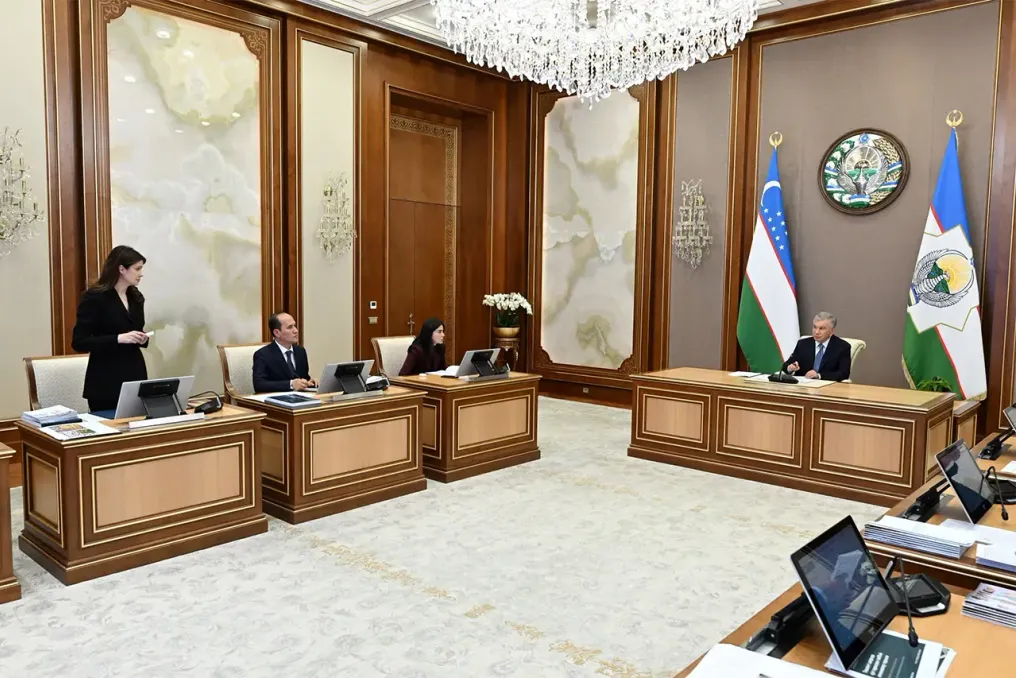
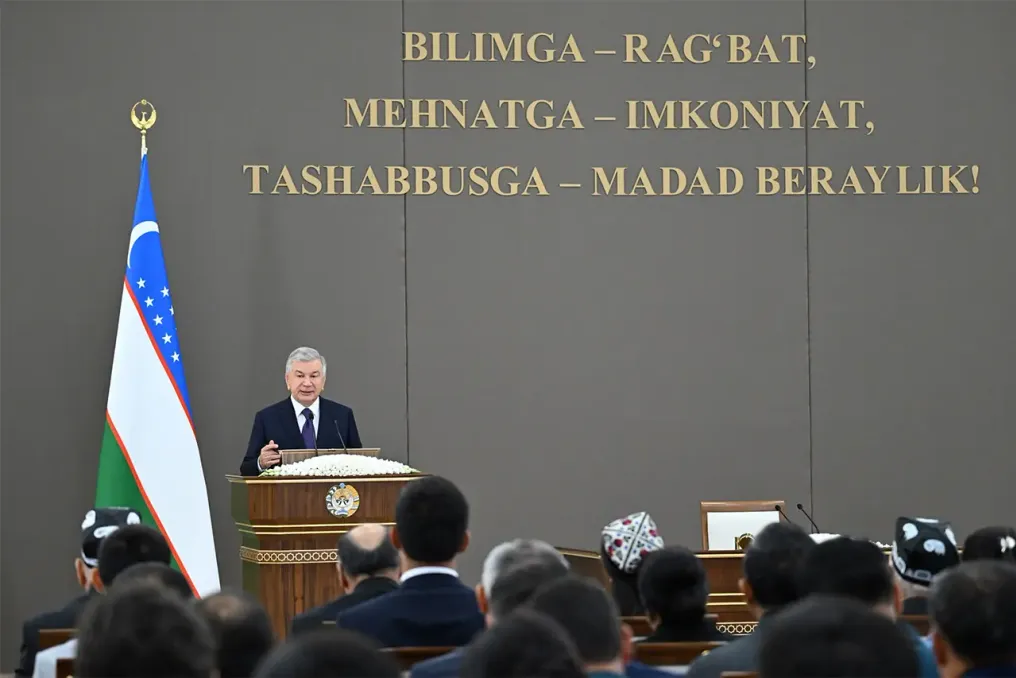
President Shavkat Mirziyoyev held a meeting dedicated to the socio-economic development of the Kashkadarya region. The President expressed satisfaction after meeting with the residents of Kashkadarya during the harvest season.
He congratulated the participants on Uzbek Language Day and paid tribute to Abdullah Aripov, a native of Kashkadarya, Hero of Uzbekistan, and author of the national anthem. Kashkadarya, which only a few years ago was among the regions with the most difficult conditions, is predicted to be free from poverty and unemployment by the end of the current year, as the president stated that clear calculations exist to achieve this goal.
Mirziyoyev noted that the visible changes in the cities, districts, and mahallas of the region, as well as the enthusiasm of entrepreneurs, investors, and youth, gave him a huge surge of energy. He visited a modern energy- and water-efficient enterprise managed by Nurbek Ergashov, head of the Sultonteks cluster. The entrepreneur's plans to create another 30,000 jobs by 2028 and expand opportunities, especially for women, received support.
The President announced the signing of a decree awarding Ergashov the honorary title 'Honored Entrepreneur of Uzbekistan.' Additionally, the title 'Honored Agricultural Worker of Uzbekistan' will be conferred upon Abdumannop Khodyberdiyev for establishing a family lemon growing school in Chim mahalla of Kamashi district and contributing to increasing household incomes.
The work of Javlon Jolgiev, editor-in-chief of the Mutolaa project, was recognized for his efforts to promote education and reading in Kashkadarya. It was announced that he and the winners of the 'Family Reading' contest will receive new two-room apartments in Tashkent. The President suggested presenting the awards on site.
In the first nine months of the year, industrial production in Kashkadarya grew by 8.4%, services by 16.6%, and agriculture by 4.9%. Nevertheless, the president emphasized that a significant gap remains between the region's current indicators and its economic potential. In terms of industrial output per capita, Kashkadarya ranks seventh in the country, ninth in services, and eleventh in agricultural production and construction.
Mirziyoyev suggested that if district administrations and banks create an environment where knowledge is rewarded and work is supported by opportunities and initiatives, Kashkadarya could become one of the country's leading regions within one or two years. The region possesses sufficient resources to bring its industrial sector to a new level. Employees have been instructed to convert gas, electric, and mineral resources into jobs that generate income and high value-added products.
Three major projects worth $300 million are prepared at the GTL plant. By utilizing 430,000 tons of crude oil produced at the facility, the region can implement a $1.5 billion project for producing new polymers and petrochemical products. There is also potential to increase the capacity of the Dekhanabad Potash Plant from 365,000 tons to 600,000 tons. Furthermore, over 30 design proposals worth $830 million have been developed in the fine chemicals sector.
The project manager assigned to the region and other officials were instructed to prepare a three-year program covering projects worth $20 billion and providing for the creation of 50,000 jobs. Special attention will be paid to building supply chains around large enterprises in Kashkadarya. Six industrial clusters are scheduled to be established in Guzar, Shurtan, Mubarek, Dekhanabad, and Nishan by the end of the year. Branches of the Kashkadarya Free Economic Zone will also be opened in Shurtan, Mubarek, Yakkabag, and Kasana. Initially, 250 billion soms will be allocated for infrastructure development.
The region is also localizing the production of modern tractors and agricultural machinery assembled by the Chinese company FM World, and launching projects to produce agricultural drones at this enterprise. The President reported that last week he listened to presentations from major energy investors. Masdar plans to commission a 300 MW solar power plant and a 75 MW energy storage system in Kashkadarya next year. This project costs $250 million.
The implementation of a 45 MW waste-to-energy project with a Chinese partner is concluding in the Karshi district. To strengthen the power grid, $70 million will be attracted for the construction of two large substations in Nishan and Kukdal, which are expected to operate next year. An additional $150 million has been allocated for a new 245-kilometer transmission line along the Talimarjan–Sogdiana route; officials have been instructed to complete this project next year.
Kashkadarya's agriculture can provide livelihoods for an additional 200,000 people. To achieve this, a joint project with the World Bank, based on Egyptian experience, will be launched to sow drought-resistant and salt-tolerant fodder crops over 100,000 hectares of pastures in eight districts using drones. Work will be carried out in Nishan, Guzar, Mubarek, Kukdal, Kasana, Mirishkor, Kamashi, and Dekhanabad. Districts have been instructed to establish livestock complexes for 10,000 head of cattle and 50,000 head of small ruminants. A zero VAT rate will be applied to residents when selling imported livestock.
In Guzar district, 10,000 hectares of land will be brought into agricultural use. Half of this area will be sown with cotton, and the rest with fodder crops. The land will be transferred to farmers, and a cluster production system will be established. Officials have been instructed to develop a package of incentives for putting land into productive use within a week.
Satellite data has identified another 30,000 hectares of land in Kashkadarya that can be used for agriculture. Most of this land is located in Mubarek, Kasana, and Kukdal. Additional plots will be developed in Nishan, Kamashi, Karshi, Mirishkor, Guzar, Yakkabag, Kitabe, Chirakchi, and Shahrisabz. Ten permanent consultants from Egypt will participate in this work.
The President highlighted the persistent difficulties and high costs associated with supplying water to agricultural lands in Kashkadarya. Next year, 265 kilometers of canals will be lined with concrete, and 20 pumps will be modernized. A total of 550 billion soms has been allocated for these works. In 2027, water-saving technologies will be implemented on 75,000 hectares in cooperation with farmers.
This year, four small reservoirs, each with a capacity of 50,000 cubic meters, were built in Kasana, Nishan, Kamashi, and Mirishkor. This initiative will be expanded. By June 1st, two more reservoirs of the same volume will be built in each of the districts of Kasana, Nishan, Mirishkor, Kamashi, and Yakkabag. Mirziyoyev stressed that ensuring drinking water for residents remains one of Kashkadarya's most pressing problems.
Using 1 trillion soms allocated this year, officials are tasked with completing the construction of 747 kilometers of water supply and sewage networks, as well as 43 facilities within two months. These works are expected to provide 200,000 people with access to clean drinking water. An additional 100 billion soms has been allocated to launch a project to build a water pipeline network from the Hisarak reservoir to the cities of Karshi, Kamashi, Guzar, and Karshi. Officials must attract another $210 million and ensure high-quality implementation. This project will provide 350,000 people with clean drinking water.
A reconstruction project for the Talimarjan–Mubarek water pipeline will also begin, which will improve water supply for another 700,000 residents of Nishan, Kasbi, Mirishkor, Mubarek, and Karshi districts. The feasibility study is expected to be completed by April 1st, and $150 million will be attracted for the project.
Major projects to improve road infrastructure in Kashkadarya will be implemented. The reconstruction of a 100-kilometer section of the A-380 highway passing through the region will begin in collaboration with the Asian Development Bank. This project costs $350 million. The Karshi ring road will be extended by 5.5 kilometers and connected to the highway. Officials have been instructed to complete the feasibility study this year and start construction in January.
At railway crossings on the Karshi–Pamuk and Guzar–Beyneu roads, severe traffic jams occur when trains pass. Two modern overpasses costing 250 billion soms will be built in these locations. In Chim mahalla of Kamashi district, they demonstrated what a modern mahalla should look like: a school complex for 640 students and a kindergarten for 240 children were built, along with a family clinic. A new mahalla administrative building, youth center, sports complex, and recreation park were erected. Most importantly, there are no more low-income families or unemployed residents in this mahalla. The President instructed officials to use this experience to create two modern mahalla centers in every district by Independence Day next year.
The Chim model will also be applied in Mirishkor district: lemon greenhouses covering 20 hectares, intensive fish farming on 30 hectares, and an almond orchard on 50 hectares will be created. Intensive horticulture will be planted on 8,000 hectares of leased land in the spring, and greenhouses will be built on another 3,000 hectares. High-value crops will be grown on the remaining 11,000 hectares through partnership agreements. Officials have been instructed to start this work in every district.
The President stressed that banks must demonstrate practical results in channeling financial resources towards projects initiated by residents and entrepreneurs. In Andijan, officials were instructed to develop 20 new financial products that allow lending not only against collateral but also based on cash flow and specific orders. It is expected that a similar approach will yield results in Kashkadarya. Banks will be evaluated not by the number of new products they introduce, but by the growth of enterprises and businesses receiving financing through them. Officials were also tasked with eliminating excessive lending requirements. Currently, applicants must provide 102 types of documents to obtain a loan, of which 53 are already available in information systems, and another 22 are unrelated to the loan application. These changes are expected to accelerate the financing of mahalla initiatives and support job creation.
Kashkadarya has the potential to attract 6 million tourists annually. Since the beginning of the year, 2.5 million tourists have visited the region, including 500,000 who traveled to the village of Gillan independently. The first phase of the ski resort in Gillan is planned to open next year in cooperation with Tatarstan. The President also noted the potential of transforming other villages with landscapes similar to Gillan into ethnic tourism centers. Such villages include Taragai in Chirakchi district, Bashir in Kitabe district, and Tatar in Yakkabag district. Mountain rivers in the villages of Sayod and Suvtoshar in Shahrisabz district may facilitate rafting and sports tourism. Officials have been instructed to prepare a master plan for these six villages within a month and start implementing projects worth $50 million from March 1st.
Furthermore, gastronomic festivals called Lola va Kabob will be held in Guzar every spring, and Chiyal Yakhna will take place in Kukdal. The President also highlighted the experience of the Technical School of Professional Skills, where 32 instructors recently returned from Germany after undergoing professional development programs.