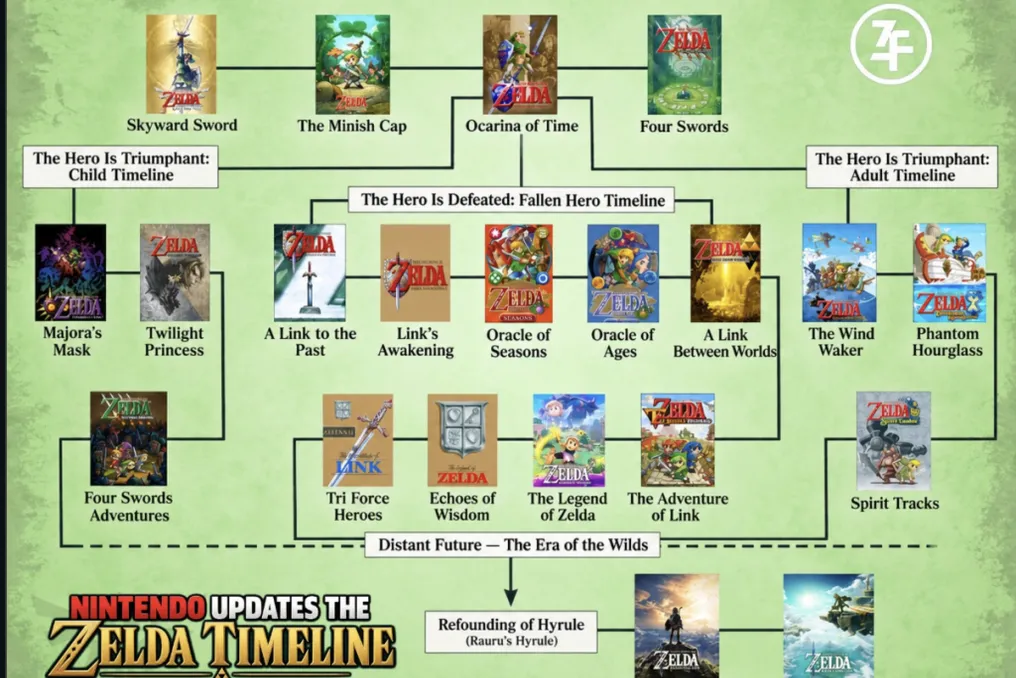
The chronological organization of The Legend of Zelda divides the games into three parallel timelines, all originating from Ocarina of Time. An important fact is that this sequence did not exist during the game development; it was formally released in 2011 through the book Hyrule Historia, when the franchise was already over 25 years old and had nearly twenty titles released.
This indicates that Nintendo did not conceive a complete saga and then segment it into games. On the contrary, the company produced the games over 25 years and subsequently organized everything into a coherent line, or not.
The game Skyward Sword, released in 2011, serves as the starting point for the narrative. The original 1986 title is found at the end of this timeline. Some games underwent minor script changes, known as retcons, to better fit the new structure. This chronological framework remains constantly updated, with its last modification occurring in September 2026, along with the announcement of the Ocarina of Time remake.
With the franchise reaching 40 years and the remake scheduled for November 5, 2026, it becomes relevant to understand how this complex structure is organized. However, this apparent confusion can be seen as a positive characteristic of the series.
Each Zelda title has its own complete story, with a defined beginning, middle, and end. This allows the player to start with Breath of the Wild, Ocarina of Time, or the most recent remake without needing to have played anything before, as the game itself provides the necessary information. There are few clear exceptions: Majora's Mask continues Ocarina of Time with the same Link, Tears of the Kingdom is a direct sequel to Breath of the Wild, and Phantom Hourglass succeeds The Wind Waker. Even in these cases, the subsequent game manages to stand on its own.
Although knowing the connections enriches the experience, there is a strong argument for those who play in release order, as this sequence allows players to experience revelations as they were planned. Imagining playing The Wind Waker in 2002, treating it as an ordinary cartoonish Zelda, and later discovering that ocean covers the Hyrule of Ocarina of Time, or finding a warrior skeleton in Twilight Princess that turns out to be the Link of Ocarina, dead unrecognized, are moments that lose impact when the player already knows the chronology.
In practical summary, it is recommended to play in whichever order is most enjoyable, using the chronology only as supplementary reading material, and not as an obligatory prerequisite.
The entire saga begins with a curse established in Skyward Sword: the Demon King Demise is defeated, but before dying, he pronounces that an incarnation of his hatred will eternally pursue those who carry the goddess's blood and the hero's spirit. This fundamental phrase sustains the entire franchise, explaining why the princess is always called Zelda, the hero is Link, and the villain always returns. It is not the same individuals, but rather the same three souls continuously reincarnating.
Four games occur before the narrative split: a young person raised in the forest discovers they are chosen by the goddess. Ganondorf, king of the Gerudo and incarnation of Demise's hatred, stages a coup to obtain the Triforce. Link extracts the Master Sword from the pedestal, but at only ten years old, his body cannot withstand the power, resulting in a seven-year sealing. Taking advantage of this opening, Ganondorf obtains the Triforce and divides it into three parts. Seven years later, Link awakens as an adult and becomes the Hero of Time, winning the conflict.
It is at this point that the story branches into three paths. Zelda sends Link back to the past so he can recover the lost seven years. Upon returning with his memories, he alerts the royal family, and Ganondorf is stopped before the initial coup. This is the world Link leaves when traveling through time: a world without a hero.
The third branch is the most peculiar, as it starts from a hypothetical scenario: what if Link had failed in the final battle of Ocarina? In this alternate universe, Ganondorf manages to gather the three parts of the Triforce. The Seven Sages manage to imprison him in the Sacred Realm, triggering the War of Sealing, which in turn corrupts into the Dark World.
A notable detail for collectors is the change in the order between Link's Awakening and the Oracle games. While Hyrule Historia (2011) placed them in a different order, the Zelda Encyclopedia (2018) inverted this sequence; the current updated order is the one in effect.
For years, it remained unanswered where Breath of the Wild and Tears of the Kingdom fit in. Neither was ever integrated into any of the three main branches. Tears of the Kingdom added complexity by revealing that Hyrule was founded by Rauru and Sonia of the Zonai race, which would imply the existence of two Ganondorfs: the Gerudo of Ocarina of Time on the surface and the original Ganondorf sealed underground. This question was never fully resolved.
In September 2026, after the 40th Anniversary Direct that presented the remake, the Japanese page of the game included a revised chart with a subtle yet crucial change: a second founding of the Kingdom of Hyrule, positioned immediately before the War of Sealing in Tears of the Kingdom, keeping the first founding at the beginning of the chronology, as always occurred.
The community's interpretation of this is that the Hyrule of Rauru represents a re-founding, occurring long before the classic chronology. The location simply resumed the name Hyrule, just as the hero always returns to the name Link.
In the source code of the same page, content creators identified the two games as a shared epilogue: the convergence point of the three branches. This idea was already defended by the series developers, suggesting that Breath of the Wild and Tears of the Kingdom occur so far advanced that the three lines have become legends, making it impossible to distinguish legend from history within the universe itself.
It should be noted that the expression