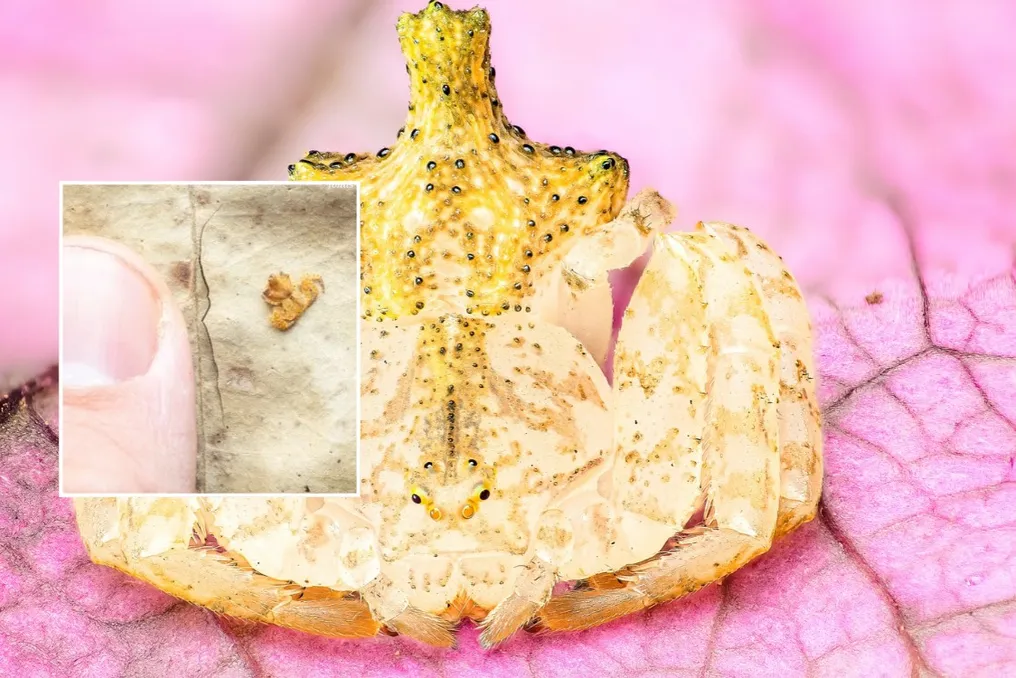
A small spider, resembling a flower, surprised Jonas Gazzaneo Denardo, a Biology student and macrophotographer, during a walk through the campus of the State University of São Paulo (Unesp) in Rio Claro, São Paulo state. The record was captured on the morning of September 17th.
The identified species is *Epicadus trituberculatus*, a crab spider notable for its unique appearance and ability to blend into vegetation. The animal was found motionless on a purple ipe flower, near the university's Institute of Biosciences, catching the photographer's attention.
Jonas reported that the encounter was completely fortuitous, as he was not specifically looking for that animal, but rather walking through the green areas of the Unesp campus with the goal of documenting invertebrates through macrophotography. Even though experienced in observing small living beings, he had to examine the spider very carefully.
A disguised hunter
What sparked his interest was the unusual body shape of the spider, which looked like a tiny sculpture resting on a leaf. He explained that spiders of the genus *Epicadus* are camouflage specialists, blending perfectly with leaves and flowers; he only noticed it due to a subtle asymmetry in the middle of the foliage upon close observation.
Belonging to the family Thomisidae, *Epicadus trituberculatus* is part of a group of spiders that uses ambush and camouflage to capture prey. Unlike other spiders that rely on webs, many species in this family remain on vegetation, waiting for insects to approach.
During the recording, Jonas observed the animal completely still, a typical behavior for these predators. He described how the spider remained motionless, employing the classic ambush hunting tactic characteristic of crab spiders, patiently waiting for some careless insect to get close enough for an attack.
The resemblance between certain spiders of the genus *Epicadus* and flowers generates scientific interest. A 2017 study published in the journal *Scientific Reports* by Brazilian researchers investigated how the species *Epicadus heterogaster* uses visual signals, including ultraviolet light reflection, to attract pollinators. The scientists noted that these spiders can attract insects even when on leaves without nearby flowers. However, the findings of this study cannot be directly applied to the *Epicadus trituberculatus* photographed in Rio Claro.
Dozens of photos for a single record
For Jonas, discovering the species for the first time was a memorable experience. However, turning this moment into detailed photographs required great patience and precision. He stated that he had never seen an *Epicadus trituberculatus* in person before, emphasizing that the record was special due to the impressive exotic beauty of the species and the rarity of encountering such perfect mimicry in nature.
The biggest technical obstacle was keeping the spider in focus. Since the animal was on vegetation, any movement caused by the wind hindered the framing. The photographer resorted to focus stacking, a technique that involves combining dozens of images taken with different levels of sharpness to cover the entire subject.
Species identification involved several phases. Initially, Jonas analyzed the morphological characteristics of the spider and consulted scientific references from the *World Spider Catalog*. Subsequently, confirmation was obtained at the Arachnology Laboratory (LARC) of Unesp in Rio Claro, under the guidance of Professor José Paulo Guadanucci, and validated by arachnologists Jean Martins and Fernando Daros. The record was also shared on citizen science platforms focused on biodiversity monitoring.
Hidden biodiversity on campus
Beyond the quality of the images, this encounter reinforced for Jonas the importance of green areas as a refuge for various species, even in urban settings. He declared that records like this demonstrate how university campuses, especially a wooded campus like Unesp in Rio Claro, act as true sanctuaries for wildlife.
For the student, the sighting also serves as an incentive for people to observe the small animals inhabiting their surroundings more closely. He concluded that by paying more attention to our surroundings, we discover a rich and fascinating biodiversity coexisting with us in academic and urban spaces.