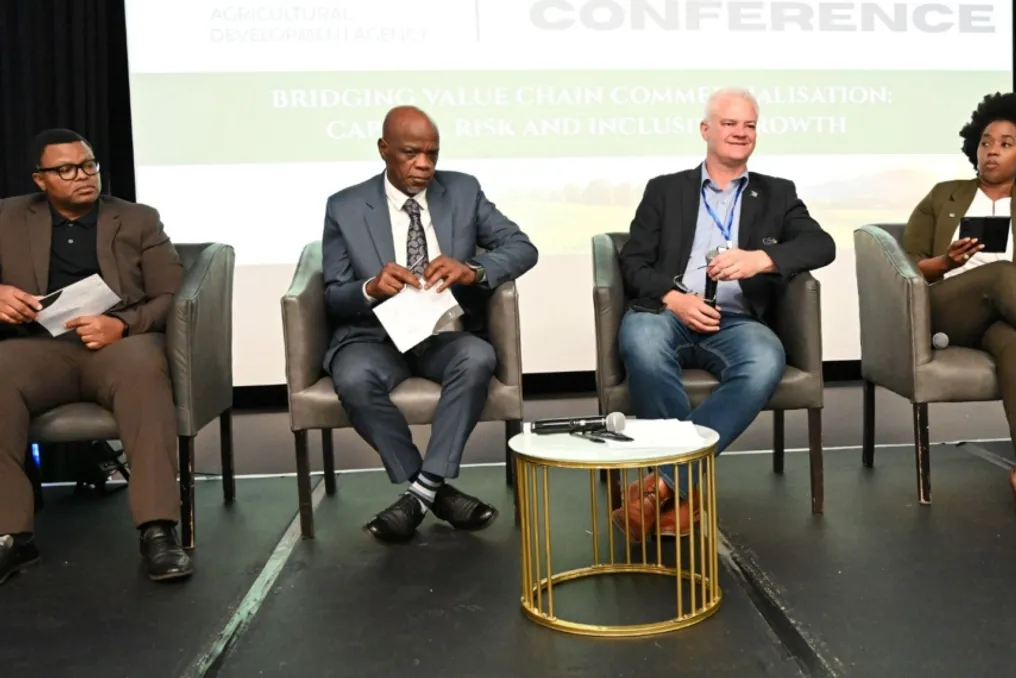
At the annual Agricultural Development Agency (Agda) congress in Boksbuur, Gauteng, experts emphasized that opening commercial opportunities for emerging farmers in South Africa's agricultural sector requires more than just increasing production volumes. It was noted that access to markets, long-term capital, agro-processing, and strengthening partnerships are vital.
Speakers highlighted the need to support smallholder farmers in transitioning to commercial agriculture, enhancing their competitiveness in global markets, and building stronger links between producers, processors, financiers, and buyers.
Vuyiswa Ramokgopa, a member of the Gauteng Provincial Executive Committee for Agriculture and Rural Development, stated that the African Continental Free Trade Area (AfCFTA) opens up prospects for agricultural exports, value addition, and agro-processing. She stressed that South Africa is already a significant player on the continent with a good foundation for further development.
Ramokgopa cited an example from the Southern African Development Community (SADC), where bananas produced in Mozambique are transported to Johannesburg for ripening before being returned to Mozambique and other markets. This case demonstrates the potential for expanding agro-processing and strengthening regional agricultural trade.
Furthermore, Ramokgopa called for greater recognition of the informal market, which accounts for about 60% of fresh produce trade in the country. She insisted that discussions on market access must include not only large retail chains but also informal traders who require support and skills development to participate more effectively in the agricultural value chain.
Regarding agricultural financing, Ramokgopa noted that the issue is not so much a lack of funds as it is limited access by farmers to information about available opportunities and the requirements of various institutions. She emphasized that farmers need to understand the requirements of financiers and establish commercially viable enterprises supported by reliable income, collateral, and strong business relationships. She also advocated for an increase in long-term capital, warning that agriculture cannot always meet the demands of investors expecting returns within five years.
Meanwhile, Dr. Tobias Doer, CEO of Grain SA, stated that South African farmers need to compete internationally by improving productivity and more effectively utilizing value-added market opportunities. He compared this to participating in international competitions, arguing that farmers need support to win.
Doer stressed that economic growth is critical for job creation and strengthening domestic demand, while international markets offer additional chances for agricultural producers. He advised grain producers to consider options beyond exporting raw commodities, including transforming grain into high-value animal protein products such as poultry, pork, and beef. According to him, if you compete with grain, you always remain in the commodity market, but if you compete in the animal protein market, you compete and earn in the premium market.
The President of the African Farmers Association of South Africa (Afasa), A. J. Mthembu, noted the strategic importance of agriculture despite rapid technological changes, as food production remains essential. He also pointed to opportunities to expand South Africa's product basket by cultivating a wider range of goods for domestic and international consumption, calling for sustainability amid changing markets.
Sizwe Dludla, an investment partner at the National Empowerment Fund (NEF), suggested that deeper integration of existing agricultural enterprises could help farmers utilize available resources more effectively. He pointed to the possibility of connecting disparate farming operations with established markets and ancillary businesses, such as linking processing plants with poultry producers and connecting farmers with school feeding programs. Dludla noted: 'The market exists, but it needs a certain specific quality, quality consistency, and financiers are ready to fund farmers to produce the required quality.'
He urged farmers, buyers, and financiers to work together to form an agricultural ecosystem that supports stable production and meets market demands.
Joanne Kotze, CEO of AgriSA, cautioned that financial and production resources alone will not be enough to ensure the success of emerging farmers. She stated that South Africa needs better mechanisms to help people transition from small-scale farming to sustainable commercial operations. Kotze also emphasized the importance of social structures, skills, partnerships, and collective responsibility in building a successful farming business. She reminded: 'The fact that you are a farmer does not give you the right to come to me and say: 'I need to borrow money from you',' stressing the need for farmers and financial institutions to understand their mutual obligations. She warned that focusing only on land, water, and finance while ignoring the relationships and support systems underpinning agricultural business can make farmers vulnerable to failure.