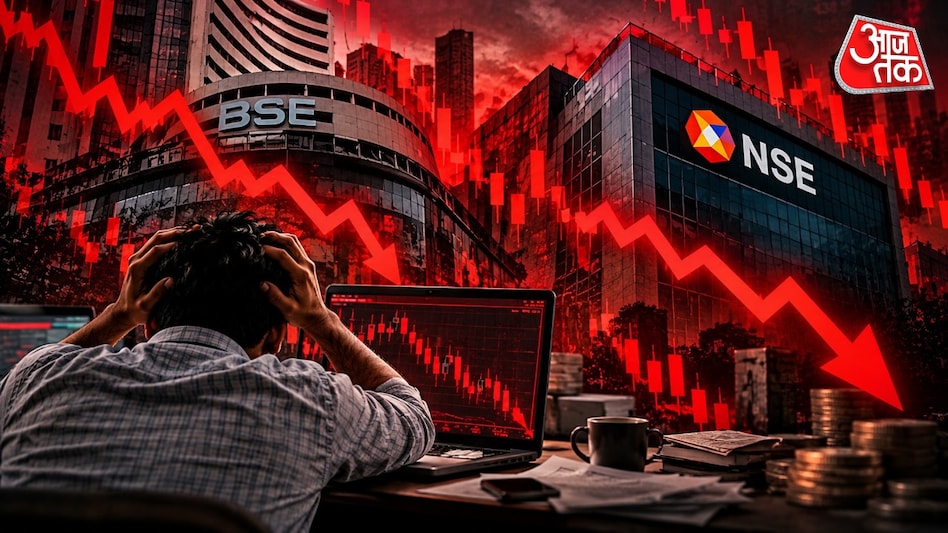
Stock market crash preceded Jio's IPO: Sensex and Nifty indices fell, IT stocks suffered
Read more
Aaj Tak
www.aajtak.in

Stock market crash preceded Jio's IPO: Sensex and Nifty indices fell, IT stocks suffered

The stock market experienced another crash (Stock Market Crash). Tuesday, the third working day of the week, began with both market indices opening in a state of significant decline. The BSE Sensex index, comprising 30 stocks, started falling by more than 800 points, while the NSE Nifty showed a decline of over 200 points.

Of particular note is the fact that the listing of the country's largest IPO in history—Jio Platforms, owned by Mukesh Ambani—is planned for this same day. However, before this event, the market experienced a serious disruption that led to a sharp drop in the Sensex and Nifty. The strongest decline was recorded among IT sector stocks.

Under negative global signals, the market opened in the red zone. The BSE Sensex index, compared to the previous closing level of 73,598, dropped to 73,253 immediately after opening, and then lost 826 points just a few minutes later, reaching 72,872.

A similar panic was observed on the NSE Nifty. This index of 50 stocks opened in the negative relative to the previous close of 22,749, first reaching 22,678, and then, following the example of the Sensex, continued to fall, trading at 22,540 at the time of writing.

IT company stocks contributed the most to the stock market crash. During the initial trading period, IT stocks plummeted sharply: Infosys shares fell by 4.50%, Tech Mahindra shares by 3.50%, TCS by 3%, and HCL Tech by 2.50%. Additionally, other shares belonging to large companies also showed a decline: ITC Share fell by 2.20%, Bajaj Finserv Share by 2%, and ICICI Bank Share by 1.70%.

Similar stories

Indian stock market experiences decline: capitalization drops by 3.43 lakh crore
Read more
www.aajtak.in

Indian stock market experiences decline: capitalization drops by 3.43 lakh crore

The Indian stock market is currently under significant pressure, with continuous declines observed in the Sensex and Nifty indices. Small and mid-cap stocks have been particularly affected, leading to substantial daily losses for investors.

On Thursday, the market capitalization of BSE fell from 461.78 lakh crore to 458.35 lakh crore, losing 3.43 lakh crore. On the same day, the Sensex dropped by 460.30 points or 0.62%, reaching 73,249.39, while the Nifty decreased by 123.70 points or 0.54%, settling at 22,687.65.

Furthermore, the BSE Smallcap Select index fell by 80.61 points or 0.94%, dropping to 8,533.71, and the BSE Midcap Select index slid by 126.26 points or 0.74%, reaching 16,979.59.

Among the 30 stocks in the BSE Sensex, 11 showed growth, while the remaining 19 experienced a decline. Reliance Industries shares lost the most, falling by 2.59% to 1176 rupees. They were followed by Eternal, HDFC Bank, and Powergrid shares, which dropped by more than 2%.

The primary reason cited for the turmoil in the stock market is the rise in crude oil prices. On Thursday, the price of crude oil rose by 3%, exceeding the $112 per barrel mark. The increase in oil prices has intensified inflation concerns, which has caused the sharp fall in the stock market.

Other factors also contribute to the decline in the stock market. (Note: Always consult your financial advisor before investing in any stocks.)

BSE Sensex Index Falls by 1400 Points After Sharp Rise, Stock Market Crashes
Read more
www.aajtak.in

BSE Sensex Index Falls by 1400 Points After Sharp Rise, Stock Market Crashes

Tuesday proved to be an extremely unexpected day for investors in the stock market. Following a strong initial rise, the stock market experienced a crash. The Bombay Stock Exchange's (BSE) Sensex index fell by approximately 1400 points from its daily high by 13:30.

The situation was also unfavorable for the National Stock Exchange's (NSE) Nifty index.

The BSE Sensex opened on Wednesday with a strong surge, exceeding the 74 thousand mark. It began trading at 74,337.93, up from Monday's close of 73,852.90. Within minutes, the index demonstrated rapid growth, reaching 74,682.19.

However, after reaching this level, the rise suddenly turned into a decline. By the time the article was written, the Sensex had dropped to 73,281, representing a fall of 1401 points from its daily high.

Similar to the BSE Sensex, the Nifty index, which comprises 50 NSE stocks, also changed its momentum. After starting trading with a strong acceleration, Nifty suddenly plummeted. On Wednesday, the index opened at 23,016, showing growth compared to the previous close of 22,888.95, and reached 23,120, following the movements of the Sensex. A subsequent decline followed, and the index traded at 22,672, which represented a drop of 448 points from the daily high.

Sharp Decline in Large Stocks

While most large-cap stocks on the BSE looked green during the initial trading, by the time of publication, stocks such as Eternal Share (3.40%), Bajaj Finance Share (3.30%), Trent Share (2.88%), Maruti Share (2.40%), Axis Bank Share (2.20%), NTPC Share (2.15%), Bajaj Finserv Share (2.10%), BEL Share (2.15%), IndiGo Share (2.05%), M&M Share (1.95%), and HDFC Bank Share (1.60%) were observed to be falling.

Fluctuations in RIL and IT Stocks

Amid the overall market downturn, many large company stocks experienced a decline. Nevertheless, Reliance Industries shares, belonging to Mukesh Ambani's company, showed growth of up to 2.30% due to the launch of the Jio Platforms IPO. However, the rate of growth slowed down along with the market crash. Furthermore, Infosys Share (3.10%), Tech Mahindra Share (2.80%), HCL Tech Share (2.20%), and TCS Share (2.09%) demonstrated growth.

The main question was what caused the change in market sentiment and the collapse of Sensex-Nifty after such a vigorous rise. The primary reason is considered to be the rise in crude oil prices. Tensions continuing in the Middle East and the reduction in crude oil reserves in the US led to the international crude oil price exceeding $110 per barrel.

The high cost of oil raises concerns for major importers like India and puts pressure on the market. Additionally, profit-taking among investors, who actively sold assets as soon as the market started rising amid uncertainty, played a significant role in the decline.

Indian stock market sharply declines: Sensex index loses over 1000 points
Read more
www.aajtak.in

Indian stock market sharply declines: Sensex index loses over 1000 points

The Indian stock market experienced a sudden and significant decline on Monday. The Sensex index lost about a thousand points, while the Nifty also fell by approximately 300 points.

By 1:30 PM, the Sensex had dropped by 930.80 points or 1.25%, reaching 73,798.47, while the Nifty closed at 22,867.75, showing a fall of 278.40 points or 1.20%.

Out of 30 stocks listed on the BSE, only 4 showed a slight increase, while the remaining 26 experienced a substantial drop. HDFC Bank contributed the most to the decline, with its shares falling by approximately 3%. This was followed by Axis Bank, which fell by about 4%, Infosys by 3%, as well as stocks like Trent, HDFC Bank, Hindustan Unilever, and Bajaj Finance, which decreased by more than 2%.

Investor losses amounted to 400 billion rupees

This sharp downturn led to a significant reduction in investor earnings. The market capitalization of BSE companies decreased from 472 billion rupees to approximately 468 billion rupees, corresponding to a loss of about 400 billion rupees.

Four reasons for the decline

1. Significant drop in banking stocks: Following the release of second-quarter results for the fiscal year 2027 by private banks, including HDFC Bank, bank stocks fell by 2%, and this bank entered the list of stocks with the largest losses in the Nifty 50. Furthermore, Axis Bank shares also fell by more than 4%; there was also a decline in the shares of Kotak Mahindra Bank and ICICI Bank.

2. Weak sentiment: The MSCI, the broadest index of the Asian stock market, declined by 0.5%. While the KOSPI of South Korea recovered from an initial fall and reached a gain of 0.2%, the Nikkei 225 futures of Japan dropped by 1.3%, the Hang Seng futures of Hong Kong fell by 0.2%, and the Shanghai Composite also dropped by 0.2%.

Additionally, the US market recorded a sharp decline on Friday as sales of AI-related IT stocks resumed, and crude oil prices continued to rise, which was also a blow to the Indian market.

3. High crude oil prices: Brent Crude fell by 1.5% to $108.27 per barrel, and WTI fell by 0.6% to $100.83 per barrel. Despite the drop on Monday, crude oil prices remained high, and the impact of geopolitical tensions persisted on market sentiment.

4. Rise in VIX in India: The fear index, or volatility index, rose by almost 4%, reaching 14.52, indicating increased uncertainty among investors.

Popular