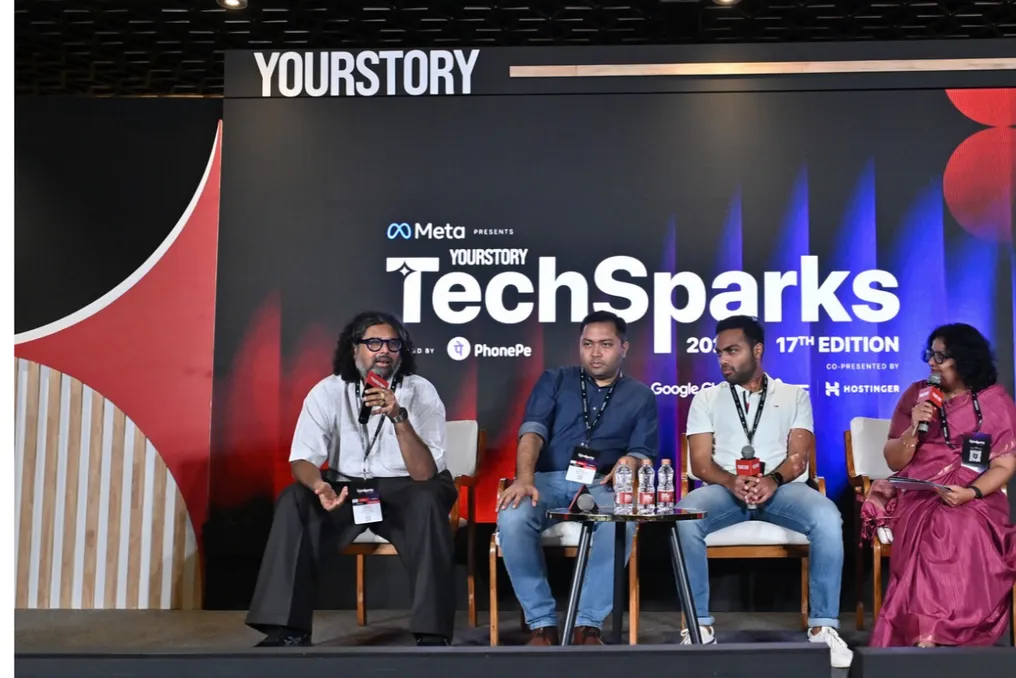
In a world where content has become excessive, a new problem arises: how to make people stop, pay attention, and return when everyone is creating their own content, including content generated by artificial intelligence?
A discussion titled 'Format is the Product: When Content Becomes Infinite' took place at the TechSparks 2026 event. Participants included Avinash Mudaliar, co-founder and CEO of HT Media Labs and creator of Saregama Carvaan; Dipit Purkayasta, co-founder and CEO of Inshorts; and GSAN Aditya, COO of Eloelo Group. The discussion focused on how formats influence content consumption, how a format can stand out in a saturated digital space, and why the format itself can be as important as the content.
The question was raised about what constitutes the key differentiator: format, distribution, personalization, or consumer relationship. Mudaliar noted that these four elements are not competitors but rather complement each other, and a combination of them is necessary to attract a person. He emphasized that the current problem is not the content, as it has become infinite, but time, which is finite.
He shared that when creating Carvaan, he focused on a clear target audience—people who did not want to go through the complex procedure of opening an application, creating a playlist, logging in, or paying just to listen to a song. Instead, Carvaan offered a fully digitized, personalized product with 5000 songs, mimicking the experience of listening to old radio and limiting choices so listeners could immerse themselves in the music.
In the case of OTT Play, the emphasis was primarily on personalization, helping users determine what and where to watch.
Dipit Purkayasta shared his experience launching Inshorts 12 years ago, when people began consuming content on smartphones, but there were no applications that truly innovatively solved the problem of news and information consumption on these devices. He stated that today users turn to them for a reliable, factual source of information, wanting to stay informed while avoiding the noise and sensationalism of social media, using Inshorts as a source for 'digital detox.'
For Eloelo, the micro-drama format allowed for telling more stories faster and reaching a wider audience. Aditya believes that people's tastes are constantly changing, and although there is endless content, the main focus is often on the top 5%. Therefore, success depends on the ability to constantly update storylines, present new stories, and deliver them using advanced data science for personalization so that people always see what interests them.
When the question of content value arose in an era where AI can create everything, Purkayasta noted that while AI-based platforms satisfy consumers' needs for on-demand information, people still need real-time updates. He stressed that AI cannot present what is happening right now at TechSparks, and someone must feed this information into the system, which is the generation of live content, i.e., news. Summaries and articles are secondary products of this process.
Purkayasta added that when an event occurs, the key issue becomes trust in sources and distributors, and that trust becomes the most valuable capital that is accumulated, and in his opinion, LLM agents will also value this.
Aditya believes that AI will accelerate content creation but will not replace human creativity. He sees AI as an excellent tool for storytellers but does not believe it will replace human creativity, pointing out that despite investments in Hollywood and Bollywood, no deterministic system can predict whether a story will become a hit. He concluded that the constant change in people's tastes and expectations can only be resolved by human creativity, even if AI accelerates storytelling workflows.
Mudaliar points to trust and verification as key distinguishing features in the AI-driven content ecosystem. He spoke about a concept they are testing at HT Tech: HT is already a trusted source for most India-focused LLMs in news due to its century of experience. They are proud of their journalism and publish verified stories. They are currently creating the HT Verify ecosystem. For example, one of their employees captures an event, creates a video from it, which is then turned into social content, and writes about it around 3000 words, formatted according to the schema preferred by AI LLMs and suitable for citation. Thus, they are effectively training AI that this content is not only trustworthy but also verified and ready for consumption, leading to the content being cited and transformed for the user.
For Purkayasta, understanding the audience outside of Indian urban areas required identifying a gap in reliable local content. When Inshorts began studying consumption patterns in small towns in 2019 after the surge in mobile internet usage due to the advent of Jio, the team discovered that local news from small towns often went unreported. He noted that the biggest gap in these markets was that content generation was happening improperly.
The company solved this problem with the Public platform, which features verified creators covering the lives of their cities and towns. Launched in 2019, it reached about 80 million users.
Aditya believes that the micro-drama economy has opened up opportunities for storytelling for narrower audiences instead of chasing mass demand. Due to reduced production costs and shorter turnaround times, authors can experiment with plots based on specific regions and communities. He gave the example that he can now talk about plots relevant to, for instance, a district in Uttar Pradesh, while the financial result remains positive, allowing him to cover Tamil Nadu, Andhra Pradesh, Karnataka, and Kerala.
Mudaliar believes that the industry still has a long way to go in developing products for India's diverse linguistic audience. Despite the focus on creating a product for Bharat, he argues that many products continue to draw inspiration from platforms developed primarily for urban consumers. He pointed out that 98% of India's population consumes content in local languages, and many of them do not know how to search or write in English, using voice search as their first contact, similar to how Google Maps and Uber drivers do. Therefore, in his opinion, products oriented towards voice need to be created for India.