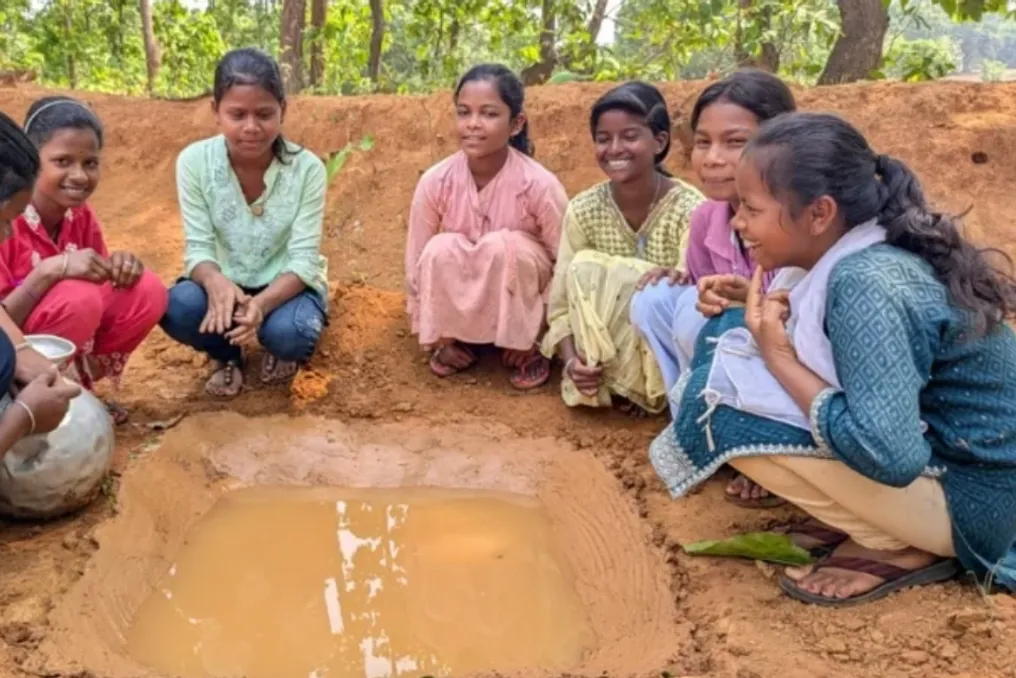
Children in Odisha study water conservation using Sal leaves and clay in forests
Read more
The Better India
thebetterindia.com

Children in Odisha study water conservation using Sal leaves and clay in forests

Unusual experimentation on water conservation has begun in the forests of Keonjhar district in the state of Odisha. The idea was for children to learn how to retain moisture by observing nature, using only a Sal leaf, a little clay, and a small depression in the ground.

The Lesson Hidden in the Leaf

During a walk through the dry forest slopes near the village of Khaladipani in Keonjhar district, a local elder stopped next to a curled Sal leaf. A thin film of dew had condensed in its cup-like curve, retaining moisture despite the surrounding soil drying out under the heat. For the children accompanying him, this became a small observation behind which lay a broader question: if a leaf can capture and retain a small amount of water, can they replicate this ability on land where water is a scarce resource?

The elder, known among locals as the 'jungle master,' encouraged the children to try. Instead of using plastic sheets or factory containers, the children began conducting experiments with Sal leaves and clay, creating small pits capable of collecting and holding water. This experiment was documented by Biswabijayini Mohanty in a report published by Village Square on September 16, 2026, titled 'The Water Conservation Lesson from a Leaf.' The report described how an observation during a forest walk turned into a practical water conservation exercise, where children learned through trial, error, and close attention to the environment.

How the Children Made the Pits

The children dug shallow depressions at the edge of the forest using simple tools, branches, and their hands. However, they soon encountered a problem: the loose soil absorbed the water poured into the pits before it could be retained. The jungle master helped them revise the design.

First, they laid wide Sal leaves on the bottom and sides of each depression, overlapping them like tiles. Then, they spread clay soil over the leaves, compacting and leveling it until the hollow took the shape of a shallow bowl. These two materials served different functions: the layer of leaves helped support the clay while drying, and the compacted clay formed a base designed to slow down water penetration into the surrounding soil. The children repeated this process, allowing the clay to harden before filling the pits. In about two weeks, they created a network of small water-retaining depressions along the forest boundaries. According to Village Square, the pits were generally no deeper than a forearm and rarely wider than a large dinner plate. The construction did not use plastic liners, expensive equipment, or complex engineering; the materials were taken from the surrounding landscape, and the method evolved through observation and experimentation.

When Rain Tested the Idea

These pits were intended to hold water during dry months. But after several days of rain, runoff washed away the loose soil down the slopes, turning the surrounding water sources murky. However, the pits seemed to retain relatively cleaner water. The explanation partly lies in how water behaves when allowed to settle. Rainwater flowing over open ground can carry suspended soil particles and other sediments. When this water collects in a relatively calm depression, heavier particles gradually settle at the bottom, leaving the water above less turbid. The report also records sightings of wild animals, including sambar deer, rabbits, mongooses, and squirrels, observed drinking from these pits. Nevertheless, there is an important distinction between water that looks clean and water that is safe to drink. The report lacks results from laboratory tests confirming the potability of the water collected in these pits.

What Science Says About Sal Leaves and Water

The principle underlying the experiment has parallels with traditional agricultural methods documented elsewhere in Odisha. A study by Dr. Prasanta Kumar Mishra, a leading scientist at the Central Research Institute of Dryland Agriculture, describes how tribal farmers in the village of Pakanaghon in Kandhamal district use Sal leaves as mulch in turmeric fields. The report, published by LEISA India, notes that farmers spread a layer approximately 20–25 cm thick on their fields before the monsoon season. The leaf cover helps retain soil moisture, reduces runoff and soil loss, suppresses weeds, and protects the soil from the direct impact of raindrops. Mulching works by covering the soil surface, reducing its exposure to direct sunlight and wind, and helping to slow evaporation. It can also reduce the impact force of raindrops on the ground, limiting soil particle displacement. Depending on the soil type and rainfall conditions, this cover can allow more water to remain available in the soil.

The experiment in Khaladipani uses Sal leaves differently: instead of spreading them across agricultural fields, the children place them under a compacted clay liner in small depressions. Both methods demonstrate how the local Sal can be used for moisture and soil management. The children are not simply instructed about water scarcity or the need to protect forests. They are encouraged to observe the leaf, understand its function, test a hypothesis, and learn from subsequent results. This is a practical starting point for environmental education.


Similar stories

Banana extinction threat: the impact of diseases, climate change, and genetic diversity
Read more
super.abril.com.br

Banana extinction threat: the impact of diseases, climate change, and genetic diversity

Until the mid-1950s, consumers ate a completely different type of banana than the one known today. The dominant variety on supermarket shelves was Gros Michel—sweeter, creamier, and more fragrant than modern varieties. However, this type of banana no longer exists because it was destroyed by the Fusarium disease, widely known as Panama disease.

This fungal infection kills the plant by occupying its vascular system and blocking the transport of water and minerals necessary for banana survival. The fungus Fusarium oxysporum is highly resistant and can persist in plantation soil for over 20 years; currently, there is no chemical treatment or effective method to eliminate the fungus after an area has been infected.

As an alternative for global consumption, the Cavendish variety emerged (known as nanica in Brazil). Today, this is the most common variety on the market, developed as a response to the disease that wiped out Gros Michel. For about 40 years, Cavendish thrived on plantations supplying much of the world's market due to its resistance to the initial strain of the fungus.

However, the situation began to change in 1990. An aggressive strain of the fungus, known as Tropical Race 4 (R4T), started to develop, which began destroying the Cavendish group. Since then, R4T has spread and attacks banana plantations in many parts of the world. In Brazil, it is currently considered absent, although it is classified as a pest posing an economic and ecological threat.

In addition to the aggressiveness of R4T, there is another problem: bananas are propagated through cloning, which leads to low genetic diversity among different types. While this ensures uniformity of fruit, it also means they are susceptible to the same diseases—if a disease affects one plant, it can affect the entire population of that variety.

Climate change also contributes to the extinction threat. Rising temperatures, extreme weather events, and climate-related pests negatively affect banana-producing countries, which report crop reductions and loss of agricultural land across the region.

This is because bananas, especially the Cavendish variety, are sensitive fruits. They require a temperature range of 15°C to 35°C for normal development, as well as sufficient water. They are also vulnerable to storms, which can lead to the loss of banana leaves and hinder the plant's photosynthesis process.

According to the Going Bananas report, by 2080, 60% of the best areas for growing bananas could be lost due to climate change. Currently, Asia is the world's largest banana producer, followed by the Americas and Africa—some of the regions most vulnerable to climatic events.

Nevertheless, according to new research, hope for saving bananas still exists. This month, the Yelloway initiative announced the development of a fully fertile Cavendish banana. This means that new, commercially viable, and disease-resistant banana varieties can be created through crossbreeding.

Various approaches also exist worldwide. For example, researchers at the Queensland University of Technology in Australia have created a genetically modified Cavendish variety that provides resistance to TR4. This result, named QCAV-4 variant, has been approved for human consumption in Australia and New Zealand.

First Environmental Atomic Festival EcoAtomFest Held in Tashkent
Read more
nuz.uz

First Environmental Atomic Festival EcoAtomFest Held in Tashkent

The first environmental atomic festival, EcoAtomFest, took place in Tashkent on October 24, 2026, at the Tashkent Branch of NIYAU MIFI. The event was organized by the state corporation Rosatom with the support of the Uzatom agency and served as the concluding stage of the Autumn School and Impact Team environmental camp.

The festival's program aimed to connect the study of sustainable development principles with direct environmental protection activities. Students from Uzbekistan, Russia, Kazakhstan, Kyrgyzstan, and Tajikistan participated. Participants engaged in tree planting, attended environmental lectures, and took part in master classes, allowing them to meet like-minded individuals and learn about opportunities to implement their own initiatives.

The main event of EcoAtomFest was the collective planting of fifty ash trees. Before starting the work, all participants underwent necessary briefings, then divided into small groups and began working in specially prepared areas under the guidance of volunteers.

Greening territories aligns with Uzbekistan's national goals in environmental protection and increasing the number of green spaces. The state project 'Yashil Maqon,' launched by the President of the Republic of Uzbekistan Sh.M. Mirziyoyev in 2021, aims to raise the level of greening in the country from 14.2% to 30% by 2030. Such actions contribute to involving youth in achieving these goals and fostering a sense of responsibility towards the urban environment.

After finishing the tree planting, guests participated in the interactive part of the program. Experts and volunteers organized sessions dedicated to daily environmental practices, features of urban nature, and finding solutions to environmental problems. Volunteers from the organization 'Oltin Qanot Volontyorlari' conducted a master class on growing microgreens.

Pavel Volkov, head of NGO 'Indigo,' shared advice on proper care for young and mature trees. Margarita Davydova, an activist and community specialist from birds.uz, introduced visitors to local bird species and observation practices. Mohinurkhon Ergash, an eco-activist and expert from the Volunteer Association of Uzbekistan, invited participants to discuss the ecological challenges of the republic's regions and develop their own proposals for their resolution. Jamshid Khakimov, chairman of NGO 'ECOLAND,' conducted an introductory lesson on ecology, after which visitors could engage in eco-crafts and visualize their concept of an eco-friendly home through drawings.

At the festival, participants were introduced to an international grant competition for environmental and socially significant projects, organized by Rosatom. Uzbekistan is one of the countries whose organizations are eligible to apply for this competition. The competition supports various areas, including nature conservation, environmental culture, education, volunteering, assistance to vulnerable populations, and urban infrastructure development. Projects can be presented as new initiatives or as individual stages of already implemented programs; the best projects will receive financial support, and winners will receive consulting and organizational assistance from invited experts.

The cultural program was opened by representatives of specialized boarding school No. 11 'Nurliman' from the Syrdarya region, who performed with the dombra and a dance number. Aziz and Akmal Anvarov from the Tashkent region presented the 'Andijan Polka,' and the Divas Dance Studio demonstrated the Korean folk dance 'SARANG-MU.'

EcoAtomFest concluded with an awards ceremony for activists recognized for their contribution to the environmental condition of the Republic of Uzbekistan. The organizers expressed gratitude to all representatives of environmental and volunteer structures for their educational activities and participation in environmental protection events. The festival became an important platform for interaction between youth, the expert community, and public organizations, successfully combining the educational process with practical work on greening and strengthening environmental culture.

Alexandra Khidirnazarova, Head of the Industrial Safety, Labor Protection, and Environmental Department of the 'Nuclear Power Plant Construction Directorate,' noted that 'environmental protection and safety culture begin with a responsible attitude towards one's actions.' She emphasized the importance of involving youth not only in discussions but also in practical activities, as such initiatives align with Uzbekistan's priorities for increasing green areas and forming the environmental culture of future specialists.

Diana Gamazova, member and mentor of the Impact Team 2050 international youth advisory council and head of the 'Atomic Energy for Central Asia' project, stressed that the camp allowed participants to see the close connection between technology, ecology, and quality of life. She added that knowledge of sustainable development gains special value when it is embodied in practical actions within international teams.

Alexey Dremuchev, CEO of 'Rosatom Central Asia,' stated that 'environmental responsibility is demonstrated through concrete actions,' and noted that EcoAtomFest brought together youth, volunteers, and experts around a common goal. He expressed hope that this meeting would be the beginning of long-term partnerships and new environmental initiatives.

Six owls in Bijaun under forest department care receive about a kilogram of chicken daily
Read more
www.aajtak.in

Six owls in Bijaun under forest department care receive about a kilogram of chicken daily

Six small owls are currently under the supervision of the Forest Department in Bijaunur, Uttar Pradesh. Living conditions, special food, and a specific feeding schedule have been arranged for them. Chicken is placed before them in the evening, but they only start eating after dark.

On the first day, they were given half a kilogram of chicken, which they all ate. Subsequently, the daily ration was increased to approximately one kilogram of chicken.

The story of these six owls began during the cleaning for the Diwali festival. They were discovered in a window of a house in the Krishna Vihar colony in Bijaunur. The homeowner reported the finding to the Forest Department to ensure their safety. Now, the Forest Department team is responsible for their care.

According to officials, the chicks are still very small. Once they grow up and become capable of living and flying independently, they will be released into their natural habitat.

Circumstances of the owl discovery

The incident occurred in the Krishna Vihar colony in Bijaunur. While cleaning the house, Jagish Kumar noticed six owl chicks sitting in the building's window. Seeing these small birds, Jagish Kumar considered protecting them and notified the Forest Department. Subsequently, all the chicks were handed over to the Forest Department team.

It is reported that a net was installed on the window, after which the mother owl flew away. Therefore, assistance from the Forest Department was requested to care for these chicks. After rescuing all six chicks, they were brought to the district office of the Forest Department. Currently, they are housed in two cages, and the team monitors their nutrition, health, and safety. These chicks belong to the barn owl species. The Forest Department is trying to provide them with proper care until they mature so they can then be released into the wild.

Dietary change: from half a kilogram to a daily ration

The care provided for the diet of these small owls is of particular interest. Initially, they were given half a kilogram of chicken, which they all consumed. Then, a daily ration of about one kilogram of chicken was provided for them. The chicken is cut into small pieces and placed before them; all six chicks eat it together. The lifestyle of these owls is also interesting: the Forest Department team places the chicken in the evening, but they do not start eating immediately. They begin their meal after it gets dark. Owls are typically nocturnal animals, and many species forage at night.

What did the DFO state?

Regarding this matter, the DFO of Bijaunur, Jai Singh Kushwaha, stated that the case of the owl chicks is under his purview. The Forest Department team conducted their rescue, and they have been under the department's supervision for some time. According to the DFO, the chicks are still very small, and as soon as they grow up, the Forest Department will release them. Currently, the care of these six chicks is being managed at the district office of the Forest Department.

Popular