RoboParty releases source code for its humanoid robot RP1, including mechanical design and control software
Read more
Pandaily
pandaily.com

RoboParty releases source code for its humanoid robot RP1, including mechanical design and control software

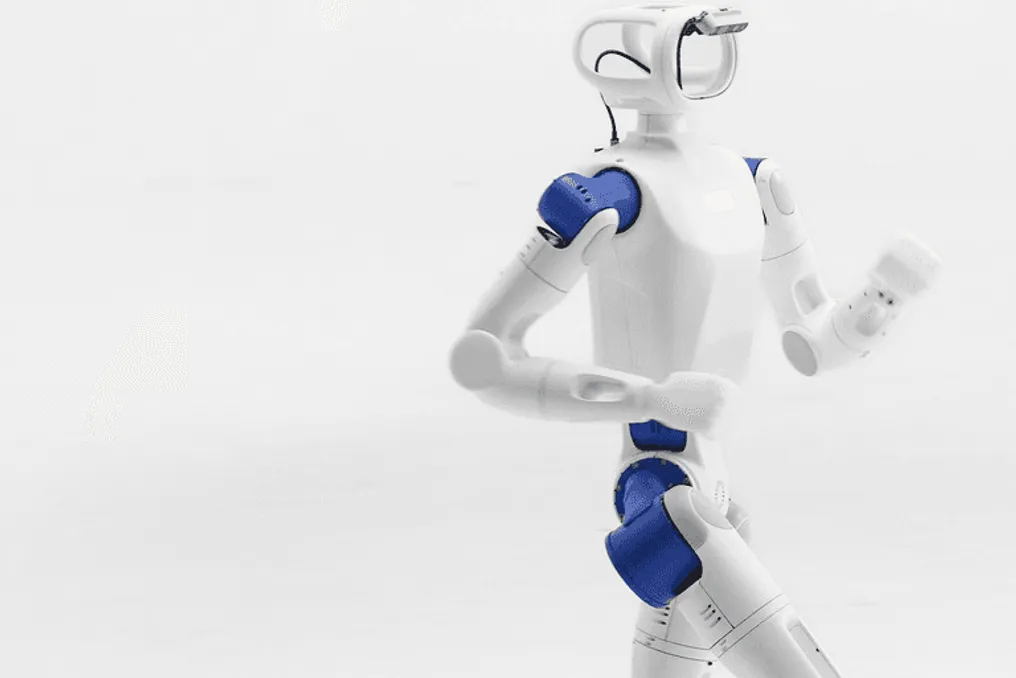
RoboParty has released the RP1, a humanoid robot positioned as a fully open, fully functional platform. Instead of providing only a Software Development Kit (SDK) or a few Application Programming Interfaces (APIs), the company is publishing materials across the entire development chain: from mechanical and electrical design and proprietary joint modules to firmware, robot models, deployment tools, and training. The description of this project was presented in technical documentation on October 25th.

The RP1 robot stands 135 cm tall. The open version is equipped with 24 active degrees of freedom, while the Professional version offers 30 degrees of freedom, including two in the head and seven in each arm, suitable for more complex manipulation research. The head and hand modules can be replaced for use in various applications such as education, scientific research, data collection, tours, or entertainment. RoboParty demonstrated the robot's ability to walk continuously, track human movements, recover from pushes, and stand up after falls.

The hardware is based on ROMOMO, RoboParty's integrated rotary joint module. According to published specifications, the nominal peak torque ranges from 25 to 160 Newton-meters when powered by 48V and using CAN-FD communication. These modules combine inner rotor motors with planetary gearboxes, allowing for the sacrifice of low rotor inertia for fast response, stiffness, overload resistance, and reduced cost. RP1 uses an off-axis hip joint and a parallel ankle, where two motors jointly control pitch and roll, and the hollow cable routing attachment simplifies joint disassembly.

On the GitHub platform, the RP1 overview repository contains links to subprojects dedicated to mechanical source files, electronics, testing and assembly procedures, ROMOMO joint firmware, and host tools, as well as the RP Hand dexterity with SDKs in C++, Python, and ROS 2, full machine testing, and controller application. The repository lists mechanical CAD models, schematics, PCB layouts, Gerber files, material specifications, and assembly documentation for the hardware, while URDF, MJCF, and mesh models are available for simulation. The original article notes that the exact scope of each release should be checked in individual repositories.

Regarding software, the embedded stack connects motors, inertial sensors, and the battery management system through a unified device interface, enabling control at a frequency of 500 Hz and policy updates at 50 Hz. An open-source motion remapping tool called hhtools maps human movements onto the robot while respecting joint limits and ground contact. Within the basic development platform, RoboParty's PartyOS opens parts of the base motion layer, including hhtools, MimicLite, and UFO—a recovery project for disturbances and falls. Higher levels for intent representation and agent skill orchestration remain under research.

RoboParty has opened applications for the RP1 beta program, intended for developers and teams with real projects ready to report issues and provide feedback on this platform.
Similar stories

Fudan's RoboSkill framework allows robots to save acquired knowledge as reusable skills with text and code
Read more
pandaily.com

Fudan's RoboSkill framework allows robots to save acquired knowledge as reusable skills with text and code

A team from the Institute of Reliable Embodied Intelligence at Fudan University has introduced RoboSkill—a framework that enables general-purpose robots to retain acquired knowledge. Instead of collecting new demonstration data for every task, the agent first explores the task and then saves an effective method as a skill consisting of written instructions and executable code.

The research, titled 'Explore, Execute, Evolve: A Skill Acquisition and Reuse Loop for Embodied Agents,' was published on arXiv, and the corresponding code is available on GitHub.

The work represents a paradigm shift in robotics. Models that integrate vision, language, and actions traditionally require fresh data from each deployment site, and data collection from robots is costly due to the need for teleoperation, scene resets, and demonstration repetition.

The team found that modern multimodal agents are capable of observing, reasoning, and writing control code directly during operation. In the LIBERO-10 simulation environment, with a four-hour budget and multiple attempts, the best agents achieved one hundred percent success. When operating on a real robot, the strongest agent successfully completed 91.7 percent of simple tasks and 80 percent of complex ones.

The main challenge remains speed. Since agents cyclically go through observation, reasoning, action, and verification stages, the reasoning process between short arm movements can take minutes. The average duration of simulation runs was 94.5 minutes, and successful task completion on a real robot required 20 to 27 minutes.

RoboSkill addresses this issue in two ways. First, it incorporates tactile feedback. Pressure, force, and torque readings inform the agent about gripper contact, eliminating the need for constant image checking. After adding tactile data, the average simulation time for one agent decreased from 25.35 minutes to 15.93 minutes, and the pipette extraction task on a real robot was reduced from 33.63 minutes to 20 minutes.

Second, the framework accumulates skills. After completing a task, the agent analyzes what happened and documents the effective method, subsequently updating it based on subsequent results. For example, the method of determining table height via contact can be used in a new scene, even if the height needs to be measured again. Skill reuse allowed the average simulation time for one agent to decrease from 94.5 minutes to 35.9 minutes.

The most significant contribution was saving code alongside text. The transition from text-only skills to those incorporating both text and code reduced the average time for all four tested agents. For one of them, the time decreased from 67.1 to 39.9 minutes, and the first-attempt success rate increased from 15 percent to 67.5 percent. Overall, the team reports an increase in first-round success on LIBERO-10 from 12.5 to 25 points, a reduction in simulation time by 7.6 to 72.4 percent, and an increase in real-robot success by 8.3 points. The researchers note that skills can also be transferred between different tasks and different agent models.

Popular