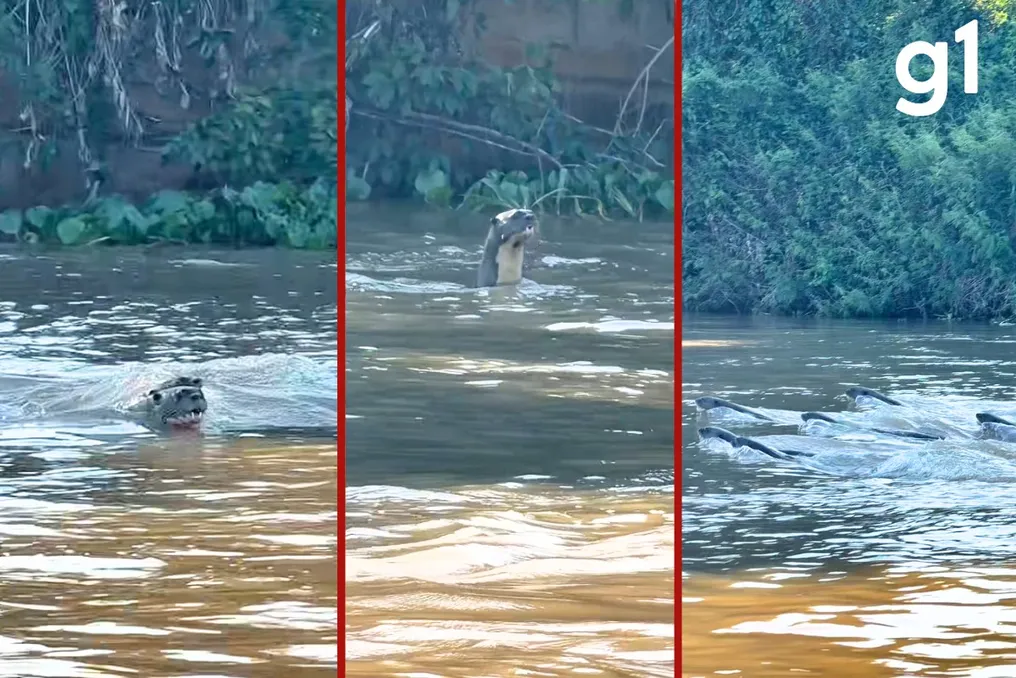
A territorial conflict between two families of giant otters was recorded at the Encontro das Águas State Park, located in Poconé. The event was documented on October 20 by biologist Thiago Silva Soares during a wildlife observation activity in the Mato Grosso Pantanal.
The confrontation lasted for approximately twenty minutes and involved a chase that extended for about two kilometers, accompanied by intense vocalizations from the animals. According to Thiago, the team monitored the situation from the beginning, when four otters associated with the Piquiri River approached the nest of another group, consisting of about eight individuals.
The otters involved belonged to two distinct groups. In the context of the tourist activity, eight individuals resided in the den area, on the banks of the Cuiabá River. Conversely, four otters associated with the Piquiri River advanced to the location.
The arrival of the opposing group triggered a reaction in the resident animals, initiating the chase that continued for approximately two kilometers, until the area where the Cuiabá and Piquiri rivers meet. Thiago reported that upon reaching near the Piquiri River, the otters stopped because they were invading the territory of the other group. At this point, the otters entered their own river, at which time the vocalization ceased, and they returned to their original area.
Thiago Silva Soares described the scene as something worthy of a wildlife documentary, stating that the team observed everything from inside the boat, maintaining a safe distance for both themselves and the animals, while the otters drove out the rivals.
The giant otter, also known as the river otter or giant otter, is classified as the largest otter on the planet, capable of reaching 1.80 meters in length and weighing about 33 kilograms when adult. G1 compiled various information about this species.
Among its notable characteristics is its vocal repertoire, as otters are capable of emitting at least fifteen different sounds, each with a specific meaning and used in various contexts, whether to warn the group of danger or to intimidate a threat.
Furthermore, they use 'latrines' which function as communal toilets, places where they defecate and urinate to mark their territory. The odor of these latrines carries information about the group and can be detected meters away by other groups in the region.
Finally, otters show great sensitivity to human interference. For this reason, poorly managed tourism represents a serious threat to the species. According to the Ariranhas Project, boat traffic and inappropriate proximity can alter group behavior, leading them to leave the area or even resulting in the death of pups.