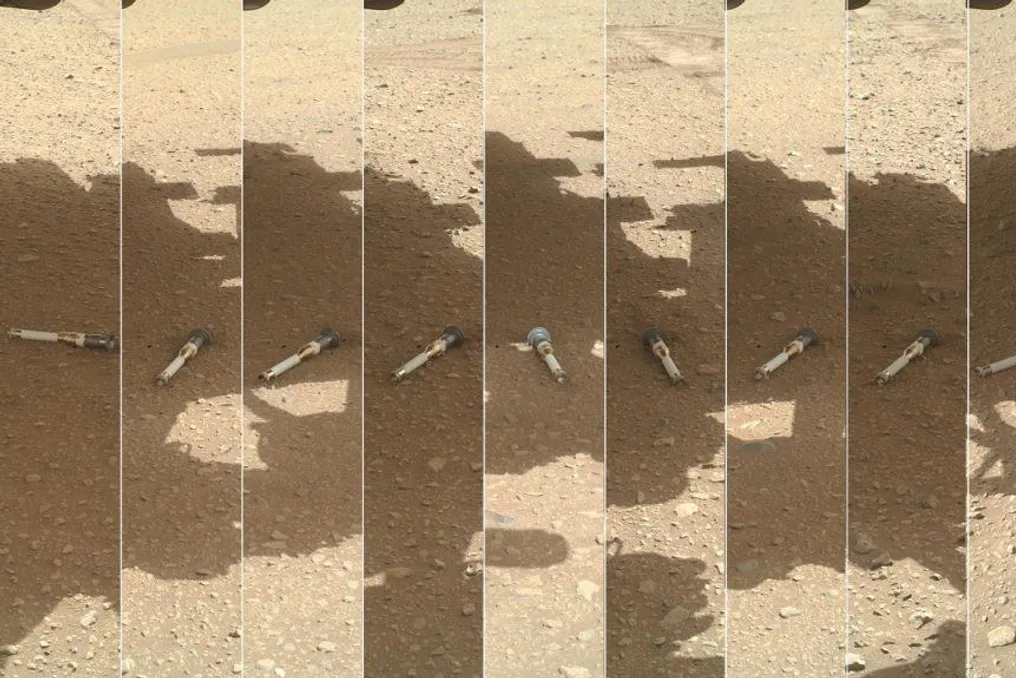
The search for signs of life on Mars partially depends on analyses that can only be conducted with high accuracy on Earth. Samples collected by the NASA rover Perseverance are stored in tubes on the surface of the Red Planet. However, their return involves technological difficulties, high costs, and strict protocols to prevent contamination of the material and protect the Earth's biosphere.
The initial plan of the Mars Sample Return mission, developed by NASA in collaboration with the European Space Agency (ESA), involved collecting the tubes left by Perseverance and delivering them to a lander. Alternatively, two helicopters equipped with robotic manipulators could retrieve samples directly from the surface. A small rocket would launch a capsule containing the material into Martian orbit, from where a European spacecraft would capture and transport it to Earth. The delivery was initially planned for 2033.
Nevertheless, the project has faced technical problems, delays, and rising costs. Due to these obstacles, NASA suspended the original mission architecture and began evaluating more economical options, including proposals from the private sector. As a result, the return schedule has been revised and now depends on determining a new strategy.
While the United States reviews its plans, China is developing the Tianwen-3 mission, which aims to bring Martian material to Earth by 2031. The China National Space Administration (CNSA) intends to collect and return samples using its own technologies. If schedules are met, the country could deliver material from Mars earlier than the American-European mission.
Concerns about sample return are not limited to the possibility of discovering signs of life. Scientists must also ensure that the material is not contaminated during transport and that its arrival on Earth does not pose biological risks.
The planetary protection policy of the Committee on Space Research (COSPAR) establishes international guidelines for reducing contamination between Earth and other celestial bodies. One of the issues is so-called forward contamination, which occurs when terrestrial organisms are transferred to extraterrestrial environments. The reverse process, known as back contamination, involves the possibility that extraterrestrial material could introduce organisms or biological agents to Earth.
In the case of Mars, the hypothesis of microorganisms capable of surviving the journey and causing consequences for the Earth's biosphere must be considered in safety protocols, but there is no evidence of Martian life in the samples. Biological risk should not be confused with a confirmed threat to human health.
In an interview with Olhar Digital, astrobiologist and professor of geobiology at the Institute of Geosciences of the University of São Paulo (USP), Douglas Galante, stated that he considers the risk of any Martian organism posing a biological threat to Earth to be very low. In his opinion, there is no reason to panic, although the possibility of ecological consequences requires a scientifically rigorous approach.